Time Management Expert Mahjong Play: Your Calm Focus Guide

Time Management Expert Mahjong Play: Your Calm Focus Guide
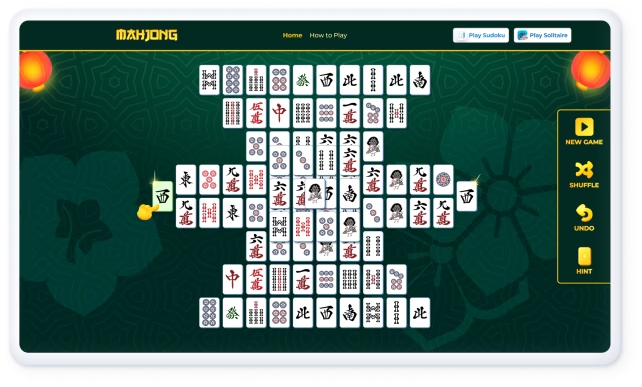
Short, intentional Mahjong Solitaire sessions — scheduled, timed, and reflected on — are one of the most practical calming habits a casual player or older adult can build. The prescription is simple: short sessions per day, multiple times per week, with a clear start and stop time set before you open the board. Mahjong Online Club is a strong starting point: free, browser-based, no registration required, and designed specifically for distraction-free single-player play.
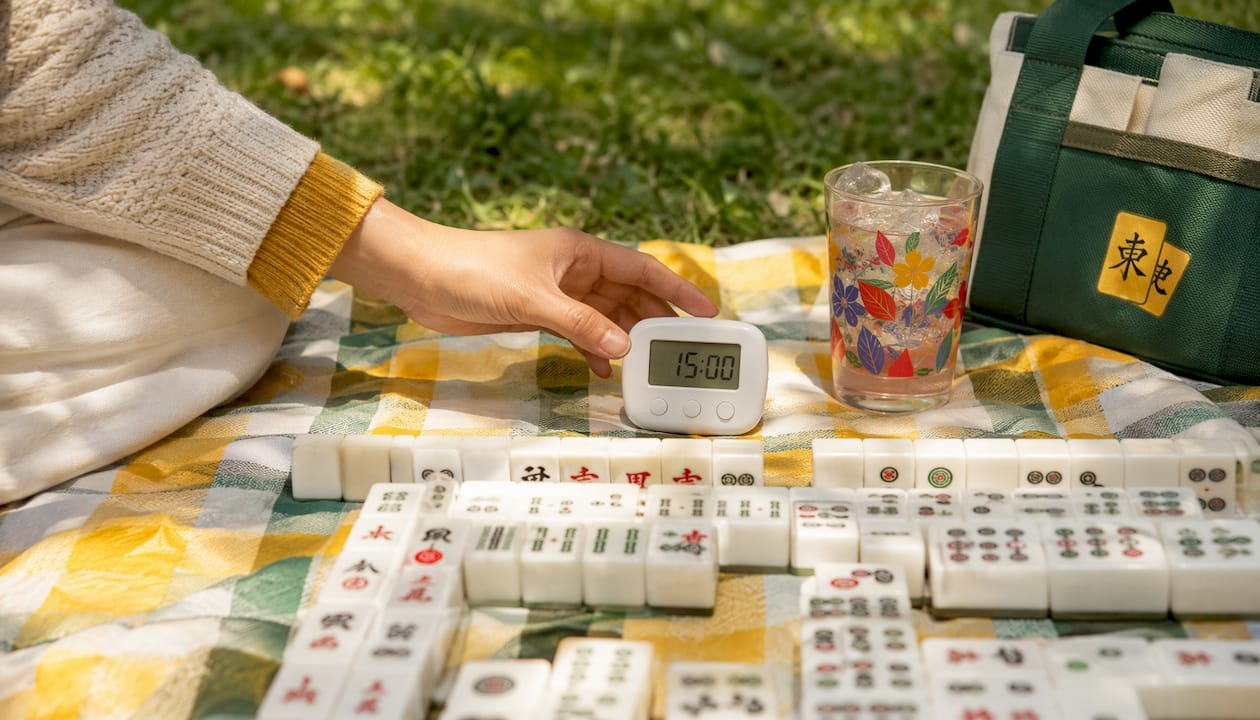
Table of Contents
- Why does Mahjong Solitaire sharpen focus and time-management skills?
- How do you slot Mahjong sessions into your daily routine?
- What time-management lessons does Mahjong actually teach?
- How do you set up a calming, distraction-free Mahjong session?
- What does a two-week starter plan look like for casual players?
- What features should you look for in a calming single-player Mahjong site?
- How do you balance Mahjong play with your other productivity tasks?
- How should you track and reflect on your Mahjong sessions?
- Key Takeaways
- Mahjong as a mindful practice: what you should realistically expect
- A calming, no-signup Mahjong session is one browser tab away
- Useful sources
Why does Mahjong Solitaire sharpen focus and time-management skills?
Mahjong Solitaire sits squarely within the casual time-management games genre — level-based, goal-oriented, and built for short, purposeful sessions. That structure is not accidental. It mirrors the same cognitive demands that make focused work productive.
Regular, short sessions build several skills at once:
- Pattern recognition: Scanning the board for matchable pairs trains your brain to spot relevant information quickly, a skill that transfers directly to prioritizing tasks.
- Working memory: Holding multiple tile positions in mind while planning your next move exercises the same mental muscle used in project planning.
- Mood regulation: Completing a puzzle triggers a small, reliable win — and consistent short play has been linked to measurable mood improvement.
- Temporal intentionality: Choosing when to stop a session is itself a time-management decision, one you practice every time you play.
Experts recommend short, scheduled blocks rather than impulsive, open-ended play. The distinction matters: treating a session as focused practice rather than idle clicking produces better cognitive gains and stronger habit formation. The cognitive benefits of tile-matching games are well-documented, particularly for older adults working on attention and memory.
How do you slot Mahjong sessions into your daily routine?
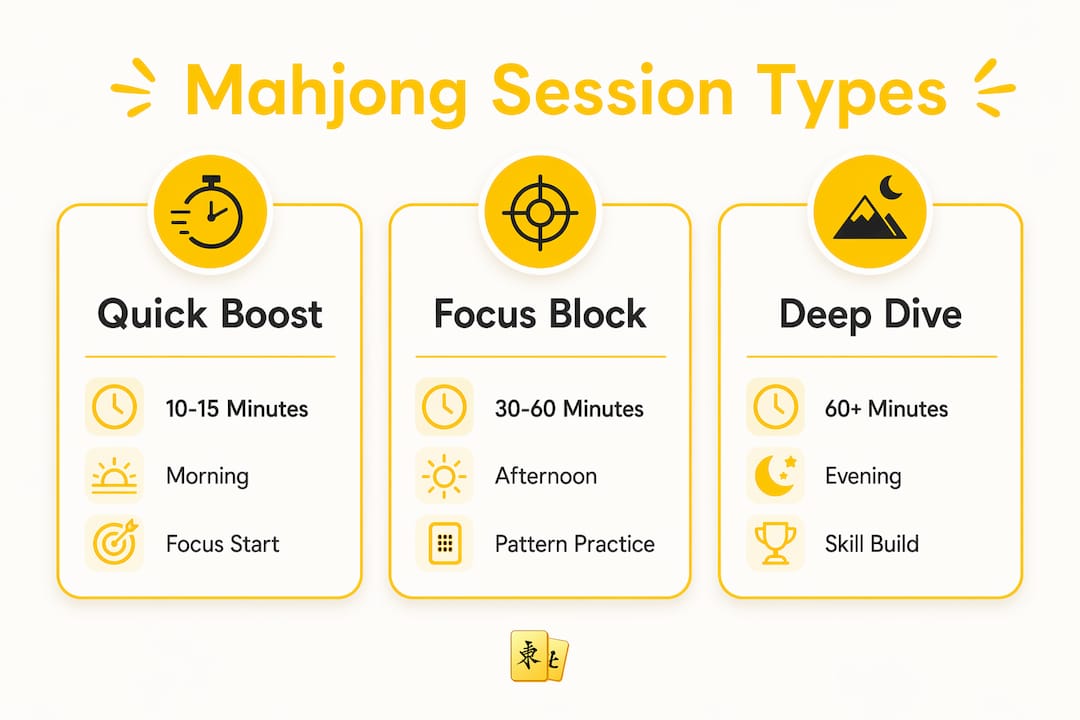
Three session types cover most situations. Choose one before you sit down.
| Session Type | Duration | Best Time of Day | Primary Goal |
|---|---|---|---|
| Quick Boost | 10–15 minutes | Morning, before work or chores | Wake up attention, ease into the day |
| Focused Block | 30–60 minutes | Mid-morning or early afternoon | Pattern practice, skill building |
| Wind-Down | 10–15 minutes | After dinner or before bed | Calm the mind, decompress |
Experts at Path of Houou recommend 30–60 minute focused blocks as the sweet spot for pattern recognition practice without fatigue. For older adults or anyone new to structured play, starting with a 10–15 minute Quick Boost and working up over two weeks is a smarter entry point.
Fitting sessions into existing routines reduces friction. A mid-afternoon Mahjong break replaces mindless scrolling and resets attention for the rest of the day. Pairing it with a habit you already have — a cup of tea, a lunch break, a post-walk rest — makes it stick faster.
Pro Tip: Set a kitchen timer or your phone's built-in timer before you open the game. Decide the session length in advance. When the timer sounds, finish your current move and close the tab. This single habit is what separates intentional play from time-sink play.
What time-management lessons does Mahjong actually teach?
The most transferable lesson from Mahjong is intentional disposal: choosing to let go of a tile — or a task — because holding it blocks a better outcome. Hyungjin Lee frames this as treating each game as a round or chapter. Discarding a tile you are attached to is not a loss; it is a deliberate choice that preserves long-term focus and reduces burnout.
Discarding a tile you are attached to is not a loss. It is a deliberate choice that preserves long-term focus. Every discard is a decision about what you are not going to pursue — and that clarity is exactly what good time management requires.
The second lesson is flexibility over commitment. Adaptability in Mahjong — staying open to pivoting your hand rather than locking into one plan — maps directly to managing multiple projects. Holding versatile tiles (ones that connect to several possible sequences) is the same instinct as keeping your schedule slightly open for unexpected priorities.
Mahjong also teaches the risk-management principle that a small, certain win beats a risky, high-reward play you may never complete. Applied to your day: finishing three realistic tasks beats half-finishing six ambitious ones.
After each session, ask yourself one question: What did I let go of today, and did that make the rest of the board clearer? That reflection takes 60 seconds and compounds into a genuine decision-making habit over weeks.
Pro Tip: Keep a small notepad near your device. After a session, jot one word: what you let go of in the game. Over two weeks, you will notice patterns in how you make decisions — both on the board and off it.
How do you set up a calming, distraction-free Mahjong session?
Environment shapes the quality of the session as much as the game itself. A few deliberate choices before you start make a real difference.
- Screen size: Use the largest screen available to you — a tablet or desktop monitor reduces eye strain and makes tile details easier to read.
- Contrast and brightness: Set your display to a comfortable brightness level; high-contrast tile themes reduce visual fatigue during longer sessions.
- Sound: Turn off device notifications and, if the game has sound effects, decide in advance whether they help or distract you.
- Seating and posture: Sit in a chair with back support. For older adults with limited mobility, a cushion and armrest support make 30-minute sessions comfortable.
- Lighting: Natural light or a warm lamp behind the screen reduces glare. Avoid playing in a dark room with a bright screen.
For accessibility, look for a platform that offers larger tile sizes, high-contrast visual themes, and slower animation speeds. Mahjong Online Club's interface is designed with these considerations in mind, making it a practical choice for older adults or anyone who finds standard tile sizes small.
Pro Tip: Before you open the game, decide two things: how long you will play and what you want to practice (pattern recognition, relaxed play, or reflection). Pre-deciding removes the friction of in-session choices and keeps the experience genuinely calming.
What does a two-week starter plan look like for casual players?
This plan builds habit and skill gradually. Adjust session length on low-energy days — a 10-minute micro-session still counts.
| Day | Session Length | Objective | Adaptation Option |
|---|---|---|---|
| 1–2 | 10–15 min | Explore the board, no pressure | Seated, one short puzzle |
| 3 | 15 min | Practice matching pairs deliberately | Two short puzzles |
| — | 15 min | Focus on tile efficiency — clear edges first | Rest day if fatigued |
| — | 10–15 min | Reflection session, review what felt easy | Optional rest |
| 9 | 20–30 min | Introduce a pattern goal before starting | Reduce to 10–15 min if needed |
| 10 | 30–60 min | Focused block, track how many moves before a block | Seated stretch break midway |
| — | 30–60 min | Full focused session with post-play reflection | Split into two 15-min sessions |
| 15 | 20–30 min | Review progress, set a goal for week three | Celebrate finishing the plan |
Mahjong's learning curve is manageable at any age — start with core strategies and increase complexity only when a session feels comfortable, not forced. The beginner strategy guides at Mahjong Online Club pair well with this plan for players who want structured skill-building alongside the routine.
What features should you look for in a calming single-player Mahjong site?
Not every Mahjong site is built for calm. The wrong platform can turn a relaxing break into a frustrating, ad-cluttered experience. Here is what to prioritize:
- Ad-free play: Ads interrupt the flow state that makes Mahjong calming. A clean interface is non-negotiable for genuine relaxation.
- No registration required: Creating an account adds friction. The best platforms let you play immediately in your browser.
- Timer controls: The ability to set or see a session timer supports intentional play rather than open-ended clicking.
- Large, readable tiles: Especially for older adults, tile clarity reduces eye strain and keeps the experience enjoyable.
- Calm visual design: Muted color palettes, minimal animation, and a clean layout support focus rather than distraction.
Mahjong Online Club meets all five criteria. You open the browser, the game loads, and you play — no account, no ads, no pop-ups.
To start a 10-minute session: open Mahjong Online Club in your browser, set a timer for 10 minutes, choose a layout, and begin. When the timer sounds, stop. That is the entire setup.
How do you balance Mahjong play with your other productivity tasks?
The risk with any enjoyable game is overuse. A 10-minute break that stretches to 90 minutes is not a time-management win. A few guardrails keep Mahjong in its proper role.
Treat Mahjong sessions the way you treat any scheduled task: give them a fixed slot and a hard end time. The timer habit from the scheduling section is your primary defense against drift. If you find yourself opening the game outside your scheduled slot, that is a signal to reassess the habit, not a reason to abandon it.
One practical rule: never start a Mahjong session when you have an unfinished task with a deadline within two hours. The game works best as a genuine break, not a procrastination tool. Pairing it with a completed task — as a reward rather than an escape — keeps the habit productive.
Building mental agility with Mahjong is a gradual process. Three to five sessions per week, each with a clear end time, delivers the cognitive benefits without crowding out the rest of your day.
How should you track and reflect on your Mahjong sessions?
Tracking does not need to be complicated. A simple log — date, session length, and one observation — gives you enough data to see patterns over two to four weeks.
What to track:
- Session length: Did you stick to your planned time?
- Mood before and after: A one-word note ("scattered" → "calm") is sufficient.
- One game observation: What did you notice about your decision-making today?
After two weeks, review your log. Most players find that sessions under 15 minutes feel rushed, while sessions over 60 minutes show diminishing returns in mood benefit. That personal data is more useful than any general recommendation.
Reflection also reinforces the mindset lessons from the game. If you notice you kept holding onto tiles you should have discarded, that pattern is worth examining in your daily task list too. The board is a mirror.
Key Takeaways
Short, intentional Mahjong Solitaire sessions — scheduled, timed, and reflected on — build genuine focus and time-management habits for casual players and older adults.
| Point | Details |
|---|---|
| Session length and frequency | Play short, timed sessions multiple times per week with a timer set before you start. |
| Scheduling tactic | Pair sessions with an existing daily habit (tea, lunch break, post-walk rest) to build consistency without effort. |
| Core mindset rule | Intentional disposal — letting go of a tile or task — is the single most transferable time-management lesson Mahjong teaches. |
| Session setup | Choose your session length and goal before opening the game; use a large screen, good lighting, and notifications off. |
| Mahjong Online Club | Offers free, ad-free, no-signup browser play with a calming interface — the lowest-friction way to start a timed session today. |
Mahjong as a mindful practice: what you should realistically expect
Consistent, short Mahjong practice delivers real but modest gains. Over two to four weeks of three-to-five sessions per week, most casual players notice improved attention during play, a calmer transition back to work tasks, and a small but genuine sense of daily accomplishment. Those are worthwhile outcomes. What it does not deliver is a dramatic cognitive transformation or a substitute for sleep, exercise, or professional support.
For older adults specifically, the gains tend to be gentle and cumulative. Attention sharpens gradually. Pattern recognition improves with repetition. The science behind Mahjong's calming effect supports these modest, realistic expectations — and modest, realistic expectations are exactly what make a habit sustainable.
The mistake most casual players make is treating Mahjong as either trivial entertainment or a miracle brain exercise. It is neither. It is a structured, repeatable micro-practice for temporal intentionality — and that is genuinely useful, provided you show up consistently and reflect on what you notice.
This article is general informational content, not medical or cognitive-therapy advice. Consult a qualified professional for guidance specific to your health situation.
A calming, no-signup Mahjong session is one browser tab away
If you have been reading this guide and thinking "I should try that," the barrier to entry is genuinely zero. Mahjong Online Club gives you free, ad-free, browser-based single-player Mahjong with no account required — open the tab, set your timer, and play.
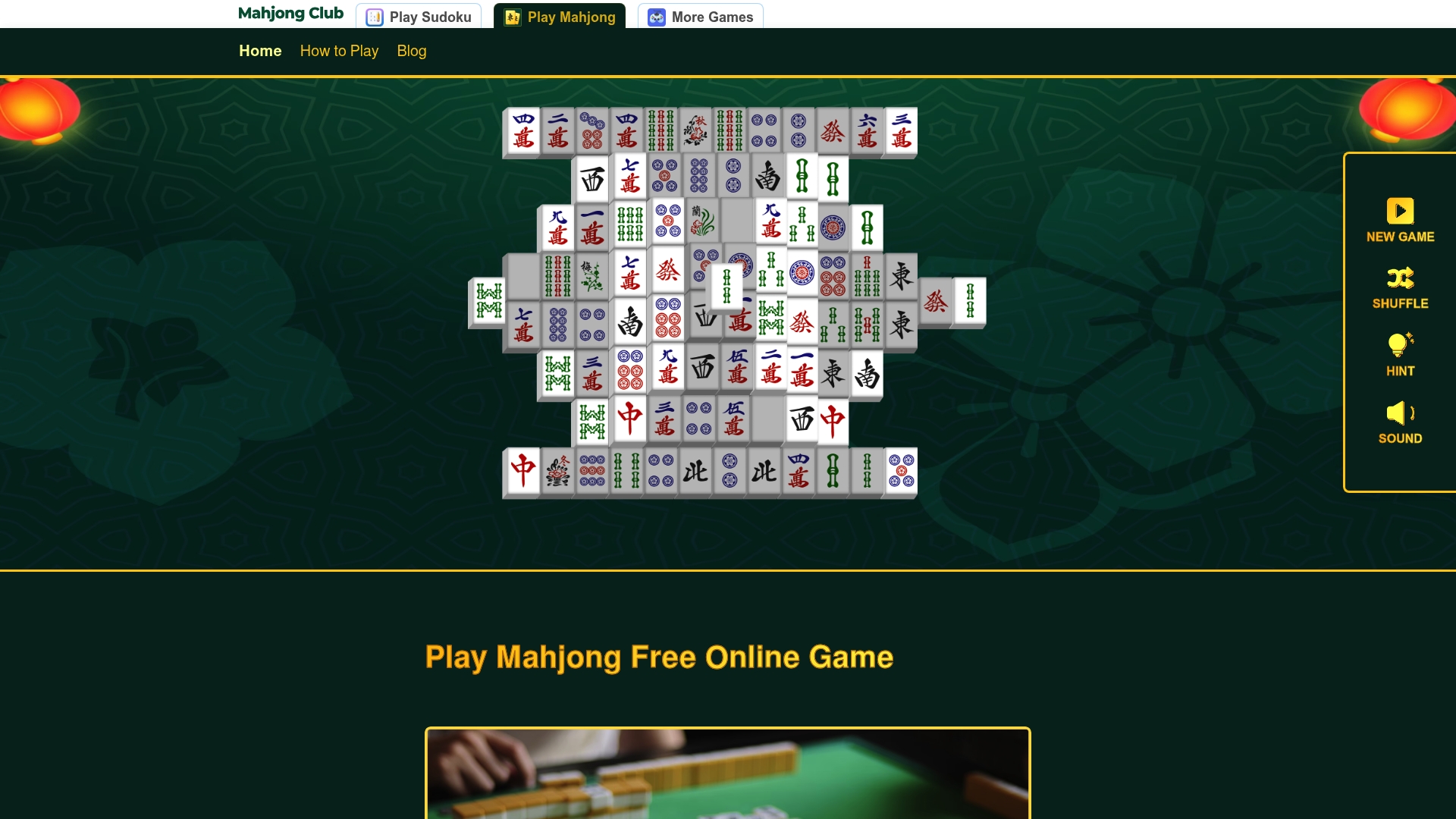
The platform is built for exactly the audience this guide addresses: casual players and older adults who want a calming, focused experience without pop-ups, registration forms, or autoplay ads. Large tiles, a clean visual design, and a distraction-free interface mean the puzzle does the work. Start with a 10-minute timed session right now, follow the two-week plan above, and see what two weeks of consistent, intentional play actually feels like.
Useful sources
The research and resources below informed this guide. They are grouped by topic for easy reference.
| Topic | Source |
|---|---|
| Scheduling and temporal intentionality | Path of Houou — Week 15: Scheduling |
| Time management in games (genre context) | Time management game — Wikipedia |
| Mahjong strategy and mindset lessons | Business Lessons from the Mahjong Table |
| Decision-making and intentional disposal | What I learned from playing Mahjong — Hyungjin Lee |
| Winning strategy and adaptability | Winning Mahjong Strategies — South China Morning Post |
| Beginner accessibility and learning curve | Missy Mahjong |
| Tile efficiency and pattern drills | Best Mahjong Strategy Tips — Mahjong Master |
| Temporal game design and player time | Shaping Time in Games — Digital Library |
Recommended
Similar Articles

Matching Pairs Mahjong Step by Step for Beginners
Learn matching pairs mahjong step by step! Master tile-matching strategies to clear the board effectively and enhance your gameplay.

Best Gamemiracle.com Alternatives for Horse Racing Fans
Discover the best gamemiracle.com alternatives for horse racing fans. Explore top games that combine racing, management, and social competition!
Riichi vs Hong Kong Mahjong: Rules, Scoring, Strategy
Riichi vs Hong Kong Mahjong explained by an expert: rules, scoring differences, and strategy with data-backed tips and a clear, practical table.