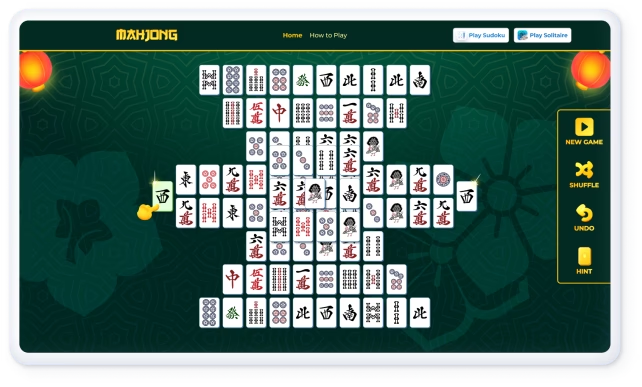
How to Play Mahjong?
Mahjong Solitaire is played by removing all 144 tiles from a stacked board, two at a time, by pairing free tiles that share the same face. This guide walks you through every rule you need from the first board to advanced play — the layout, the four tile families, the exception rules for Flowers and Seasons, and the strategic habits that turn near-impossible boards into clean wins.
If you're brand new to the game, the most important thing to understand up front is what kind of Mahjong this is. The four-player tabletop game with discards, calls, and winning hands is a different game that shares the same tile art. The single-player puzzle on this page — Mahjong Solitaire — uses those tiles purely as a matching mechanic. There's no opponent, no hand-building, and no scoring beyond your own time and tile count. It's just you, the board, and the order in which you decide to take it apart.
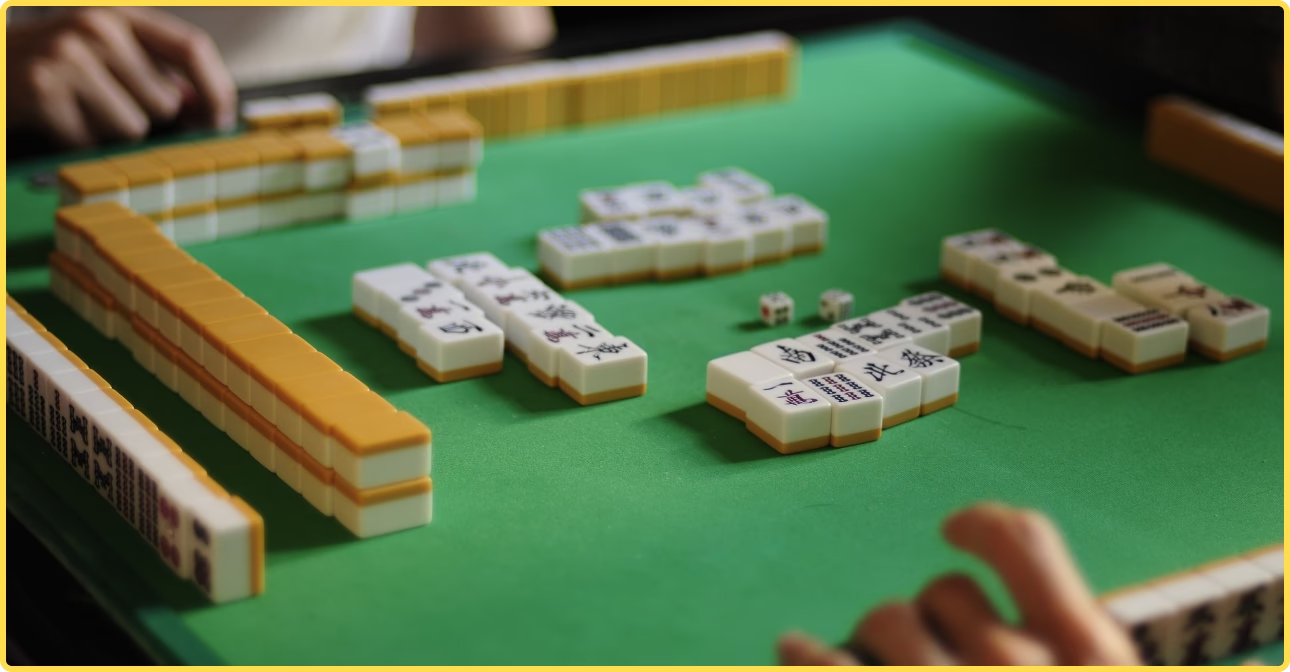
Beyond the entertainment, Mahjong is a genuinely brain-friendly game. Reviews of cognitive-leisure research consistently link Mahjong-style play with improvements in pattern recognition, working memory, and visual-spatial reasoning — and players regularly describe it as gently meditative, in the way that knitting, sudoku, or a long walk can be. If those benefits sound appealing once you've learned the rules, you can move straight to a fresh board at Mahjong Online Club and start playing instantly.
Mahjong Solitaire Rules
The complete ruleset is short enough to memorise in a minute, but every rule earns its place. Here are the four you'll use constantly:
Rule 1 — Match identical free tiles. Remove two tiles at a time, both of which must show the same face and both of which must be "free" (defined in Rule 3).
Rule 2 — Bonus tiles match within their family. The eight bonus tiles (four Flowers, four Seasons) don't need to be visually identical — any Flower pairs with any other Flower, and any Season pairs with any other Season. Every other tile (including the four Wind directions and the three Dragon colours) must match exactly.
Rule 3 — A tile is "free" only when nothing sits on top of it and its left or right side is clear. Both conditions must hold. A tile flanked on both sides with nothing above is free; a tile with nothing above but blocked on both sides is locked.
Rule 4 — Win by clearing the board. Remove all 144 tiles in 72 successful pair-matches, and the round is yours.
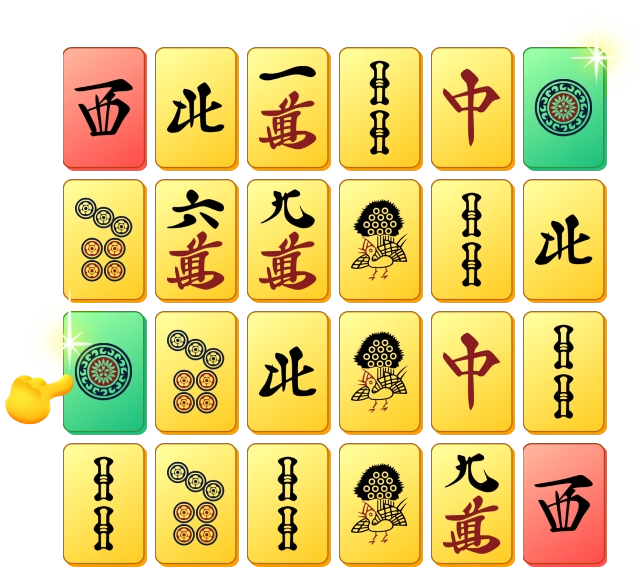
In practical play on Mahjong Online Club, the interface gives you immediate visual feedback. Click any tile and it turns green — that's the system confirming the tile is free and ready to pair. If a tile flashes red when clicked, it's currently locked by something on top of it or by neighbours on both sides, and you'll need to clear the surrounding tiles first.
For example, to remove the "Bamboo 5" tile, you'll need another identical "Bamboo 5" that is also free at the same moment. The "East Wind" tile only matches another "East Wind" — not "South," "West," or "North." A "Red Dragon" will never match a "Green Dragon" or a "White Dragon"; each dragon colour is its own face.
The exceptions, again, are the bonus tiles: any "Spring" pairs cleanly with "Summer," "Autumn," or "Winter," depending on which one is also free at that moment. The same applies inside the Flowers group — every flower face matches every other flower face.
Types of Mahjong tiles
The standard Mahjong Solitaire set uses 144 tiles spread across three main families: Suits (108 tiles), Trumps (28 tiles), and Bonus tiles (8 tiles). Learning to recognise each family at a glance is the single biggest speed-up a beginner can give themselves — most "I can't find a match" moments are really "I can't tell these two tiles apart yet."
Suit tiles
The three numbered suits — Dots, Bamboo, and Symbols — make up the bulk of the board. Each suit runs from 1 to 9, and each numbered tile has four identical copies, giving 36 tiles per suit and 108 suit tiles in total. Matching is strictly by suit and number: a Bamboo 3 only pairs with another Bamboo 3, never with a Symbol 3 or a Dot 3.
Dots

The Dots suit (sometimes called "Circles" or "Coins") is the easiest family to count at a glance — each tile shows the number of dots that matches its value. A single dot for 1, three dots in a triangle for 3, nine dots for 9.
Bamboo

The Bamboo suit shows stylised bamboo stalks corresponding to each tile's value. A small quirk worth remembering: the Bamboo 1 is the odd one out — instead of a single stalk, it's traditionally drawn as a bird (often a sparrow or peacock). New players sometimes hunt for two "stalks" and miss the pair entirely.
Symbols

The Symbols suit (also called "Characters" or "Wan") uses Chinese numerals from 一 (one) to 九 (nine), with the character 萬 (meaning "ten thousand") on each tile. The faces are visually denser than Dots or Bamboo, which is why most players slow down on Symbols matching for the first few rounds — that's normal, and recognition speeds up quickly with practice.
Trump tiles
Trump tiles (also called "honour tiles") cover the Winds and Dragons — 28 tiles in total, with four identical copies of each face. Like suit tiles, they match strictly by exact face.
Winds

The four Wind tiles represent the cardinal directions: East (東), South (南), West (西), and North (北) — four copies of each, sixteen tiles in total. East pairs only with East, South only with South, and so on. Don't be fooled by the visual similarity of the Chinese characters; double-check before committing to the match.
Dragons

The three Dragon tiles come in Red (中), Green (發), and White (often shown as a blank or framed tile) — four copies of each, twelve tiles in total. Each colour is independent and never matches the others. The White Dragon's understated design fools beginners more than any other tile in the set, so flag it early.
Bonus tiles
Bonus tiles are the elegant exception that gives Mahjong Solitaire its character. Only eight tiles total — four Flowers and four Seasons — and they pair within their own family rather than face-to-face. Each individual face is unique, but any member of the family matches any other member.
Seasons

The four Season tiles — Spring, Summer, Autumn, Winter — are each unique illustrations, but they all match one another freely. If Spring and Autumn are both free at the same time, they pair. Same for Spring and Winter, or Summer and Autumn.
Flowers

The Flower tiles work identically — four distinct floral illustrations (traditionally Plum, Orchid, Chrysanthemum, and Bamboo flower), but any Flower matches any other Flower. Because there are only four of each bonus type, players sometimes leave them too late and find them locked under suit tiles; clear them when the chance appears.
Advanced Strategy: How Strong Players Read the Board
Once the rules are second nature, the real game begins — and it's almost entirely about deciding which legal move to play, not finding a legal move at all. Here are the techniques that separate consistent winners from streaky players. (Want to put them straight to work? Open a fresh Mahjong board in a new tab and apply each one as you read.)
1. The Visual Scanning Technique. Instead of moving your eyes randomly across the board, work in a deliberate sweep: top-down by layer, then left-to-right across each visible level. This catches "three free, one buried" situations and stops you from missing matches hidden in plain sight.
2. Layer Prioritisation. The board is a 3D onion. Tiles on the top layers and the outer edges have the fewest dependencies — removing them exposes the most new options. As a rule of thumb, when two matches are both legal, take the one on the higher layer. A top-of-stack match almost always uncovers more future moves than an edge-row match on the bottom.
3. Long Rows vs. Deep Stacks. A long horizontal row of tiles can only be entered from its ends — middle tiles stay locked until both sides shrink. A tall vertical stack only releases its lower tiles when you clear the top. Reduce both dimensions in parallel, with slight extra attention to the longest unbroken row in the layout, since it's usually the rate-limiter for the whole board.
4. The Three-Free Rule (avoid the orphan trap). If three identical tiles are free and the fourth is still buried, you cannot freely match any two of the three you see. You must pair the two that lie above (or earlier in the unblocking sequence relative to) the buried one — otherwise you trap the buried tile permanently and the board becomes unsolvable. This single rule prevents more lost games than any other principle in Mahjong Solitaire.
5. Three-move look-ahead. Before committing to any match, mentally walk forward two more moves: "If I match these, the next free tiles are X and Y — and after that, Z opens up." When two candidate matches both look fine on move one but one of them dead-ends two moves later, the difference is invisible without look-ahead. This is the technique most associated with high win rates in algorithmic studies of the game.
6. Maintain board balance. Don't sweep one side of the layout clean while leaving the other side fully stacked. Imbalanced clearing reliably traps matching pairs on the over-cleared side with no partner.
Why Some Boards Genuinely Can't Be Solved
A small but important point of honesty: not every Mahjong Solitaire deal is winnable, even when you play perfectly. A randomly arranged board can contain unbreakable blocking patterns — for example, three identical tiles stacked directly on top of the fourth in a single column. Researchers studying the game have shown that determining solvability under incomplete information is computationally hard in the general case (formally, PSPACE-hard).
In practice, this matters less than it sounds, for one simple reason: the board generator on Mahjong Online Club is designed to deal pre-verified solvable layouts. That means when a board feels stuck, the answer is almost always that an earlier matching decision orphaned a tile — and the Undo or Shuffle button is your way back to a winning line. For a deeper breakdown of the maths behind unsolvable layouts and how layout designers eliminate them, we've covered it in detail on the Mahjong Online Club blog.
Result
Congratulations — you've finished the rookie course and you now know the full Mahjong Solitaire ruleset, every tile family, and the strategic principles that separate beginner play from confident play.
You can now start playing Mahjong online for free, straight in your browser, with no app to download and no registration. Don't forget that the Hint and Shuffle tools are there for you whenever the board tightens up — and when you're ready to push your play further, the Mahjong Online Club blog publishes deeper strategy breakdowns, history pieces, and community puzzles each month.
FAQ Section — Guide Page
How do you play Mahjong Solitaire for beginners?
Mahjong Solitaire is played by removing all 144 tiles from a stacked board in matching pairs. A tile is "free" only when no other tile sits on top of it and at least one of its sides (left or right) is empty. Click two free tiles that show the same face to remove them, and keep going until the board is empty. The only exception is the bonus tiles — any Flower pairs with any Flower, and any Season pairs with any Season.
How many tiles are in a Mahjong Solitaire game?
A standard Mahjong Solitaire game uses 144 tiles in total: 108 suit tiles (Dots, Bamboo, and Symbols, each 1–9 with four copies), 28 trump tiles (four Winds and three Dragons, four copies of each), and 8 bonus tiles (four Flowers and four Seasons, each face unique but pairing within its family).
Can you play Mahjong with 2 players?
The four-player tabletop version of Mahjong needs four players for the full ruleset, but there are well-established two-player and three-player variants. Mahjong Solitaire, the tile-matching puzzle on this site, is a single-player game — so the question doesn't really apply here. If you want to play with another person, you can take turns on the same board or race each other on identical layouts.
Why does my Mahjong Solitaire board get stuck?
Most "stuck" boards on Mahjong Online Club aren't algorithmically unsolvable — they were solvable when you started, and an earlier matching choice closed off the winning path. The most common cause is the three-free-one-buried trap: matching the wrong two of three visible identical tiles when the fourth is locked underneath, which orphans the buried tile permanently. Use Undo to step back, or Shuffle to redistribute the remaining tiles into a fresh solvable position.
Is Mahjong Solitaire good for your brain?
Yes — reviews of cognitive-leisure research consistently link Mahjong-style play with improved pattern recognition, working memory, and visual-spatial reasoning, particularly with regular play. Solitaire specifically exercises the visual-spatial system the most, because every move requires scanning a layered 3D board and projecting future positions. Many players also describe it as gently meditative, similar to a short mindfulness session.
What's the best Mahjong Solitaire strategy?
The single most reliable strategy is layer prioritisation: when more than one match is legal, take the one on the highest layer of the board, because it uncovers the most new tiles. Combine that with board balance (don't clear one side faster than the other), the three-free rule (never orphan a buried fourth tile), and three-move look-ahead (mentally walk forward two more moves before committing), and your win rate will climb significantly.