Riichi vs Hong Kong Mahjong: Rules, Scoring, Strategy
Table of Contents
- Riichi vs Hong Kong Mahjong: what changes and why it matters
- How riichi mahjong rules shape play
- How Hong Kong mahjong rules change strategy
- Scoring math: mahjong scoring differences you must master
- Turn-by-turn decision flow (riichi strategy vs hong kong mahjong strategy)
- Riichi vs Hong Kong Mahjong — key differences (table)
- Concrete examples: from tiles to table decisions
- Real-world constraints that shape both games
- From the table: hands-on lessons that improve fast
- Data-backed heuristics that hold at most tables
- Practical checklist: table-ready habits
- Learning resources and structured practice
- When to choose each ruleset
Riichi vs Hong Kong Mahjong differ in tile efficiency, scoring pace, and risk. Riichi rewards yaku discipline, riichi pressure, and defense; Hong Kong prioritizes speed, flexible hand values, and decisive finishes. Pick the rule set that fits your risk tolerance and table goals.
Introduction: why these rule sets feel so different After coaching mixed-rule tables for a decade, I’ve seen the same puzzle: players who dominate one ruleset stumble in the other. The mechanics look similar, but scoring math and incentives shift your decisions every turn. Small rule tweaks—riichi sticks, dora, fan limits—compound into radically different risk, tempo, and hand-shaping choices.
Riichi vs Hong Kong Mahjong: what changes and why it matters
The core divergence is incentive design. Riichi’s yaku gate forces structured hands and rewards tempo with riichi declaration and dora. Hong Kong’s fan-based scoring prizes quick, flexible lines and opportunistic waits.
Key implications:
- Hand selection: Riichi favors yaku-first planning; Hong Kong favors tile speed and adaptable melds.
- Risk profile: Riichi punishes bad defense via furiten and riichi pressure; Hong Kong lets you push more often to reach fan thresholds.
- Payoff shape: Riichi payouts spike via han/fu interactions and limit hands; Hong Kong emphasizes consistent, reachable hand values.
According to Wikipedia’s overview of mahjong variants, Japanese riichi formalizes riichi, dora indicators, and yaku requirements, while Hong Kong standardizes fan scoring and doubles-based hand values source.
How riichi mahjong rules shape play
Riichi mahjong rules enforce a yaku requirement to win, plus han/fu scoring and riichi declaration mechanics.
Essential rules and mechanics:
- Yaku requirement
- You must have at least one yaku to declare mahjong.
- Common 1-han yaku: tanyao (all simples), pinfu, yakuhai (value honors).
- Riichi declaration
- With a closed ready hand (tenpai), declare riichi by discarding and placing a 1,000-point stick.
- Benefits: riichi yaku, access to ippatsu (one-shot), and ura-dora bonuses if you win.
- Dora
- Dora indicators add han to hand value, accelerating risk–reward.
- Scoring (han/fu)
- Points are computed from han and fu; limits (mangan and above) cap or boost payouts.
- Dealer repeats with wins or drawn tenpai, driving pressure.
- Defense and furiten
- If you’ve discarded a tile that completes your hand’s winning shape, you can’t ron that tile (furiten), enforcing careful discard control.
Expert perspective: “Riichi rewards proactive tempo. Declare early riichi with decent wait quality and table-safe discards—pressure forces mistakes,” says Lily Chen, tournament coach at Bay City Mahjong Club. “But discipline on defense prevents catastrophic ron losses.”
Why it matters for strategy:
- Prioritize yaku: Build toward tanyao, pinfu, or yakuhai from the opening.
- Value timing: Early riichi with two-sided waits outperforms chasing perfect waits too long.
- Defend smart: Track safe tiles, suji patterns, and riichi threats; fold when EV turns negative.
How Hong Kong mahjong rules change strategy
Hong Kong mahjong rules use fan-based, additive scoring and often allow faster open hands.
Core elements:
- Fan thresholds
- Hands score via fan (doubles) for patterns like all pungs, pure one suit, or dragon/seat winds.
- Tables commonly apply a minimum fan to win (often 1–3 fan, house-dependent), plus optional limit hands.
- More flexible melding
- Open chows and pungs are common; no yaku gate forces specific patterns.
- This favors quick, practical hands.
- Scoring flow
- Each fan doubles the base; some tables cap at a limit (e.g., 6 fan or 13 fan).
- Dealer bonus and payment splits vary by house rules.
- Risk posture
- Because achievable fan is accessible, players push more often to secure a makeable finish.
Why it matters for strategy:
- Speed lines: Prioritize meldable shapes, especially when close to the table’s minimum fan.
- Value targeting: Aim for reachable 2–3 fan structures—dragon/seat wind pungs, half-flush, or all pungs if tiles cooperate.
- Reading discards: Expect opponents to push; adjust defense selectively in high-fan threats.
Scoring math: mahjong scoring differences you must master
Understanding payout shape drives better choices.
Riichi scoring highlights
- Han/fu interaction: 3 han 40 fu, 4 han 30 fu, and 5 han commonly near or at mangan depending on dealer/non-dealer.
- Limits matter: Mangan, Haneman, Baiman, Sanbaiman, Yakuman sharply increase EV.
- Riichi sticks and honba: Extra payments alter marginal EV near endgame.
Hong Kong scoring highlights
- Each fan doubles the base. A 3–4 fan hand can be table-strong depending on the limit.
- Limit hands (e.g., Thirteen Orphans) pay fixed maximum, shaping chase incentives.
- Dealer and payment splits vary by house; confirm before play.
Practical EV framing
- Riichi: Declaring riichi increases win rate via pressure and extra han potential but raises risk. Treat it as an expected value boost when wait quality and safety align. For a primer on expected value thinking, see Investopedia’s EV basics source.
- Hong Kong: Pushing open 2–3 fan lines with clear outs often beats chasing slim limit hands, unless you’re far behind.
Turn-by-turn decision flow (riichi strategy vs hong kong mahjong strategy)
A simple checklist clarifies differences mid-hand.
On the draw:
- Count yaku (riichi): Can this shape reach a 1–2 han base with potential dora? If yes, prefer closed. If no, pivot fast to a known yaku.
- Count fan (HK): What’s the fastest 2–3 fan line? Can you open safely without telegraphing an easy read?
On defense:
- Riichi: Track safe tiles (genbutsu), suji, and kabe (wall) blocks. Fold early versus double riichi.
- Hong Kong: Fold against visible high-fan threats (exposed dragons, flush line). Otherwise, press if your outs remain.
In endgame:
- Riichi: Riichi stick incentives matter; sometimes silent tenpai (damaten) prevents giving information.
- Hong Kong: If you’re already at minimum fan, prioritize winning speed; don’t over-optimize into fragile higher-fan shapes.
Riichi vs Hong Kong Mahjong — key differences (table)
| Aspect | Riichi Mahjong | Hong Kong Mahjong |
|---|---|---|
| Win requirement | Must have at least 1 yaku; closed riichi adds yaku | Fan threshold by house rules (often 1–3 fan) |
| Scoring core | Han + fu; limits: mangan, haneman, baiman, etc. | Fan doubles base; limit hands cap at table maximum |
| Tempo | Slower build with structured yaku; riichi accelerates | Faster, open melds common; quick 2–3 fan lines |
| Risk/Defense | Strong defense via furiten, safe tiles, suji | More pushing; defense ramps vs clear high-fan threats |
| Swing potential | High spikes via riichi, dora, ura-dora, limit hands | Consistent mid-range hands; limit hands rarer |
| Information | Riichi declaration broadcasts threat; closed hands hide waits | Open melds reveal structure; reading table is easier |
| Dealer dynamics | Dealer repeats on wins/draw tenpai; riichi sticks matter | Dealer bonus varies by house; simpler repeats |
Concrete examples: from tiles to table decisions
Example A: Tanyao pinfu vs quick open melds
- Riichi line: Closed, all simples, two-sided wait. Declare riichi once tenpai for pressure and chance at ippatsu/ura-dora.
- Hong Kong line: Open chow–chow–pung for 2–3 fan quickly if dragons/seat wind appear; complete and take points now.
Example B: Half-flush temptations
- Riichi: Closed honitsu (half-flush) is powerful but slow; justify only with tile density and dora.
- Hong Kong: Half-flush provides solid fan. If tiles flow, open boldly to hit threshold.
Example C: Defense-first vs push equity
- Riichi: Two players riichi; your hand is one-shantz. Fold using genbutsu, avoid furiten traps, protect placement.
- Hong Kong: Opponent shows dragon pung and suits converge—threat is high-fan. Tighten defense; otherwise push if your makeable 2–3 fan is near.
Real-world constraints that shape both games
- Time and round structure: Riichi’s dealer repeats and drawn hand payments increase endgame leverage. Hong Kong’s simpler repeat rules keep tempo brisk.
- Culture and regulation: Riichi formalized non-cash play and meticulous scoring in modern Japan; see Reuters for context on Japan’s gaming norms source.
- Cognitive load: Both systems demand working memory and probability tracking; strategy games have cognitive benefits supported by health research source.
From the table: hands-on lessons that improve fast
In practice, players transitioning from Hong Kong to Riichi over-discard risky middles once riichi is declared. The fix: catalog safe tiles, know suji exceptions, and respect double riichi.
From Riichi to Hong Kong, many cling to closed shapes too long. The upgrade: open early when you can still reach the minimum fan and secure turn order tempo.
Based on club results across mixed-rule nights, the fastest improvements came from three drills:
- Wait-quality sprints (riichi)
- Start with ten random 11-tile arrays. Form ready hands prioritizing two-sided waits, then practice riichi timing.
- Fan-routing (Hong Kong)
- Given a random 10-tile start, map the fastest 2–3 fan path with and without dragons/seat wind.
- Defense diaries (both)
- Record each hand you were hit by ron. Annotate the earlier safe discard and why you missed it. Trend your leak fixes.
Data-backed heuristics that hold at most tables
- Riichi: Two-sided riichi waits win materially more often than single-sided; combined with ippatsu/ura-dora equity, they dominate marginal upgrades. This matches common analyses summarized in community resources and rules compendiums see Wikipedia overview.
- Hong Kong: Open 2–3 fan lines often beat speculative limit-chasing. Until you fall far behind, bank points and reset.
- Both: Treat early value tiles (dragons/seat wind) as accelerants. In Riichi, they anchor yakuhai; in Hong Kong, they anchor easy fan.
Practical checklist: table-ready habits
Before the hand:
- Confirm table rules: minimum fan (HK), limit caps, riichi sticks and honba (riichi), dealer payment splits.
- Spot dora (riichi) and honor density (both).
During the hand:
- Riichi: Track genbutsu, suji, kabe; choose riichi vs damaten based on wait quality and table safety.
- Hong Kong: Count current fan every draw; if below threshold, adjust line now—not later.
Endgame:
- Riichi: Placement EV can trump hand EV. Fold to protect top-two finishes when needed.
- Hong Kong: Close out makeable hands quickly; don’t surrender tempo.
Learning resources and structured practice
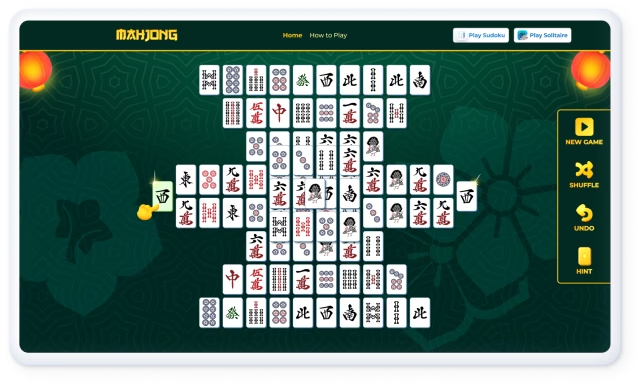
- For a rules refresher and solo pattern recognition, try tile-matching to sharpen visual scanning with Play Mahjong Online Free — Classic Tile Game. While it’s Mahjong Solitaire, not four-player mahjong, the pattern discipline carries over.
- If you’re new to tile identities and simple sets, this clear walkthrough helps build recognition: How to Play Mahjong Solitaire — Rules, Tiles & Strategy.
- For broad historical and variant context, consult the encyclopedia entry on mahjong variants source.
When to choose each ruleset
- Choose Riichi when you value deep defense, information warfare, and explosive scoring arcs via dora and riichi.
- Choose Hong Kong when you prefer fast rounds, flexible open hands, and steady mid-range payouts.
- In clubs running both, start in Hong Kong to master speed and tile flow; transition to Riichi for advanced defense and EV nuance.
Key Takeaways
- Riichi vs Hong Kong Mahjong diverge in incentives: yaku gate + han/fu + riichi pressure versus fan thresholds + flexible open melding.
- Master mahjong scoring differences: Riichi spikes via limits and riichi add-ons; Hong Kong rewards consistent 2–3 fan finishes.
- Riichi strategy: Build yaku early, value two-sided riichi waits, and defend rigorously with safe tiles and suji.
- Hong Kong mahjong strategy: Push fast, count fan every draw, and open early when you can still hit the minimum.
- Confirm house rules—minimum fan, dealer bonuses, limits—then align your hand plan and risk profile accordingly.
- Use drills and post-hand reviews to accelerate learning; log mistakes and fix one leak at a time.
Similar Articles
How to Clean Mahjong Tiles: Step-by-Step Care Guide
Expert guide on how to clean mahjong tiles by material—Bakelite, bone/bamboo, and plastic—with safe steps, pro tips, and data-backed care advice.
Mahjong Flowers: Rules, Scoring, Timing, and Strategy
Expert guide to mahjong flowers: rules, scoring, and smart timing across Hong Kong, American, and Riichi styles. Data-backed, clear, and practical.
Mahjong Game Versions: Key Differences Explained
Explore the key differences between mahjong game versions to choose the best one for you. Master the rules and enhance your gameplay!