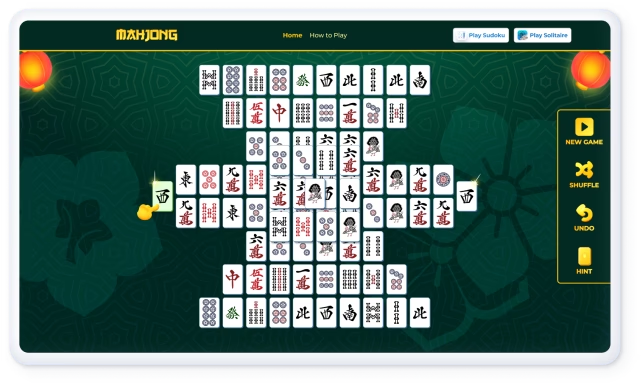
How to Have a Stress-Free Mahjong Play Session

How to Have a Stress-Free Mahjong Play Session
A stress-free mahjong play session is defined as engaging with the game at your own pace, with calm focus and no pressure to win, score, or compete. Most players associate mahjong with complex rules and social tension, but the solitaire format strips all of that away. You match tiles, breathe, and let the rhythm of the game do the rest. Mahjong Online Club is built around exactly this experience: free browser play, no registration, no ads, and no timers forcing your hand. The result is a genuinely relaxing mahjong game that works for a five-minute break or a longer meditative session.
What setup and mindset do you need for a stress-free mahjong play session?
The right setup takes less than two minutes. You need a quiet space, a comfortable seat, and access to a free browser-based game. Most major browser-based platforms offer full gameplay without signup or mandatory downloads, which removes the first friction point before you even see a tile.
Your physical environment matters more than most players realize. Dim your screen slightly, silence notifications, and close extra browser tabs. These small actions signal to your brain that this time belongs to you. Think of it as creating a calm mahjong environment the same way you would set up a meditation corner.

The mindset shift is the harder part. Most of us are conditioned to play games to win. Relaxed mahjong play asks you to flip that instinct. Your only goal is to keep the board moving at a pace that feels comfortable. Scores, speed, and perfect outcomes are irrelevant here.
What to set up before you start:
- Choose a browser-based solitaire game with no timer and no mandatory account
- Mute your phone or put it in another room
- Adjust your screen brightness to a comfortable level
- Pour a drink, get settled, and give yourself permission to play slowly
- Decide in advance that you will use Undo and Hint freely, without guilt
| Setup element | Why it matters |
|---|---|
| No-timer game mode | Removes urgency and lets you scan the board at your own pace |
| Ad-free environment | Prevents interruptions that break focus and raise stress |
| Comfortable seating | Physical ease supports mental calm during longer sessions |
| Notifications silenced | Eliminates the reflex to check your phone mid-game |
Pro Tip: Before your first move, take three slow breaths and scan the entire board without touching anything. This single habit shifts you from reactive clicking to deliberate, calm play.
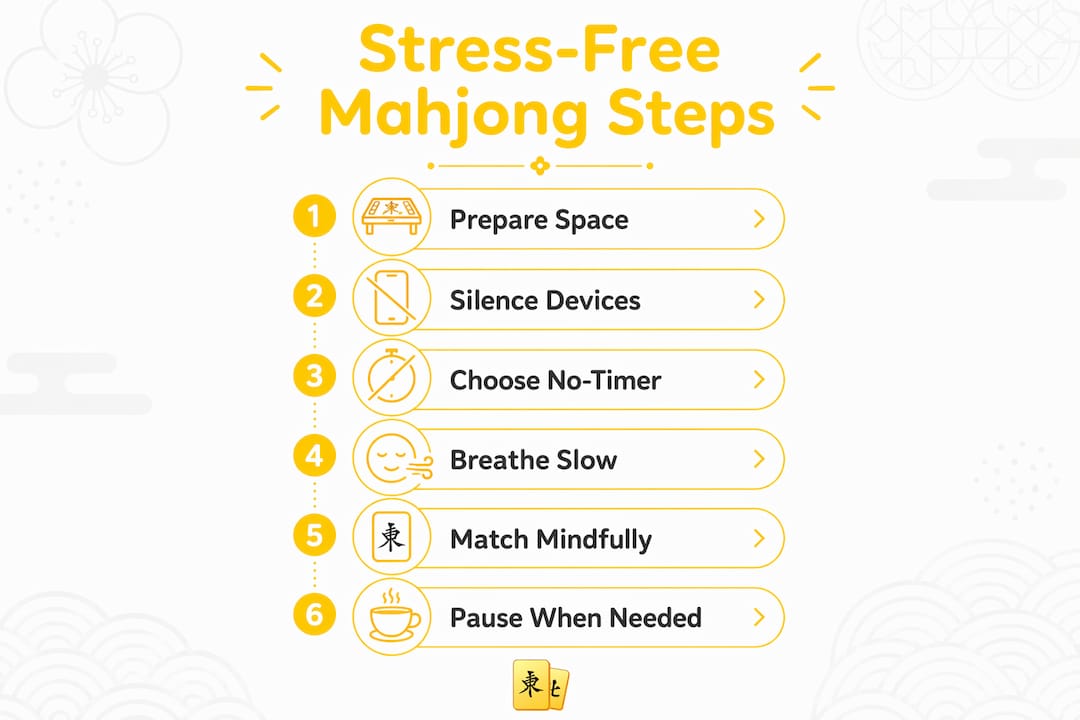
What simple steps promote relaxed and mindful mahjong gameplay?
The core gameplay loop in solitaire mahjong is short and repeatable. Experts recommend concentrating on a simple three-step cycle to maintain relaxed engagement: identify open tiles, match a visible pair, then pause and rescan. That pause is where the mindfulness lives.
Here is the full loop broken into clear steps:
- Scan the full board first. Resist the urge to click the first pair you see. A full scan takes ten seconds and reveals better options.
- Identify which tiles are "free." A free tile has nothing on top of it and at least one open side. Only free tiles can be matched.
- Match the pair that unblocks the most tiles. Prioritize pairs that open up buried sections of the board, not just the easiest visible match.
- Pause after each match. Take one breath. Let your eyes reset before scanning again. This is the rhythm that makes the session feel meditative.
- Use Undo without hesitation. If a match feels wrong, reverse it. Undo and Hint features are essential mindfulness tools, not signs of failure.
- Play without a score target. Ignore any point counter. Your only metric is whether the board is clearing and whether you feel calm.
The biggest mistake beginners make is rushing. Clicking fast feels productive, but it creates a reactive loop that raises tension. Zen-focused mahjong apps are designed around slow, repetitive matching precisely because that rhythm is what produces relaxation.
Pro Tip: If you notice your clicking speed increasing, stop completely. Look away from the screen for five seconds. This micro-reset breaks the anxiety loop before it builds.
How can you manage common challenges that disrupt a calm session?
Every player hits a wall at some point. The board stops yielding obvious matches, frustration creeps in, and the session stops feeling relaxing. The good news is that each of these friction points has a direct fix.
When you get stuck:
- Use the Hint button immediately. There is no penalty, and waiting in frustration defeats the purpose of the session.
- If Hint shows no available moves, use Undo to reverse your last two or three matches. This often reopens paths you closed accidentally.
- Accept that some board layouts are unsolvable from certain positions. Restarting a layout is not failure. It is a reset.
When frustration builds:
- Name it out loud or in your head: "I'm frustrated." Labeling the emotion reduces its intensity, a technique grounded in basic mindfulness practice.
- Step away for sixty seconds. Stand up, stretch, and return. The board will look different after a brief break.
- Remind yourself that patience and rhythm create a satisfying meditative experience, not speed or perfect play.
When the game feels too complex:
- Traditional social mahjong can cause cognitive overload for beginners due to its complexity and social pressure. Solitaire mahjong removes both. Stick with the single-player format until the tile patterns feel familiar.
- Avoid scored or timed modes until you have built genuine comfort with the basic matching loop.
- Start with simpler board layouts. Many platforms offer beginner layouts with fewer tiles and more open paths.
The underlying principle is consistent: protect your calm first, and let skill develop naturally over time. A session that ends with you feeling relaxed is a successful session, regardless of how many tiles you cleared.
What easy strategies help beginners enjoy a relaxing mahjong experience?
Beginner-friendly strategy is not about winning. It is about keeping the board open long enough to stay in the flow state. Experienced players advise scanning for tiles that block the most other pieces and clearing those first. This single habit prevents the board from locking up and keeps the session moving smoothly.
Two approaches define most casual players: edge-first clearing and center-first clearing. Edge-first feels intuitive but often buries the center tiles you need most. Center-first is counterintuitive but keeps more options open throughout the game.
| Approach | What it does | Best for |
|---|---|---|
| Edge-first clearing | Clears outer tiles first, works inward | Quick sessions, simple layouts |
| Center-first clearing | Targets buried tiles early, keeps board open | Longer sessions, complex layouts |
| Blocking-tile priority | Clears tiles that obstruct the most others first | All skill levels seeking calm play |
The blocking-tile priority method is the most effective for a relaxed session. You do not need to count tiles or calculate odds. You simply ask: "Which tile, if removed, opens up the most options?" That question alone guides better decisions without adding mental strain.
Pro Tip: Look for tiles of the same suit stacked near the center of the board. Matching those early prevents the most common dead-end scenarios and keeps your session flowing without interruption.
For players new to the format, matching pairs step by step is the clearest path to building comfort. Pair recognition becomes automatic after a few sessions, which is when the game truly starts to feel meditative rather than effortful. Mahjong Online Club also recommends reading through beginner strategy guides once you feel ready to deepen your understanding without adding pressure.
Mahjong solitaire apps with zen design and no time constraints promote relaxation and mental clarity. Players find these environments well-suited for quick mental breaks or longer sessions to reduce stress. The design of the platform matters as much as your strategy.
Key Takeaways
A calm mahjong session depends on three things: the right environment, the three-step matching loop, and the willingness to use Undo and Hint without guilt.
| Point | Details |
|---|---|
| Setup determines tone | Silence notifications, remove timers, and choose an ad-free platform before you start. |
| The three-step loop is the method | Scan, match the most valuable pair, pause and breathe before the next move. |
| Undo and Hint are tools, not cheats | Using these features keeps flow intact and prevents frustration from breaking the session. |
| Center-first clearing keeps options open | Targeting buried tiles early prevents dead ends and supports longer, calmer sessions. |
| Solitaire before social play | Build 10–20 hours of solo comfort before attempting scored or multiplayer formats. |
Why I stopped trying to "win" at mahjong and started actually enjoying it
I spent my first dozen sessions clicking as fast as I could, chasing a high score that meant nothing. The board felt like a problem to solve, not a space to inhabit. The shift happened when I deliberately slowed down and paid attention to the sound of the tiles.
High-quality digital versions simulate the clacking sound of tiles to ground players and support mindfulness. That detail sounds minor until you experience it. The auditory feedback creates a rhythm that your nervous system responds to. It is the same reason people find rain sounds calming. The pattern is predictable, and predictability is the opposite of stress.
What I have found is that the Undo button is the most underrated feature in casual mahjong. Most players avoid it out of a vague sense that using it is "cheating." That instinct is worth examining. In a relaxed session, there are no rules against reversing a move. Protecting your flow state is the whole point.
The hardest mindset shift is accepting an unsolvable board without frustration. Some layouts simply lock up, regardless of how well you play. I now treat those moments as a natural pause: restart the layout, take a breath, and begin again. That acceptance is where the real meditative value of the game lives.
— Dmytro Romaniuk
Mahjong Online Club: calm play, no barriers
Mahjong Online Club offers free, browser-based solitaire mahjong with no account required and no ads interrupting your focus. The platform is designed specifically for players who want a genuinely calm experience, not a competitive one.
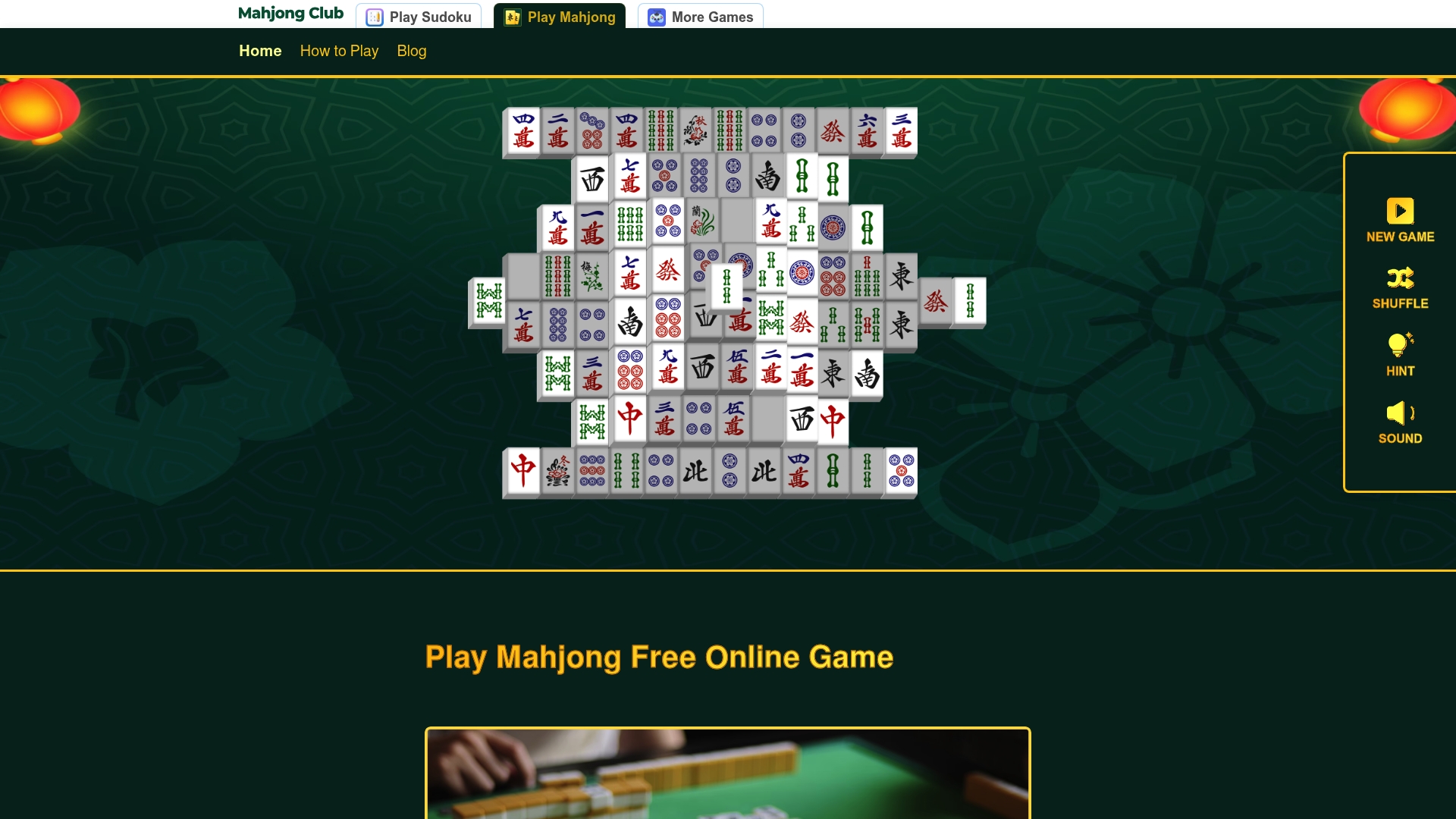
Every session on Mahjong Online Club includes Undo and Hint features built into the interface, along with layouts suited for both short breaks and longer play. If you want to go deeper, the rules and strategy guide walks you through every tile type and matching principle at a beginner-friendly pace. No pressure, no signup, and no timer counting down while you think. Just open the game and start matching.
FAQ
What makes a mahjong session truly stress-free?
A stress-free session removes timers, scores, and social pressure from the equation. Playing solitaire mahjong in a quiet environment with Undo and Hint available covers all three conditions.
Is mahjong a good game for beginners seeking relaxation?
Yes. Solitaire mahjong uses a simple matching loop that beginners can learn in minutes. Experts recommend avoiding complex scoring systems early on to prevent burnout and keep the experience enjoyable.
How long should a relaxing mahjong session last?
Session length is entirely personal. Browser-based platforms support flexible lengths from five-minute breaks to extended play, so you can stop whenever the session stops feeling calm.
Should beginners try social or scored mahjong right away?
No. Mastering solitaire mechanics for 10–20 hours builds the relaxed familiarity needed before social or scored formats feel manageable rather than stressful.
How do I avoid getting stuck during a calm mahjong session?
Use the Hint button the moment you feel stuck, and use Undo to reverse recent moves if no matches appear. Clearing tiles that block the most others first also prevents dead ends before they develop.
Recommended
Similar Articles
Riichi vs Hong Kong Mahjong: Rules, Scoring, Strategy
Riichi vs Hong Kong Mahjong explained by an expert: rules, scoring differences, and strategy with data-backed tips and a clear, practical table.
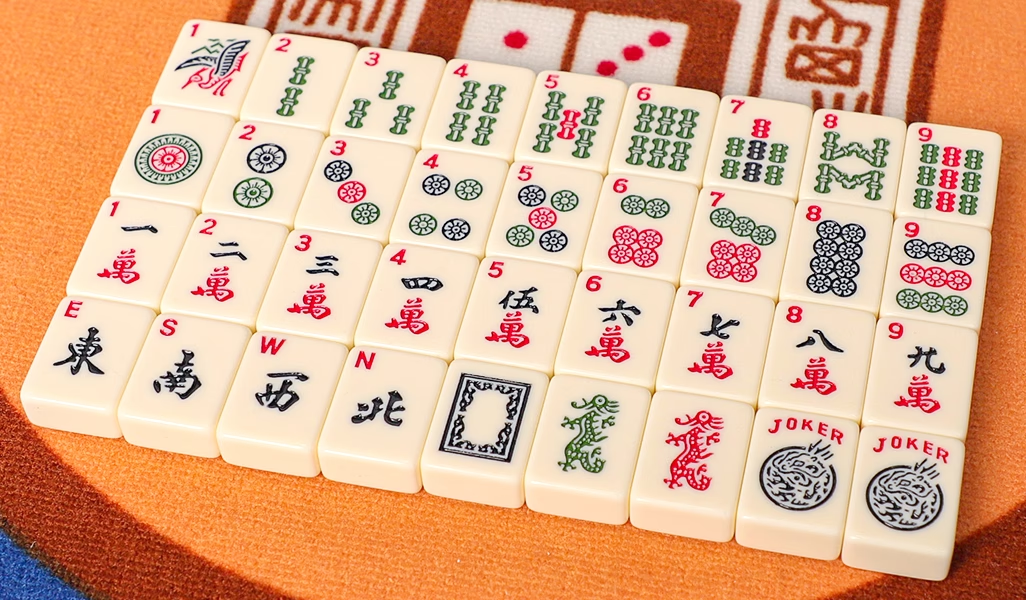
Riichi Mahjong Yaku List: Examples, Points, and Tips
Expert guide to Riichi Mahjong yaku list with clear examples, points, and scoring. Data-backed tips and pro insights to improve results fast.

Ad Free Games for Relaxation: Your 2026 Stress Relief Guide
Discover the best ad free games for relaxation in 2026. Enjoy calming, immersive experiences that help reduce stress and anxiety without interruptions.