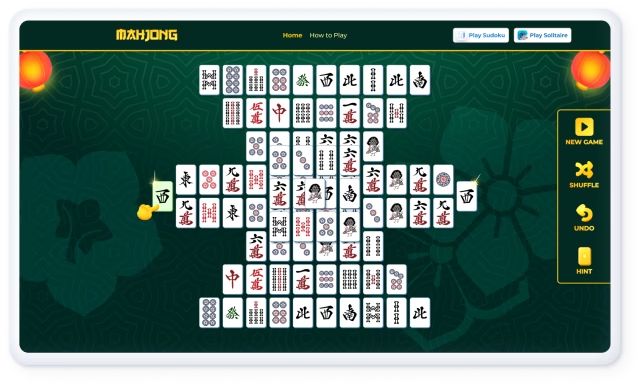
How to Optimize Your Mahjong Tile Matching Sequence

How to Optimize Your Mahjong Tile Matching Sequence
Optimizing your Mahjong tile matching sequence is defined as organizing tiles by suit and number, then selecting matches that free the most valuable hidden tiles while keeping your future options open. This approach applies to both Mahjong Solitaire layouts and competitive Riichi play, where tile efficiency determines who wins and who gets stuck. Players who group tiles deliberately and clear stacks in the right order clear boards faster and avoid the dead ends that trap casual players. Mahjong Online Club builds its strategy guides around exactly these principles, combining Solitaire board tactics with Riichi tile efficiency concepts for players at every level.
How should you group your tiles to optimize the matching sequence?
Sorting your tiles before you start matching is the single most effective habit you can build. Without a clear mental map of what you have, you will waste moves on low-value pairs and miss the sequences that actually clear the board.
Group your tiles by suit first:
- Characters (Cracks): Number tiles with Chinese characters, ranked 1 through 9
- Circles (Dots): Number tiles with circle symbols, ranked 1 through 9
- Bamboo: Number tiles with bamboo symbols, ranked 1 through 9
- Honors: Winds (East, South, West, North) and Dragons (Red, Green, White)
- Bonus tiles: Flowers and Seasons, which match any tile in their category
Within each suit, arrange tiles numerically. This lets you spot consecutive sequences at a glance, which matters most when you are building runs in Riichi or scanning a Solitaire board for pairs. Honors and bonus tiles sit apart because they only match their exact counterpart. Treating them as a separate mental category prevents you from wasting time scanning them for sequence potential they do not have.
Pro Tip: When you scan a Solitaire board, mentally label each visible tile by suit before touching anything. Players who sort first and match second make fewer wasted moves.
The payoff of this organization shows up immediately. When you know where each suit lives on the board, you spot available pairs in seconds rather than scanning the whole layout repeatedly. That speed advantage compounds over a full game, especially on layouts with deep stacks where every move counts.

Which tactics free the most valuable hidden tiles and avoid dead ends?
The core rule of advanced tile removal strategy is this: every match you make should unlock at least one tile that was previously unavailable. Matching two tiles that were already free and sitting in flat rows is low-value. Matching a tile on top of a stack is high-value because it reveals lower tiles and increases your total available moves.
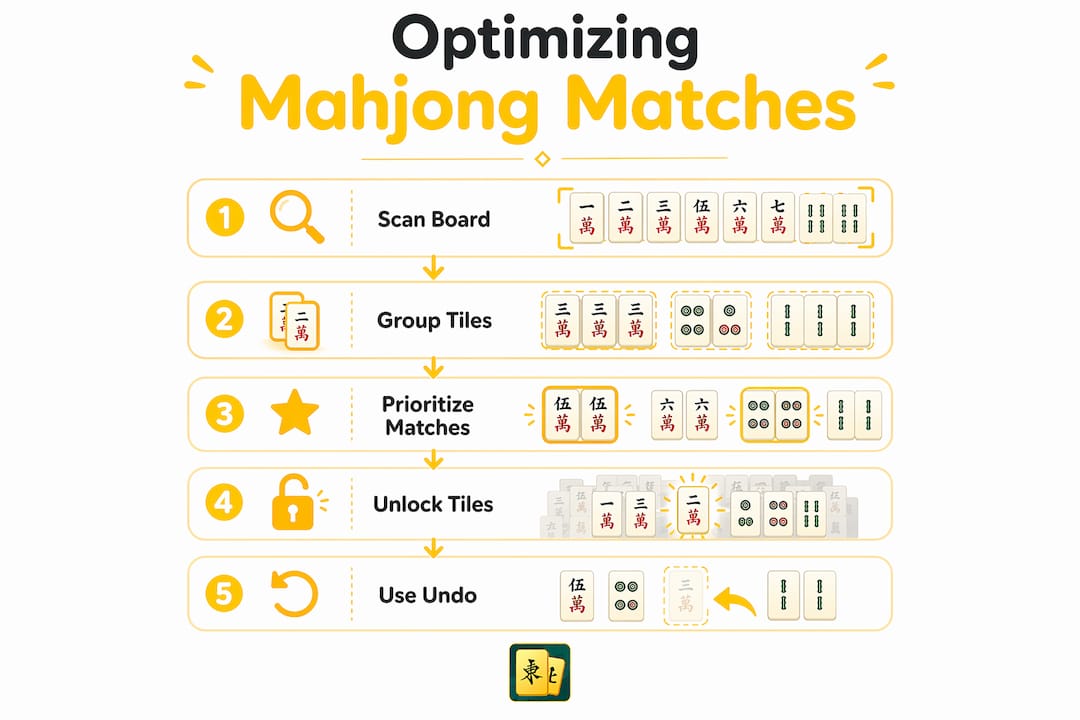
Prioritize the highest stacks first. Ignoring vertical stacks until the end is the main cause of unsolvable boards. When you clear the top layer of a tall stack, you expose two or three tiles at once. That multiplies your options for the next several turns.
On long horizontal rows, work from the outer edges inward. Clearing edge tiles first unlocks interior tiles that would otherwise stay blocked. Players who match tiles from the center outward often find themselves with a cluster of inaccessible tiles in the middle that no remaining pair can touch.
The three-tile problem is one of the most misunderstood situations in Mahjong Solitaire. When three identical tiles are visible at once, do not match the first two you see. Evaluate which pair frees the most valuable hidden tiles, then leave the third tile unmatched until a better opportunity appears. Matching greedily here is a common path to a dead end.
The Undo tool is not a crutch. Using Undo strategically lets you test whether a match actually opens new tiles or just removes two tiles without improving your position. Treat it as a decision-testing tool, not a mistake-eraser. Players who use Undo deliberately improve their board-reading skills faster than those who avoid it out of pride.
Pro Tip: After every match, count how many new tiles became available. If the answer is zero, that match was low-value. Train yourself to expect at least one new tile per move.
How does tile efficiency in Riichi Mahjong relate to matching sequence optimization?
Tile efficiency is the recognized competitive term for what casual players call "good matching." In Riichi Mahjong, tile efficiency means maximizing the number of useful tiles you can draw on your next turn. The concept reframes matching as a forward-looking decision, not just a reaction to what is currently visible.
The four key concepts every player should understand:
Shanten number: The count of how many more tiles you need to draw before reaching tenpai (one tile away from a winning hand). A lower shanten number means you are closer to winning. Every discard decision should aim to reduce shanten as fast as possible.
Uke-ire (tile acceptance): The count of distinct tiles in the remaining deck that would improve your hand. Higher uke-ire counts mean more paths to improvement. When two discards look equally good, choose the one that leaves you with higher uke-ire.
Two-sided waits: A sequence wait on both sides, such as holding 4 and 5 and waiting for either 3 or 6, is far stronger than a one-sided wait. Two-sided waits and connected sequences increase tile efficiency because they accept twice as many winning tiles.
Connectivity: Tiles that are one or two steps away from completing a set are connected. Isolated tiles with no neighbors in their suit have zero connectivity and are your first discard candidates.
The most common tile efficiency mistake is holding onto an isolated honor tile too long. Honor tiles only form pairs or triplets. They cannot join sequences. When your hand has no second copy of an honor tile and your shanten number is still high, that tile is a discard candidate. Clinging to it because it feels valuable is a habit that costs tempo every round. For a deeper look at how these concepts differ across game formats, the Riichi vs Hong Kong Mahjong comparison shows how tile efficiency priorities shift between rulesets.
What common mistakes should you avoid in your tile matching sequence?
Most players who get stuck on a Mahjong board made one of five avoidable errors earlier in the game. Recognizing these patterns is the fastest way to improve.
Matching random pairs without evaluating impact. Removing two tiles that were already free and blocking nothing is a wasted move. Every match should have a clear reason: it frees a stack tile, it unlocks an edge, or it reduces shanten.
Trapping buried tiles with early matches. Counting all four copies of a tile before matching prevents the most painful dead end in Solitaire: removing two visible copies only to find the other two are buried under tiles you cannot reach. Check visibility before you commit.
Ignoring edge tiles in long rows. Edge tiles are the keys to interior tiles. Players who match from the center outward consistently create bottlenecks. Work the edges first, always.
Neglecting stack tops in favor of easy flat matches. Flat-layer matches feel satisfying because they are quick and obvious. Stack-top matches feel riskier because they require more scanning. The stack-top match is almost always the better move. Tile isolation is a direct consequence of ignoring stacks.
Saving flowers and bonus tiles too long. Bonus tiles match any tile in their category and do not depend on suit or number. Use them when they free a stack tile or unlock an edge, not as a last resort when you are already stuck.
The underlying pattern across all five mistakes is the same: players react to what is visible rather than planning for what is hidden. Shifting from reactive matching to deliberate sequencing is the skill that separates players who finish boards from players who run out of moves.
Key takeaways
Deliberate sequencing, not speed, is the defining skill in Mahjong tile matching. Players who plan each move around what it unlocks clear more boards and build hands faster than those who match on instinct.
| Point | Details |
|---|---|
| Sort tiles by suit first | Group characters, circles, bamboo, and honors before making any match. |
| Clear stacks from the top | Matching stack-top tiles reveals more playable tiles and prevents deadlocks. |
| Work edges before center | Clearing outer tiles on long rows unlocks interior tiles that would otherwise stay blocked. |
| Use shanten and uke-ire | Track how many draws you need and how many tiles improve your hand on every turn. |
| Count all four copies | Check tile visibility before matching to avoid trapping buried copies and creating dead ends. |
What I have learned from years of watching players get stuck
I have watched hundreds of players approach a Mahjong board the same way: they scan for the first available pair and match it immediately. That instinct feels productive. The board shrinks, the move counter ticks up, and there is a small hit of satisfaction. The problem is that most of those early matches were low-value. They removed tiles that were already accessible and did nothing to open the tiles that were actually blocking progress.
The shift that changes everything is learning to pause before the first move. A ten-second scan of the full board before touching anything reveals the stack structure, the edge bottlenecks, and the tiles that are one match away from becoming available. That scan is not hesitation. It is the move.
I also think the Undo tool is underused by players who see it as admitting a mistake. Undo is a testing mechanism. The best Solitaire players I have seen use it constantly, not because they make more errors, but because they treat each move as a hypothesis. Did that match open new tiles? If not, undo it and try the other pair. That mindset, testing rather than committing blindly, transfers directly to competitive Riichi play, where every discard is a calculated bet on future draws.
The cognitive side of this matters too. Mahjong Online Club's approach to the game emphasizes mindfulness and focused attention, and that is not just marketing language. Players who slow down, scan deliberately, and treat each move as a decision rather than a reflex genuinely perform better. The step-by-step matching guide on Mahjong Online Club is worth reading even for experienced players because it forces you to articulate what you already do intuitively, and articulating it makes it repeatable.
— Dmytro Romaniuk
Practice these strategies at Mahjong Online Club
Mahjong Online Club gives you a free, no-registration browser game where you can apply every strategy in this article immediately. The platform includes Mahjong Solitaire layouts that range from beginner-friendly to deep-stack challenges, all designed without ads or distractions so you can focus on deliberate practice.

The Undo feature is built into every game, so you can test move sequences without penalty. Mahjong Online Club also publishes strategy guides that cover tile grouping, stack management, and Riichi efficiency concepts in depth. Play free Mahjong now and put the sequencing tactics from this article to work on a real board. The full rules and strategy guide is a strong next read if you want to build on the tile efficiency concepts covered here.
FAQ
What does it mean to optimize a Mahjong tile matching sequence?
Optimizing a Mahjong tile matching sequence means choosing matches in an order that frees the most valuable hidden tiles and keeps the maximum number of future moves available. It is the opposite of matching whatever pair you see first.
Why should you clear stack tops before flat tiles?
Matching a tile on top of a stack reveals lower-level tiles and multiplies your available moves. Flat-layer matches remove tiles without unlocking anything new, which reduces your options over time.
What is shanten and why does it matter?
Shanten is the number of tiles you still need to draw before reaching tenpai, the state where one more tile wins the hand. Reducing your shanten number as fast as possible is the core goal of tile efficiency in Riichi Mahjong.
How do you avoid trapping buried tiles in Mahjong Solitaire?
Count all four copies of a tile before matching any pair. If two copies are buried under unreachable tiles, matching the two visible copies locks you out of ever clearing that tile group.
When should you use the Undo tool in Mahjong Solitaire?
Use Undo immediately after a match if no new tiles became available. It is a decision-testing tool that helps you find the higher-value match before committing to a move that leaves the board unchanged.
Recommended
Similar Articles

Free Online Games No Registration: Play Instantly in 2026
Discover the best free online games no registration required! Play instantly for fun and entertainment in 2026, no downloads needed.
How to set up a mahjong set: tiles, racks, winds, layout
How to set up a mahjong set with tiles, racks, winds, and table layout. Expert guide with data-backed steps and a clear variant comparison.

What Is No Download Gaming? A 2026 Guide
Discover what no download gaming is and how it revolutionizes play. Enjoy instant access to games without storage hassles in 2026!