Why Tile Order Matters in Mahjong: Strategy Guide
Why Tile Order Matters in Mahjong: Strategy Guide
Tile order in Mahjong is the structured arrangement of your 13 or 14 tiles by suit and value, and it directly determines how fast and accurately you can read your hand. Why tile order matters in Mahjong comes down to one core truth: a sorted hand reveals melds, pairs, and waits in seconds, while a disordered hand hides them. The standard sequence, Man (Characters 1–9), Pin (Circles 1–9), Sou (Bamboo 1–9), and Honors (winds and dragons), is used by competitive players worldwide. Mastering this sequence is not optional at the tournament level. It is the foundation every other strategy is built on.
Why tile order matters in Mahjong: the standard sequence explained
The 34 unique tile types in a standard Mahjong set must be memorized and sorted rapidly for effective hand reading. That number sounds manageable until you are sitting across from three opponents with a clock running. The standard tile order, Man then Pin then Sou then Honors, groups similar tiles together so your eye moves in one direction across the rack instead of jumping around. This reduces visual clutter and lets pattern recognition do its job.
The table below shows the four categories and their internal sequence:
| Suit / Group | Tiles | Sorting priority |
|---|---|---|
| Man (Characters) | 1 through 9 | First |
| Pin (Circles) | 1 through 9 | Second |
| Sou (Bamboo) | 1 through 9 | Third |
| Honors (Winds and Dragons) | East, South, West, North, White, Green, Red | Fourth |
When tiles are arranged this way, a partial sequence like Pin 3, Pin 4 sits visually adjacent on the rack, making the missing Pin 2 or Pin 5 obvious at a glance. Isolated honors appear at the far right, separated from your numbered suits, so they stand out as discard candidates immediately. The tile meanings guide at Mahjong-online covers each suit in depth if you want to reinforce this foundation.
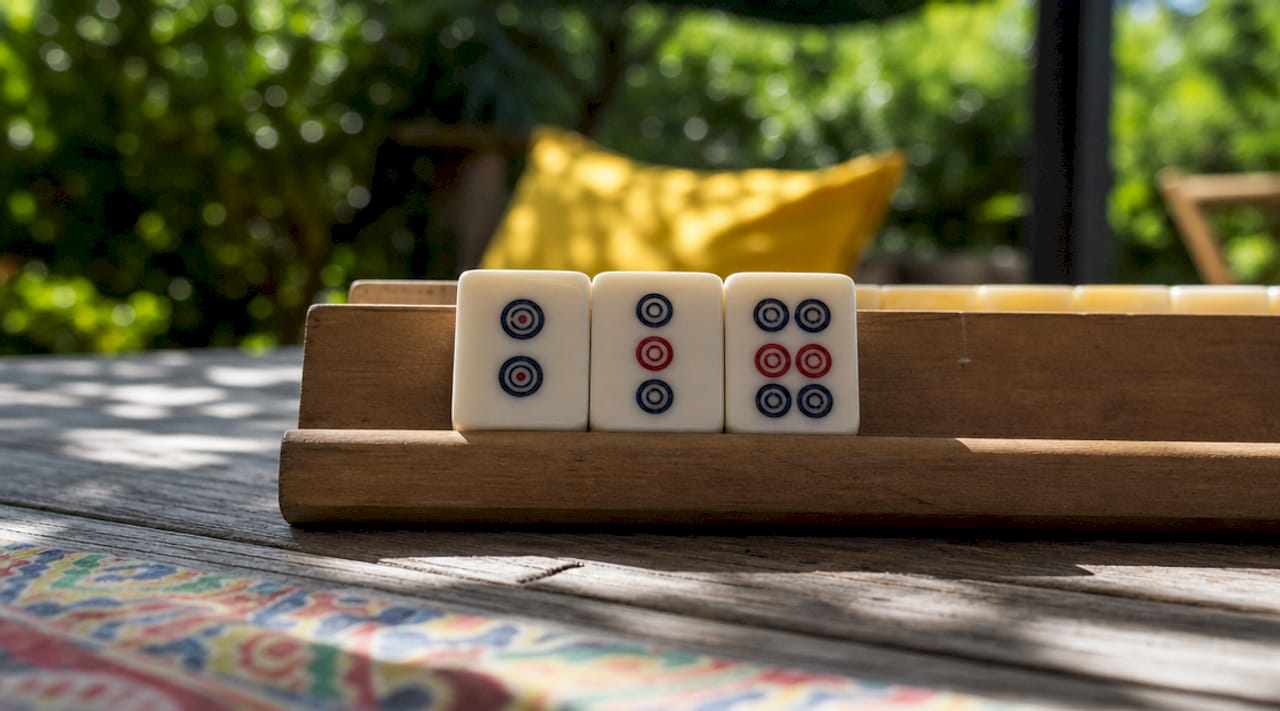
Pro Tip: Practice sorting a shuffled set of 14 tiles against a timer. Advanced players sort in under 5 seconds; beginners often need 30 seconds or more. Closing that gap is one of the highest-return drills you can do.
How does Five-Block Theory use tile order to sharpen strategy?
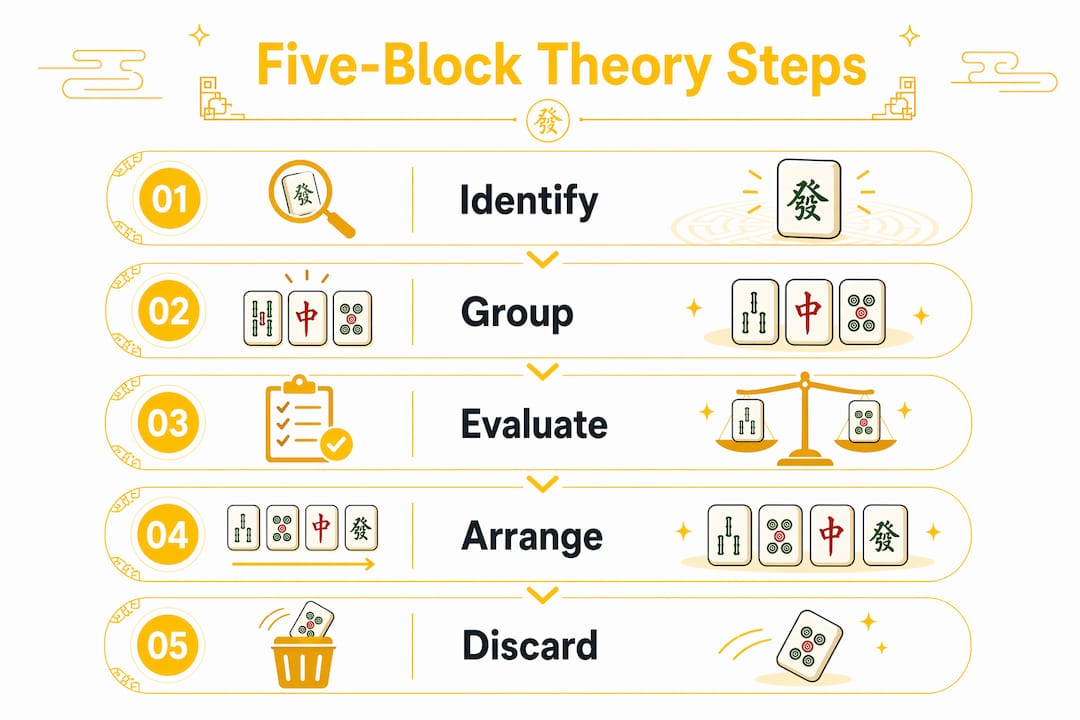
Five-Block Theory is a hand-evaluation framework that divides your tiles into exactly five functional blocks: completed melds, edge sequences, pairs, two-sided waits, and closed or edge waits. The theory only works if your tiles are already sorted. Without order, identifying which blocks you hold and which are missing becomes a guessing exercise rather than a calculation.
Here is how tile order feeds directly into each stage of Five-Block Theory evaluation:
- Completed melds appear as three consecutive or identical tiles sitting together on the rack. Sorted tiles make these instantly visible.
- Two-sided waits (for example, Pin 4 and Pin 5 waiting on Pin 3 or Pin 6) are easy to spot when numbered suits run in sequence. A disordered rack can hide these entirely.
- Pairs stand out when identical tiles are adjacent. Sorting by suit and value guarantees adjacency.
- Edge and closed waits (like Pin 1 and Pin 2 waiting only on Pin 3, or Pin 4 and Pin 6 waiting only on Pin 5) are weaker shapes. Sorted tiles let you recognize them quickly and decide whether to keep or break them.
- Isolated tiles appear as lone tiles with no neighbors in the same suit. These are your first discard candidates, and they are only obvious when the rest of the hand is ordered.
Treating the hand as an interconnected structure rather than a collection of individual tiles is the mindset shift Five-Block Theory demands. This approach helps players commit to the strongest hand shape and discard distractions early. Recognizing five key blocks early can increase win probability from roughly 2–5% to over 25–40%. That is not a marginal gain. It is the difference between playing reactively and playing with intent.
Common mistakes players make when they ignore tile order in block evaluation include holding too many partial shapes simultaneously, failing to identify which block is weakest, and delaying discard decisions because the hand looks more complex than it actually is.
How does tile order influence discard strategy and gameplay efficiency?
Discard decisions are where tile order translates directly into wins and losses. A sorted hand tells you three things immediately: which suits are void or near-void, which tiles connect to nothing, and which tiles give you the most flexibility going forward. Without that visual clarity, you are making discard decisions on incomplete information.
Here is a practical sequence for using tile order to guide discards:
- Identify void suits first. If you hold no Pin tiles after sorting, any Pin you draw is a discard unless it completes a meld. Recognizing this early saves tempo.
- Locate isolated tiles. Discarding void suit or isolated tiles within the first three turns improves hand efficiency and avoids severe penalties in certain rulesets. Sorted tiles make these liabilities visible immediately.
- Evaluate honor tiles. Isolated honors and terminals generally decrease hand efficiency unless retained for defensive purposes late in the game. Discarding them early is a standard recommendation for streamlining toward tenpai.
- Assess tile versatility. Pro players prioritize discarding less versatile tiles first, such as isolated 3s or 7s, while retaining tiles like 4s and 6s which offer more connection options. This principle only becomes actionable when tiles are sorted and their neighbors are visible.
- Recalibrate after each draw. Every new tile changes the hand's block structure. Re-sorting or mentally updating your tile order after each draw keeps your evaluation current and prevents stale discard logic.
In advanced play, tile order connects directly to shanten calculation and uke-ire evaluation. Shanten measures how many tiles away from tenpai you are; uke-ire counts how many tiles in the live wall can improve your hand. Both calculations depend on knowing exactly what you hold and how tiles relate to each other. A shanten and uke-ire evaluation is essentially impossible to run mentally on a disordered hand.
Pro Tip: When you draw a tile that does not fit your current block structure, place it at the far right of your rack before deciding. This physical separation signals "evaluate for discard" and prevents you from unconsciously integrating a weak tile into your hand shape.
What tile order nuances exist across Mahjong variants?
Tile order strategy is not identical across every version of the game. The core logic holds, but the specific tiles, sorting priorities, and enforcement levels shift depending on which ruleset you are playing.
| Variant | Tile set differences | Tile order priority | Tournament enforcement |
|---|---|---|---|
| Riichi (Japanese) | Standard 34-tile set, no jokers | Strict Man / Pin / Sou / Honors sequence | High; sorting speed is a competitive skill |
| American Mahjong | Includes jokers and uses National Mah Jongg League pattern cards | Sorting adapts to annual card patterns | Moderate; pattern cards guide arrangement |
| Chinese Classical | Flowers and seasons added to base set | Flowers sorted separately after Honors | Varies by house rules |
| Hong Kong (Cantonese) | Flowers and seasons common | Similar to classical; flowers isolated | Informal; house rules dominate |
American Mahjong rules introduce jokers and annual pattern cards that change how players arrange tiles each year. This means American players must re-learn their sorting priorities every season, which makes the underlying habit of disciplined tile order even more valuable. The mechanical skill transfers; only the specific patterns change.
Riichi Mahjong, covered in detail in the Riichi mahjong rules guide at Mahjong-online, enforces the strictest tile order norms. In competitive Riichi, sorting 14 tiles in under 5 seconds is a recognized benchmark for advanced players. This rapid sorting aids in spotting potential waits and reduces the risk of missing winning combinations under pressure. If you play Riichi seriously, timed sorting drills are not optional practice. They are preparation.
Key takeaways
Tile order is the single most foundational skill in Mahjong because it enables every other strategic decision, from block identification to discard sequencing to shanten calculation.
| Point | Details |
|---|---|
| Standard sequence builds speed | Sorting Man, Pin, Sou, then Honors reduces hand-reading time from 30 seconds to under 5 seconds for advanced players. |
| Five-Block Theory requires order | Identifying melds, pairs, and waits within the five-block framework is only reliable when tiles are already sorted. |
| Discards follow from sorted hands | Isolated tiles, void suits, and low-versatility honors become visible discard candidates only after proper arrangement. |
| Variants adjust the specifics | American Mahjong and Riichi differ in tile sets and enforcement, but the discipline of ordered sorting transfers across all variants. |
| Shanten calculation depends on order | Advanced metrics like shanten and uke-ire require knowing tile relationships precisely, which disordered hands obscure. |
Tile order is the habit that separates disciplined players from lucky ones
I have watched players with genuine pattern recognition instincts lose consistently because they never built the sorting habit. They could spot a winning hand when it was handed to them, but under time pressure, with 14 tiles in a random arrangement, they froze. The hand was there. They just could not see it fast enough.
What I have found over years of studying and playing is that tile order mastery is less about memorizing a sequence and more about building a mental reflex. The Man / Pin / Sou / Honors sequence becomes automatic after enough repetition, the same way a chess player stops consciously naming pieces and starts seeing board positions. Once sorting is automatic, your cognitive bandwidth shifts entirely to strategy.
The mistake most players make is treating tile order as a beginner's concern, something to learn once and move past. The opposite is true. The stronger your sorting reflex, the more mental space you have for Five-Block Theory evaluation, shanten tracking, and reading your opponents' discards simultaneously. These are not separate skills. They are layers built on the same foundation.
My honest advice: spend ten minutes before every session sorting tiles against a timer. Use the beginner strategy guide at Mahjong-online to connect your sorting practice to broader hand-reading principles. Tile order is not the ceiling of your game. It is the floor everything else stands on.
— Dmytro
Practice tile order and strategy with Mahjong-online
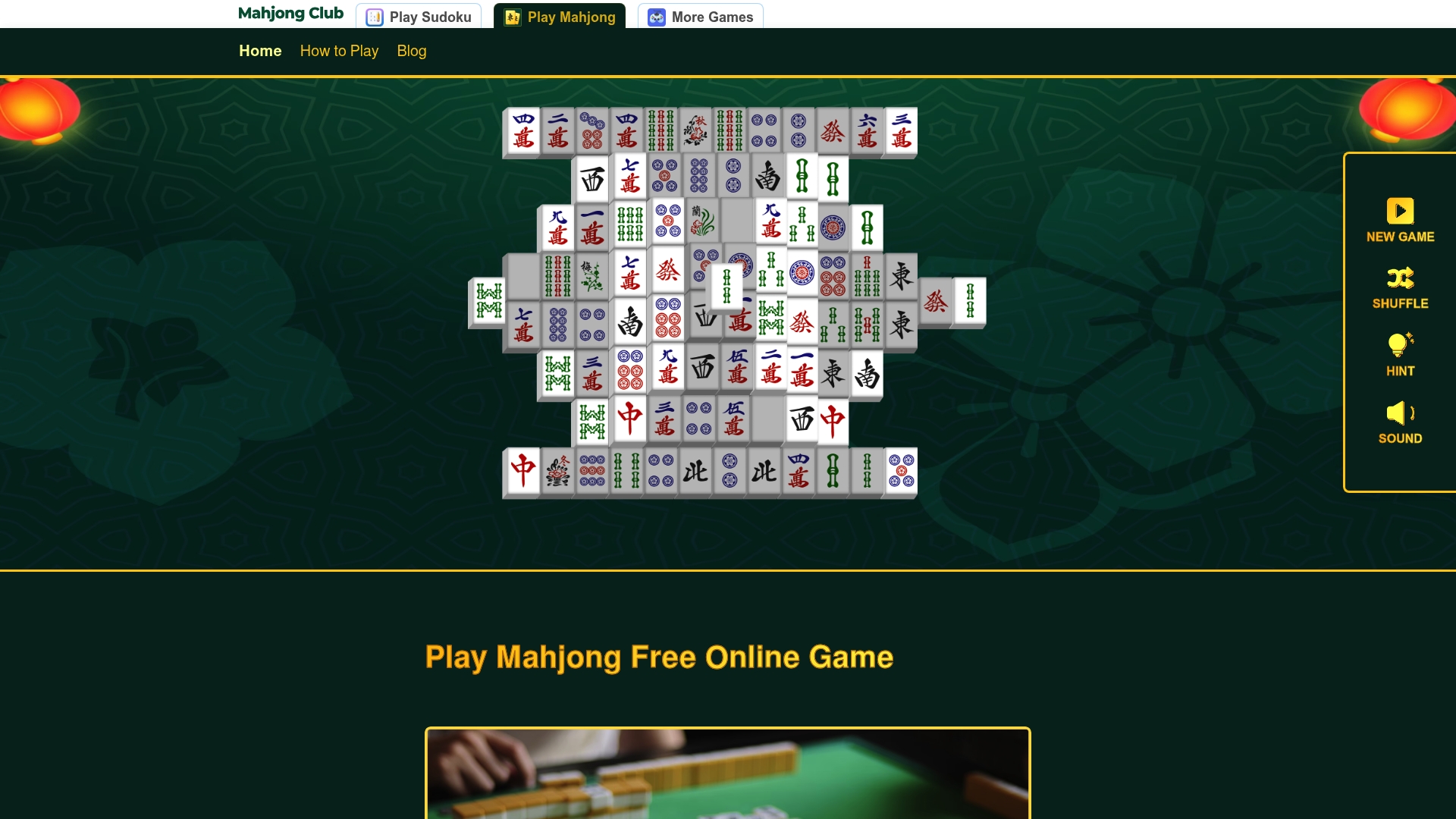
Mahjong-online offers free, browser-based Mahjong gameplay with no registration required, making it one of the most accessible ways to build tile recognition and sorting speed in real game conditions. The platform is designed for focused, distraction-free play, which means every session reinforces the pattern recognition habits that tile order mastery depends on. You can play Mahjong free directly in your browser and start applying the sorting and discard principles covered in this guide immediately. For players who want structured learning alongside practice, the rules and strategy section covers hand-reading fundamentals, tile efficiency, and gameplay mechanics in clear, accessible detail. Whether you are building speed with timed sorting or working through Five-Block Theory concepts, Mahjong-online gives you the tools and the table to practice both.
FAQ
Why does tile order matter in Mahjong?
Tile order matters because it allows players to identify melds, pairs, and waits at a glance, reducing hand-reading time and improving discard decisions. Without a consistent sorting sequence, players miss winning combinations and make slower, less accurate strategic choices.
What is the standard tile order in Mahjong?
The standard sequence is Man (Characters 1–9), Pin (Circles 1–9), Sou (Bamboo 1–9), and then Honors (winds and dragons). This arrangement groups related tiles together so patterns become visible immediately across the rack.
Does tile order affect which tiles you discard?
Sorted tiles directly reveal isolated tiles, void suits, and low-versatility honors, all of which are primary discard candidates. Players who sort consistently make faster and more accurate discard decisions than those who leave tiles in draw order.
How does tile order connect to Five-Block Theory?
Five-Block Theory evaluates hands by identifying five functional blocks: completed melds, edge sequences, pairs, two-sided waits, and closed waits. Each block type is only reliably visible when tiles are sorted, making tile order a prerequisite for applying the framework effectively.
Does tile order strategy change across Mahjong variants?
The core sorting logic transfers across variants, but specifics differ. Riichi Mahjong enforces strict Man / Pin / Sou / Honors ordering at the competitive level, while American Mahjong requires adapting tile arrangement to annual National Mah Jongg League pattern cards each season.