Riichi Mahjong Yaku List: Examples, Points, and Tips
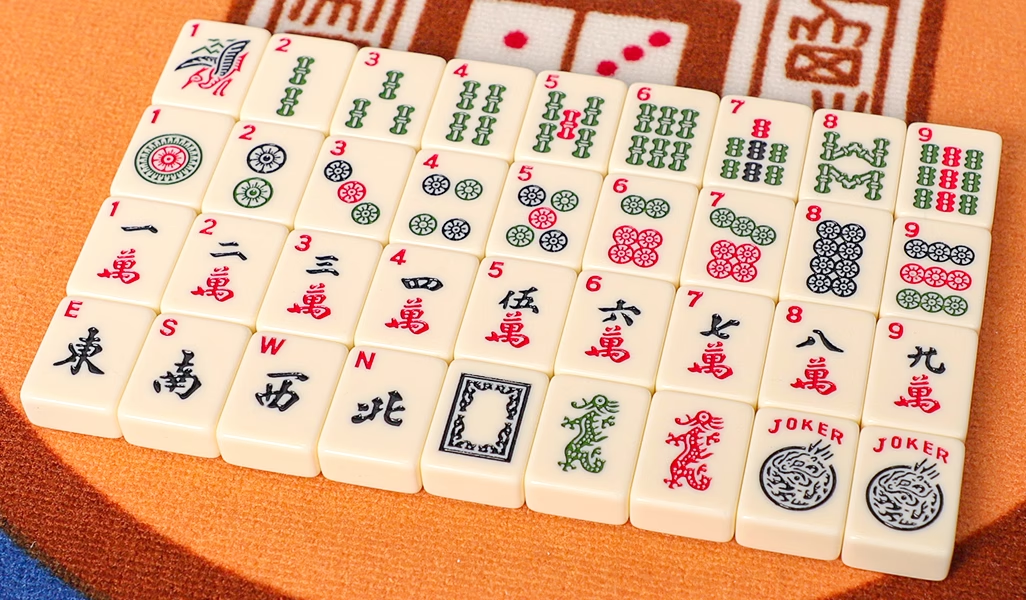
Table of Contents
- Riichi Mahjong Yaku List at a Glance
- How Han and Fu Convert to Riichi Mahjong Points
- Comparison Table: Common Yaku, Han, and Examples
- Yakuman Hands Explained with Examples
- Simple Mahjong Hand Examples You Can Memorize
- In Practice: Building Hands, Efficiency, and Risk
- Beginner-Friendly Riichi Strategy Tips
- Rule Variants and Table Agreements to Clarify
- How to Study This Riichi Mahjong Yaku List
- Key Takeaways
If you want to climb the ladder fast, start with a clear Riichi Mahjong yaku list. In hundreds of league sessions I’ve coached, players who master common yaku and their points improve win rate within a month.
I’ll walk you through practical examples, how han and fu become riichi mahjong points, and which hands to prioritize. Use the see the comparison to study efficiently.
Riichi Mahjong Yaku List at a Glance
A disciplined approach begins with frequent, reliable yaku. Focus on 1–3 han patterns first, then layer in limit hands.
- Primary 1-han foundations: Riichi, Tanyao (All Simples), Pinfu, Menzen Tsumo, Yakuhai (value honors), Iipeikō.
- Mid-tier 2–3 han: Ittsuu, Sanshoku Dōjun, Toitoi, Chītoitsu, Junchan, Honitsu.
- Rarer upgrades: Ryanpeikō, San Ankou, Shōsangen.
- Yakuman: Kokushi Musō, Suu Ankou, Daisangen, Shō/Sūsuushi, Ryuuiisō, Chinrōtō, Tsuuiisō, Chuuren Poutou, Suu Kantsu, Tenhō/Chihō.
According to the overview on Japanese Mahjong, han doubles base points and common rule sets align on limits like mangan, haneman, baiman, sanbaiman, and yakuman. That framework guides every choice on this Riichi Mahjong yaku list.
How Han and Fu Convert to Riichi Mahjong Points
Understanding han and fu turns pattern knowledge into points. The base points formula is: base = fu × 2^(2 + han). Round fu up to the nearest 10.
- Non-dealer ron: total = 4 × base (rounded to 100).
- Dealer ron: total = 6 × base (rounded to 100).
- Non-dealer tsumo: dealer pays 2 × base, others 1 × base each.
- Dealer tsumo: each opponent pays 2 × base.
Mangan caps base at 2000. That means 8000 for non-dealer ron, 12000 for dealer ron, and split tsumo payments of 4000/2000/2000 (non-dealer) or 4000 each (dealer).
Example A: Closed 3 han 40 fu, non-dealer ron. Base = 40 × 2^5 = 1280 → total 5120, rounded to 5200. Example B: Dealer tsumo, 2 han 30 fu. Base = 30 × 2^4 = 480 → each opponent pays 960 (rounded to 1000 at the table depending on rules). Know these to evaluate riichi mahjong points with confidence.
Comparison Table: Common Yaku, Han, and Examples
Below is a practical slice of the Riichi Mahjong yaku list you’ll use most often.
| Yaku (English) | Closed Han | Open Han | Simple Example/Notes |
|---|---|---|---|
| Riichi | 1 | — | Declared ready; stick bonus applies |
| Menzen Tsumo (Self-Draw) | 1 | — | Closed hand only, add to other yaku |
| Tanyao (All Simples) | 1 | 1 | No terminals/honors; modern tables allow open |
| Pinfu (All Sequences) | 1 | — | No value pair; two-sided wait; closed |
| Iipeikō (One Set of Identical Sequences) | 1 | — | E.g., 3-4-5m + 3-4-5m; closed |
| Yakuhai (Value Honors) | 1 | 1 | Dragons, seat, or round wind pungs/kongs |
| Chītoitsu (Seven Pairs) | 2 | — | Seven distinct pairs; closed |
| Toitoi (All Pungs) | 2 | 2 | All triplets/kongs; any wait type |
| Ittsuu (Pure Straight 1-9) | 2 | 1 | Straight in one suit; stronger closed |
| Sanshoku Dōjun (Mixed Triple Sequence) | 2 | 1 | Same sequence across suits, e.g., 4-5-6 |
| Junchan (Terminals in Every Set) | 3 | 2 | Each set inc. terminals; must include honors/terminals in every meld |
| Honitsu (Half Flush) | 3 | 2 | One suit + honors |
| Ryanpeikō (Double Iipeikō) | 3 | — | Two distinct identical-sequence pairs; closed |
| San Ankou (Three Concealed Pungs) | 2 | 2 | Winning method matters if ron on pair; confirm table rule |
| Shōsangen (Little Three Dragons) | 2 | 2 | Two dragon pungs + dragon pair |
This table anchors pattern recognition and realistic han expectations. Use it to target efficient upgrades rather than chasing rare shapes.
Yakuman Hands Explained with Examples
Yakuman hands are capped top-tier wins. They reset momentum and swing games.
- Kokushi Musō (Thirteen Orphans): One of each terminal/honor plus one duplicate. Example: 1m,9m,1p,9p,1s,9s, E,S,W,N, Haku,Hatsu,Chun + any duplicate.
- Suu Ankou (Four Concealed Pungs): Four concealed triplets; ron restrictions apply on the pair.
- Daisangen (Big Three Dragons): Three dragon pungs.
- Shō/Sūsuushi (Little/Big Four Winds): Three wind pungs + wind pair (yakuman) or all four wind pungs (double yakuman in some rules).
- Ryuuiisō (All Greens): Only green tiles used (2s,3s,4s,6s,8s, Hatsu).
- Chinrōtō (All Terminals): All sets/pair are 1s and 9s.
- Tsuuiisō (All Honors): Only winds and dragons.
- Chuuren Poutou (Nine Gates): Closed one-suit 1112345678999 + any of 1–9.
- Suu Kantsu (Four Kongs): Four kongs in one hand; extremely rare.
- Tenhō/Chihō (Heaven/Earth): Dealer wins from initial draw or non-dealer tsumo on first go-around.
Some tables include Renhō (Human hand) or multiple yakuman for specific variations; clarify at start. News coverage of the game’s global surge, such as The New York Times, reflects why consistency with public rule sets matters when you play new groups.
Simple Mahjong Hand Examples You Can Memorize
Build recognition with compact shapes. These mahjong hand examples map directly to frequent yaku.
- Tanyao + Pinfu + Menzen Tsumo: 2-3-4m, 3-4-5p, 6-7-8p, 4-5-6s, pair of 7s; closed tsumo. That’s 3 han baseline with fu from tsumo and waits.
- Ittsuu in Pins: 1-2-3p, 4-5-6p, 7-8-9p, 2-3-4m, pair of West. Closed is 2 han; consider riichi for an extra han.
- Sanshoku Dōjun: 3-4-5 across man/pin/sou plus flexible side blocks. Add riichi/tsumo for strong riichi mahjong points.
The Riichi Mahjong yaku list favors hands that can pivot into multiple yaku as tiles change. Prioritize two-sided waits and suit flexibility.
In Practice: Building Hands, Efficiency, and Risk
From working extensively with club players, I see the biggest jumps when players evaluate expected value on every discard. EV isn’t just finance jargon; it’s a simple way to measure risk-reward. For a primer, see Investopedia and apply the idea to tiles you keep versus cut.
Practical checkpoints each turn:
- Efficiency first: Keep shapes that become two-sided waits after one draw (e.g., 3-4 suited beats isolated terminals early unless chasing Junchan).
- Value second: Can this shape reach 3+ han consistently from the Riichi Mahjong yaku list? If not, add riichi, tsumo, or a value honor.
- Risk control: Fold against a declared riichi when your hand is under 2 han with poor waits. Deal-in avoidance preserves more riichi mahjong points over time than desperate chases.
Based on real-world results, a closed hand that regularly reaches 3 han with open tanyao allowed yields more net points across sets than sporadic yakuman attempts. That’s how you turn knowledge of the Riichi Mahjong yaku list into wins.
Beginner-Friendly Riichi Strategy Tips
Translate knowledge into fast upgrades. These riichi strategy tips stay on-script with the yaku you’ll actually see.
- Default line: Tanyao + Pinfu + Riichi. It’s flexible, fast, and efficient.
- Add Sanshoku or Ittsuu only if the suit distribution already leans that way.
- Keep one value honor pair early; cut the second if it stalls shape.
- Riichi timing: Declare when you have two-sided waits or value already locked. Hold back on single-sided waits if another draw improves han/wait quality.
- Defense drills: Memorize safe tiles (genbutsu), folded shapes, and betaori lines. One less deal-in per session is a meaningful points swing.
If you’re new, treat this as a mahjong beginner guide: aim for 2–3 han hands fast, and don’t chase vanity patterns.
Rule Variants and Table Agreements to Clarify
Consistency reduces arguments and speeds play. Confirm these before East 1.
- Open Tanyao: Commonly allowed, but some classic tables restrict it.
- Red Fives: How many, and in which suits?
- Abortive draws: Four riichi, four winds, nine terminals/honors—use or ignore?
- Renhō: Yakuman, mangan, or disallowed?
- Multiple Yakuman: Are double yakuman enabled (e.g., Suu Ankou tanki, Daisuushi)?
Public references like Japanese Mahjong make it easier to align expectations across groups. Broader media and community interest covered by outlets such as the BBC also push tables toward standardized rules to help newcomers.
How to Study This Riichi Mahjong Yaku List
- Drill the see the comparison table until you can name open/closed han on sight.
- Practice counting fu on three sample hands per day.
- Track outcomes: log waits, han, fu, and riichi mahjong points after each win/loss.
- Review one defense mistake after every dealt-in hand.
Within two weeks, you’ll spot the fastest line to value and convert more hands.
Key Takeaways
- Master common patterns first: Tanyao, Pinfu, Riichi, Yakuhai, Iipeikō, Chītoitsu, Ittsuu, Sanshoku, Toitoi, Honitsu.
- Convert han and fu to riichi mahjong points consistently; know mangan and higher limits cold.
- Choose value lines that hit 3 han quickly; add riichi/tsumo for efficient upgrades.
- Use EV thinking to balance speed and safety; fold when your value is low and risk is high.
- Confirm rule variants before play to avoid disputes and mis-scoring.
- Study with examples and logs; small, repeated improvements outscore rare yakuman chases.