Why Some Mahjong Games Are Unsolvable: 2026 Guide

Why Some Mahjong Games Are Unsolvable: 2026 Guide
Mahjong Solitaire is defined as a single-player tile-matching puzzle where players clear a board by pairing identical exposed tiles. Some games are unsolvable from the very first move, not because of poor play, but because the initial tile arrangement creates blocking patterns that no sequence of moves can resolve. Understanding why some mahjong games are unsolvable requires looking at two forces: layout geometry and player decision-making. Both shape whether you reach a clear board or hit a dead end. This guide breaks down the math, the mechanics, and the strategies that separate solvable games from impossible ones.
Why some mahjong games are unsolvable: layout and stacking
Mahjong Solitaire is fundamentally a graph traversal problem, where the challenge is navigating tile dependencies rather than memorizing tile faces. A "dependency" means one tile sits on top of or beside another, blocking it from being matched. When those dependencies form long chains, the board becomes harder to clear. When they form loops, the board becomes impossible.
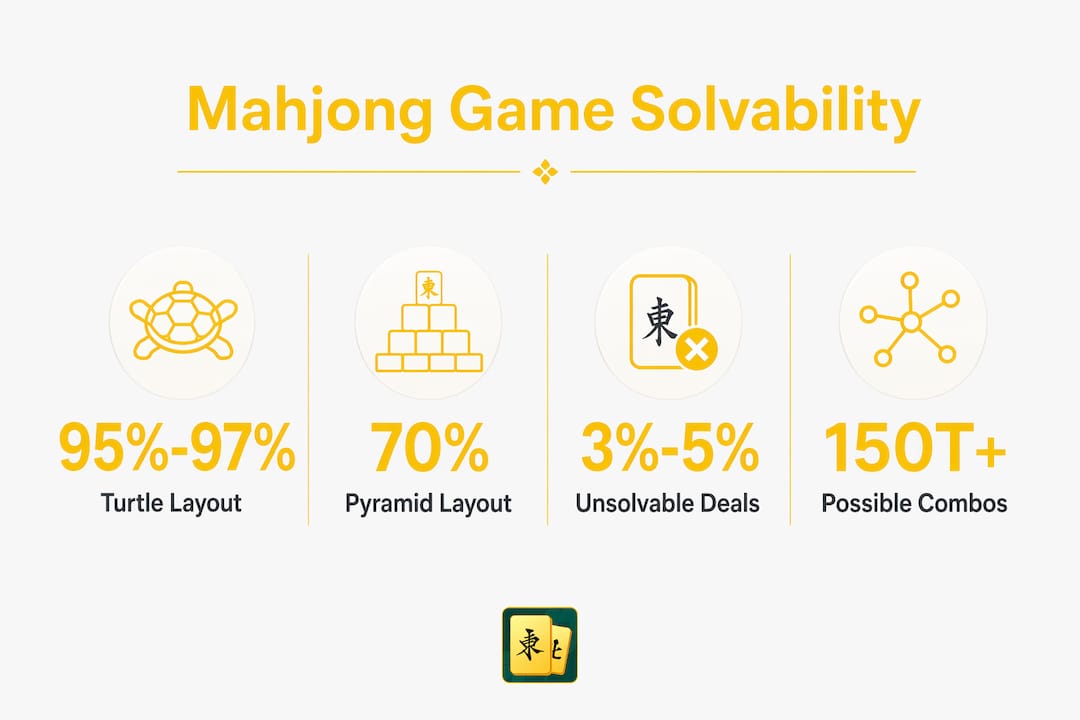
Solvability ranges from 70% to 97% depending on layout type. That spread is significant. It means the layout you start with matters more than most players realize.
How layout geometry determines solvability
The classic turtle layout is the most studied. Approximately 3%–5% of turtle layout deals are unsolvable from the start, even with perfect play. That means 95%–97% are winnable, but a small fraction are dead deals regardless of skill. Pyramid layouts carry a higher blocking risk because tiles stack in tall central columns with many tiles depending on the same buried pieces. Flat layouts spread tiles more evenly, which reduces dependency chains and raises solvability rates.
| Layout type | Approximate solvability | Key risk factor |
|---|---|---|
| Turtle | 95%–97% | Moderate central stacking |
| Pyramid | ~70% | High vertical dependency chains |
| Flat/spread | ~95%+ | Low stacking, fewer blocked tiles |
| Dragon | ~85% | Long horizontal dependency chains |
The vertical stacking trap
The most dangerous unsolvable mahjong pattern is the vertical twin trap. Two identical tiles stacked directly on top of each other create an impossible state. The top tile must be cleared before the bottom tile is accessible. But clearing the top tile requires pairing it with one of the other two identical tiles. If those other two tiles are buried elsewhere, you cannot free the top tile. The bottom tile stays locked forever. This is not a recoverable mistake. It is a structural flaw baked into the deal.
Pro Tip: Before matching any pair, scan the full board for vertical twins. If you spot two identical tiles stacked on each other, locate the other two copies immediately and plan your sequence around freeing them first.
Player choices that create dead ends
Not every unsolvable board is the developer's fault. Player decisions, especially in the first 20 moves, determine whether a winnable deal stays winnable. Matching pairs randomly produces a win rate of only about 5.9%. That number shows how quickly impulsive matching destroys a solvable board.
Dead ends from player mistakes follow predictable patterns:
- Matching flat tiles too early. Clearing tiles on the outer edges or lower layers before peeling the high central stacks traps essential tiles beneath the remaining pile. You run out of accessible matches while key tiles stay buried.
- Ignoring the four-tile rule. Every tile has four identical copies. Matching two tiles without tracking the other two can leave the remaining pair permanently blocked. Always locate all four copies before committing to a match.
- Prioritizing visible tiles over strategic ones. Matching the easiest pair feels productive. It often is not. Master players prioritize moves that free the most trapped tiles, not the most visible ones.
- Missing the 20–30 tile warning. Dead ends typically reveal themselves when 20–30 tiles remain, with no valid matches despite all tiles being exposed. By that point, the error happened 20 or more moves earlier.
Pro Tip: When you reach 30 tiles left and feel stuck, do not shuffle immediately. Spend 60 seconds tracing back which pair you matched that blocked your current options. That analysis builds the pattern recognition you need for future games.
How developers manage unsolvable deals
Game developers face a hard mathematical reality. Exhaustive solvability checking involves over 150 trillion combinations, making deterministic verification computationally impossible for most real-time applications. No algorithm can check every possible sequence before presenting a board to a player.
Instead, developers simulate numerous randomized plays to approximate solvability. A deal that survives thousands of simulated games without hitting a dead end is treated as solvable. This approach filters out most impossible deals but cannot guarantee perfection. The mahjong solvability algorithm behind these checks is a probabilistic filter, not a mathematical proof.
This creates a meaningful difference between game platforms:
- Platforms with solvability verification run background simulations before presenting each deal. Players rarely encounter inherently unsolvable boards.
- Platforms without verification shuffle tiles randomly. Some deals are impossible from the start, and players have no way of knowing until they hit a dead end.
Shuffle and undo features exist precisely because of this gap. Shuffle creates a new tile arrangement when the current board has no valid moves. Undo lets players backtrack from a bad decision. Both tools serve as safety nets, but they work best when players understand why they needed them in the first place.
Practical strategies to avoid unsolvable positions
Reducing your chances of hitting a dead end requires deliberate play from the first move. The following approach builds the habit of forward-thinking matching rather than reactive tile clearing.
- Scan all four tile copies before matching. Identify where each copy sits on the board. Match the pair that frees the most blocked tiles or exposes the most useful stack.
- Clear high stacks first. Central and vertical stacks hold the most dependency weight. Peeling them early opens more matching options and reduces the risk of trapping buried tiles.
- Avoid matching identical tiles on the same layer too early. If two copies of a tile sit side by side on the same flat layer, matching them removes two easy options. Save them as backup pairs while you work on harder stacks.
- Recognize locked tile pairs. If two tiles of the same type are both blocked by the same set of tiles, you have a dependency loop. Flag it early and plan your sequence to break the loop before it closes.
- Use hints as a diagnostic tool. A hint shows you one valid move. More useful is asking yourself why the hint chose that move. Understanding the logic behind a hint builds the tile matching sequence awareness that separates deliberate players from lucky ones.
Pro Tip: Treat every game as a planning exercise. Before making your first match, spend 30 seconds identifying the tallest stack and the most buried tile type. That 30 seconds changes your entire approach to the board.
The beginner strategy guide at Mahjong Online Club covers these sequencing principles in detail, with worked examples for common layout types.
Key Takeaways
Unsolvable mahjong games result from structural tile dependencies baked into the deal, compounded by player decisions that close off remaining options before the board is clear.
| Point | Details |
|---|---|
| Layout type determines base solvability | Pyramid layouts drop to ~70% solvability; turtle layouts reach 95%–97%. |
| Vertical twin traps are unrecoverable | Two identical tiles stacked on each other create a permanent lock no move sequence can resolve. |
| Player mistakes cause most dead ends | Matching randomly yields only a 5.9% win rate; strategic sequencing is the primary lever. |
| Developers use simulation, not certainty | Over 150 trillion combinations make exhaustive checking impossible; platforms vary in verification quality. |
| Scan all four copies before matching | Tracking all four identical tiles before committing to a pair prevents the most common dead-end trap. |
The part luck plays that most players never admit
I have spent a lot of time watching players blame themselves for unsolvable boards. They replay the game, second-guess every match, and assume they missed something. Sometimes they did. But sometimes the deal was dead before they touched a tile.
What I find genuinely interesting about Mahjong Solitaire is that it sits at the intersection of pure randomness and pure logic. The initial shuffle is random. Everything after that is a graph problem with a right answer, or no answer at all. That duality is what makes the game so compelling and so frustrating in equal measure.
The players who improve fastest are the ones who stop treating every loss as a personal failure. They ask a better question: "Was this board solvable, and did I play it correctly?" If the board was solvable and they lost, that is a skill gap worth addressing. If the board was a dead deal, that is information about the platform, not about their ability.
Unsolvable games are not wasted time. They are the clearest possible demonstration of how tile dependencies work. Every dead end teaches you something about the dependency chain you failed to break. I have learned more from losing on a solvable board than from winning on an easy one. The losses show you exactly where your pattern recognition breaks down.
Embrace the dead ends. They are the most honest feedback the game can give you.
— Dmytro Romaniuk
Play verified, solvable Mahjong games for free
Knowing why boards fail is only half the work. The other half is practicing on boards where your skill, not a random shuffle, determines the outcome.
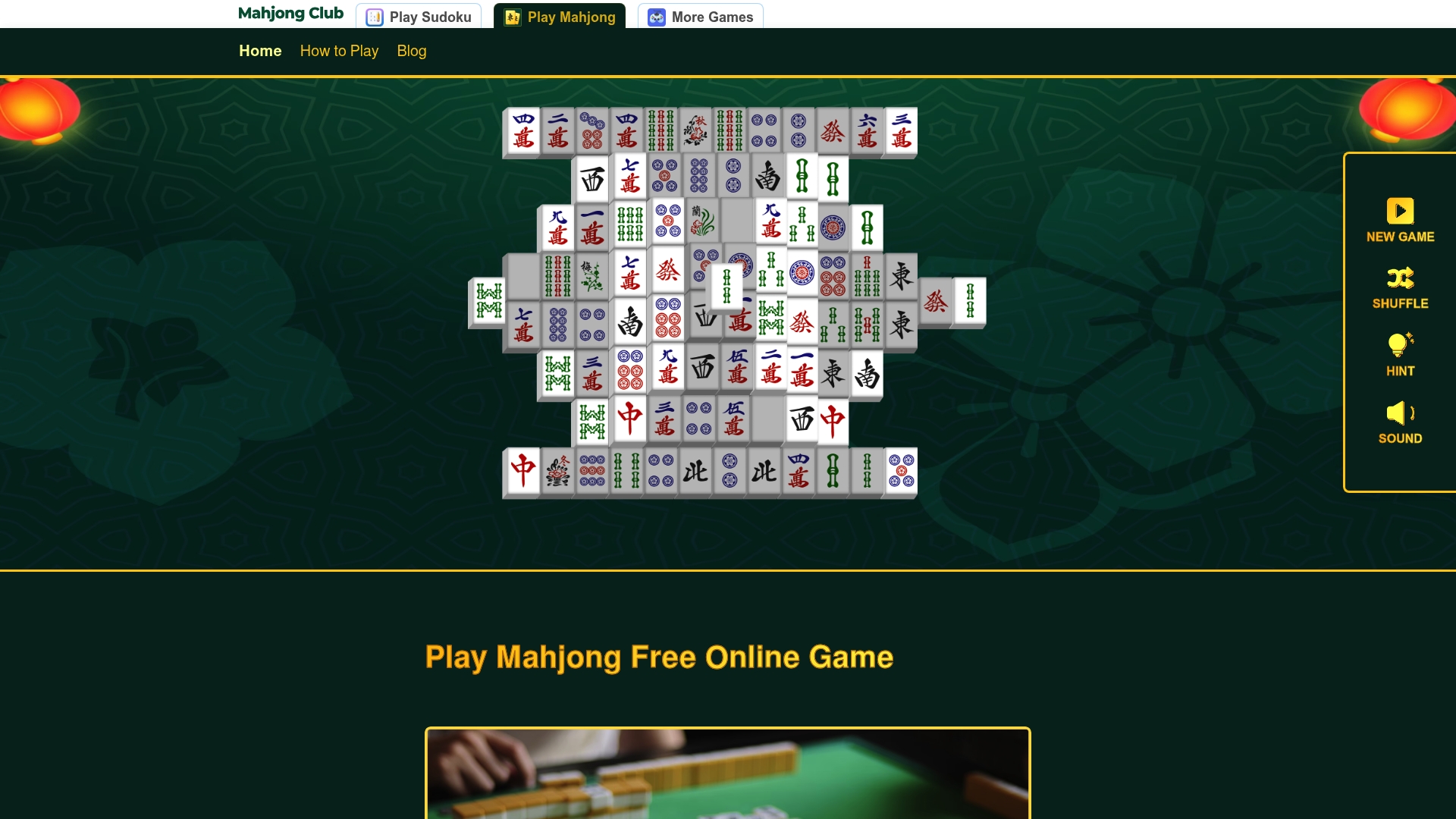
Mahjong Online Club offers free Mahjong Solitaire with no registration required, playable directly in your browser. Every deal goes through solvability verification before it reaches you, so you are always playing a winnable board. The platform includes undo, hints, and shuffle features designed as learning tools, not shortcuts. If you want to build real pattern recognition and test the strategies covered here, the rules and strategy guide is a strong starting point. No ads, no distractions, just the puzzle.
FAQ
What percentage of mahjong games are unsolvable?
Approximately 3%–5% of standard turtle layout deals are unsolvable from the start, even with perfect play. Solvability rates vary by layout, ranging from roughly 70% for pyramid layouts to 97% for turtle and flat designs.
Why do mahjong puzzles fail even when tiles are still available?
A mahjong puzzle fails when all remaining tiles are blocked by dependency chains that cannot be resolved. The most common cause is a vertical twin trap, where two identical tiles are stacked on each other with no accessible matching pair to free them.
How do developers prevent unsolvable mahjong deals?
Developers run large-scale randomized simulations to filter out deals that consistently hit dead ends. Because exhaustive checking covers over 150 trillion combinations, simulation is the practical standard. Not all platforms apply this verification, which is why solvability guarantees vary.
Can strategic play eliminate the risk of an unsolvable board?
Strategic play eliminates player-caused dead ends but cannot fix a structurally unsolvable deal. Scanning all four tile copies before matching and clearing high stacks first are the two most effective habits for keeping a winnable board winnable.
When do most players realize a mahjong board is unsolvable?
Dead ends typically reveal themselves when 20–30 tiles remain and no valid matches exist despite all tiles being exposed. By that point, the critical error usually occurred 20 or more moves earlier in the game.
Recommended
Similar Articles

Mahjong Game Versions: Key Differences Explained
Explore the key differences between mahjong game versions to choose the best one for you. Master the rules and enhance your gameplay!

Why Mahjong Improves Memory: What Science Says
Discover why mahjong improves memory with science-backed insights. Unleash cognitive benefits and enhance your brain health today!

Mahjong Game History: Origins, Evolution, and Variants
Discover what is mahjong game history, tracing its origins in 19th-century China to its global evolution and diverse variants. Join the fun!