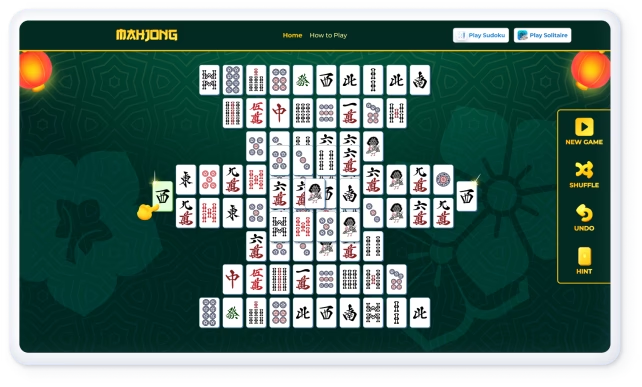
Mahjong Solvability Algorithm: How It Works

Mahjong Solvability Algorithm: How It Works
A mahjong solvability algorithm is a decision procedure that determines whether a given Mahjong solitaire board can be completely cleared by sequentially matching and removing tile pairs according to game rules. Understanding what is mahjong solvability algorithm means confronting one of the more interesting problems in combinatorial game theory: the question is formally NP-complete under perfect information, meaning no known algorithm solves it efficiently for all possible board configurations. Real software sidesteps this barrier through heuristics, retry loops, and fallback strategies. The gap between theoretical hardness and practical playability is exactly where the most useful engineering happens.
What does computational complexity tell us about mahjong solvability?
Computational complexity is the formal study of how hard a problem is for a computer to solve. Two complexity classes matter most here: NP and PSPACE.
NP-complete describes problems where verifying a solution is fast, but finding one may require exponential time. Perfect-information Mahjong solitaire is NP-complete for the decision problem: given a board where all tile positions are known, can all tiles be removed? This result means no algorithm is guaranteed to answer that question quickly for every possible layout.
PSPACE-complete is a harder class still. Maximizing removal probability is PSPACE-complete and PSPACE-hard to approximate within a factor of n raised to any positive constant. That result rules out even approximate solutions running in polynomial time unless complexity theory's foundational assumptions collapse.
Here is what these two results mean in practice:
- The decision version (can this board be cleared?) is NP-complete. Exact solvers face worst-case exponential time.
- The optimization version (what sequence maximizes clearing probability?) is PSPACE-complete. It is strictly harder than the decision version.
- Exact solvability checking requires worst-case exponential or space-heavy computation. Practical solvers rely on heuristics or layout restrictions instead.
- Solvability depends on problem formulation and game model. No universal algorithm fits all Mahjong variants.
The core lesson from complexity theory is not that Mahjong is unsolvable. It is that solving it exactly for arbitrary boards is computationally expensive enough that no production game engine attempts it directly.
This distinction shapes every design decision in Mahjong software. Developers do not wait for a provably correct answer. They build systems that produce solvable boards with high probability, then verify rather than prove.
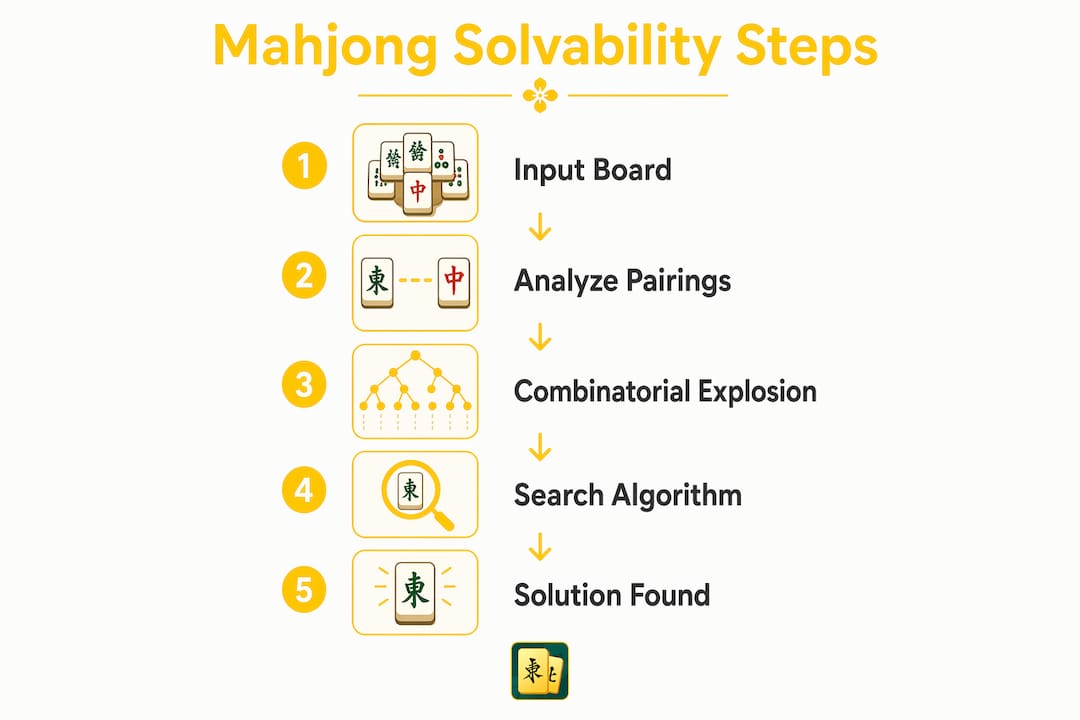
How is solvability modeled, and why does combinatorial explosion matter?

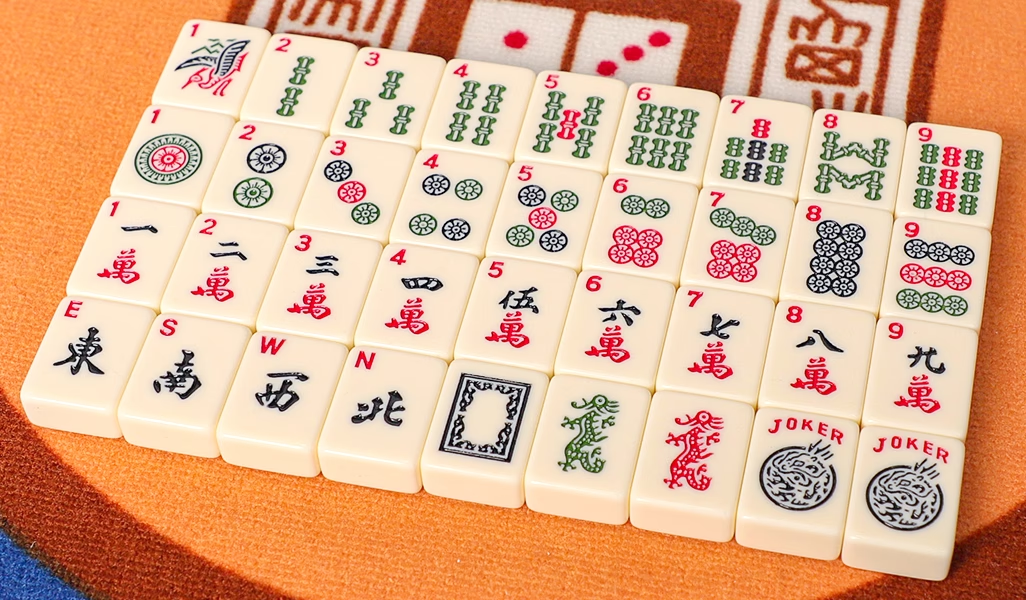
The mathematical structure of Mahjong solitaire centers on tile pairing. Each tile belongs to one of 36 categories, and each category contains exactly four tiles. To clear the board, every tile must be matched with one of its three identical counterparts.
Here is the core combinatorial challenge, step by step:
- Count the pairing options. For any group of four identical tiles, there are exactly three ways to pair them into two matched pairs.
- Multiply across all categories. With 36 categories and 3 options each, the total number of pairing configurations is 3^36, approximately 1.5 × 10^17. That is roughly 150 quadrillion combinations.
- Recognize the impossibility of exhaustive search. Checking every configuration at even one billion operations per second would take over four years of continuous computation. No game engine can afford that per board.
- Separate pairing from move order. The order of removal does not affect the final solvability outcome once pairings are fixed. This is a critical insight. It means the search space is defined by pairing choices, not by the sequence of moves.
- Focus the search on pairing patterns. State space reduction by reformulating the game as a pairing and removal dependency problem reduces complexity. The space remains large, but it is far more tractable than tracking every possible move sequence.
- Apply pre-compression. Effective solvers focus on which tiles are accessible given the current board layout, pruning branches where blocked tiles make a pairing physically impossible regardless of the abstract pairing choice.
Pro Tip: When analyzing a Mahjong board manually, think in terms of pairing commitments rather than individual moves. Identify which tiles have only one valid partner accessible, and lock those pairings first. This mirrors how algorithmic solvers prune the search tree.
The combinatorial blow-up makes exhaustive search infeasible. That reality forces every practical implementation toward heuristics and randomized retry strategies rather than complete enumeration. Understanding this constraint is the foundation of mahjong algorithms explained in any serious software context.
How do real implementations generate solvable mahjong boards?
Production Mahjong software does not attempt to prove solvability from first principles. It verifies solvability through a two-layer system that combines fast board construction with a solver that checks the result.
The standard architecture works as follows:
- Layer 1: Constructive generation. The engine builds a board using a method designed to produce solvable layouts. This is fast but not guaranteed to succeed every time.
- Layer 2: Solvability validation. A solver runs on the generated board. If the board fails the check, the engine retries.
- Retry loops. Common implementations run
buildSolvableWithRetriesup to 2,000 attempts before switching strategies. That number reflects empirical tuning, not theoretical necessity. - Alternative strategies. After exhausting the primary retry budget, the engine switches to a different construction algorithm with its own retry loop.
- Random board fallback. If all else fails, the engine generates a random board and runs a solve check on it directly. This guarantees a playable board is always delivered.
Pro Tip: If you are building a Mahjong puzzle generator, start with a reverse-construction approach: place tiles in a known solvable order, then shuffle within constraints. This dramatically reduces the number of retries needed before finding a valid board.
The table below summarizes the three-stage fallback pattern used in production codebases:
| Stage | Method | Retry Limit | Fallback Trigger |
|---|---|---|---|
| Primary | Constructive solvable generator | Up to 2,000 | Solver validation fails |
| Secondary | Alternative construction strategy | Configurable | Primary budget exhausted |
| Tertiary | Random board plus solve check | Single pass | Secondary strategy fails |
This two-layer system with repeated retries and fallback strategies is the production standard for delivering solvable puzzle boards. The engineering mindset here is deliberate: do not prove solvability in advance. Build fast, verify quickly, and retry when needed. That approach aligns with what complexity theory predicts. Exact proofs are expensive. Verification is cheap.
How does solvability knowledge improve mahjong game strategies and design?
Understanding how solvability works changes both how developers build games and how players approach solving mahjong puzzles. The two perspectives reinforce each other.
From a player strategy standpoint, solvability insights translate directly into better decision-making:
- Prioritize exposed tiles with limited partners. If a tile has only one accessible match, that pairing must be made at some point. Delaying it risks blocking the board.
- Avoid isolating tile groups. Removing tiles that expose no new tiles reduces your future options without improving your position. This concept is explored in depth in the context of tile isolation and why it undermines solvability.
- Think in layers, not individual moves. Solvability depends on pairing commitments across the whole board. Players who plan two or three moves ahead consistently outperform those reacting to single-tile opportunities.
- Use shuffle features strategically. Most digital Mahjong games offer a shuffle or hint function. These features rely on the same solvability algorithms running in the background to confirm a valid path still exists.
From a game design standpoint, solvability algorithms determine the quality of the player experience:
- Layouts generated without solvability checks frequently produce unwinnable boards. Players who encounter these lose confidence in the game, not in their own skill.
- Tile arrangement directly affects difficulty. Designs that expose fewer tiles early force players into narrower decision trees, increasing the effective complexity of solving mahjong puzzles.
- Hidden information variants, where tile faces are concealed until uncovered, shift the problem from NP-complete decision-making to probabilistic reasoning. This changes the character of the game entirely.
- Developers who understand mahjong AI algorithms can tune difficulty by adjusting how aggressively the constructive generator favors layouts with multiple valid solution paths.
The connection between algorithmic theory and player experience is direct. A board generated with a robust solvability algorithm gives you a fair puzzle. A board generated without one may be impossible, and you will never know why you failed.
Key takeaways
The mahjong solvability algorithm is NP-complete for decision problems and PSPACE-complete for optimization, making heuristic and retry-based methods the only practical path to solvable boards in production software.
| Point | Details |
|---|---|
| Complexity class matters | Deciding solvability is NP-complete; optimizing win probability is PSPACE-complete and harder to approximate. |
| Combinatorial explosion is real | With 3^36 possible pairing configurations, exhaustive search is computationally impossible for any real-time system. |
| Move order is secondary | Solvability depends on pairing choices per tile category, not on the sequence of individual moves. |
| Production systems verify, not prove | Real implementations use constructive generators plus solver validation with up to 2,000 retries and fallback stages. |
| Player strategy mirrors algorithm logic | Prioritizing tiles with limited partners and avoiding tile isolation directly reflects how solvability solvers prune search trees. |
Why theory alone will not help you build a better mahjong game
I have spent considerable time analyzing how Mahjong solvability gets implemented in practice, and the gap between the academic complexity results and what engineers actually ship is striking. The NP-completeness and PSPACE-completeness proofs are intellectually satisfying. They tell you something true and important about the problem. But they do not tell you how to build a game that players enjoy.
What I have found is that the retry-based approach is not a compromise. It is the right answer for this class of problem. When your search space has 150 quadrillion configurations, you do not need to explore all of them. You need a fast generator that succeeds most of the time, a cheap verifier that catches failures, and a fallback that guarantees delivery. That architecture is more reliable in production than any exact solver would be.
The insight that move order does not affect solvability once pairings are fixed is the most underappreciated result in this space. It means you can reduce a seemingly sequential problem to a combinatorial one, and combinatorial problems respond well to constraint propagation and pruning. If you are building a Mahjong solver or studying puzzle game complexity, start there.
My advice for anyone wanting to implement solvability checking: do not start with the complexity literature. Start with a working retry loop, instrument it to measure how often each fallback stage triggers, and tune from there. Theory tells you the ceiling. Measurement tells you where you actually are.
— Dmytro Romaniuk
Play mahjong puzzles built on solvable board generation
Every puzzle at Mahjong Online Club is generated using the kind of solvability-first approach described in this article. No board is served to you without passing a solver validation step. That means every game you start is winnable, and every failure is a strategy problem, not a broken layout.
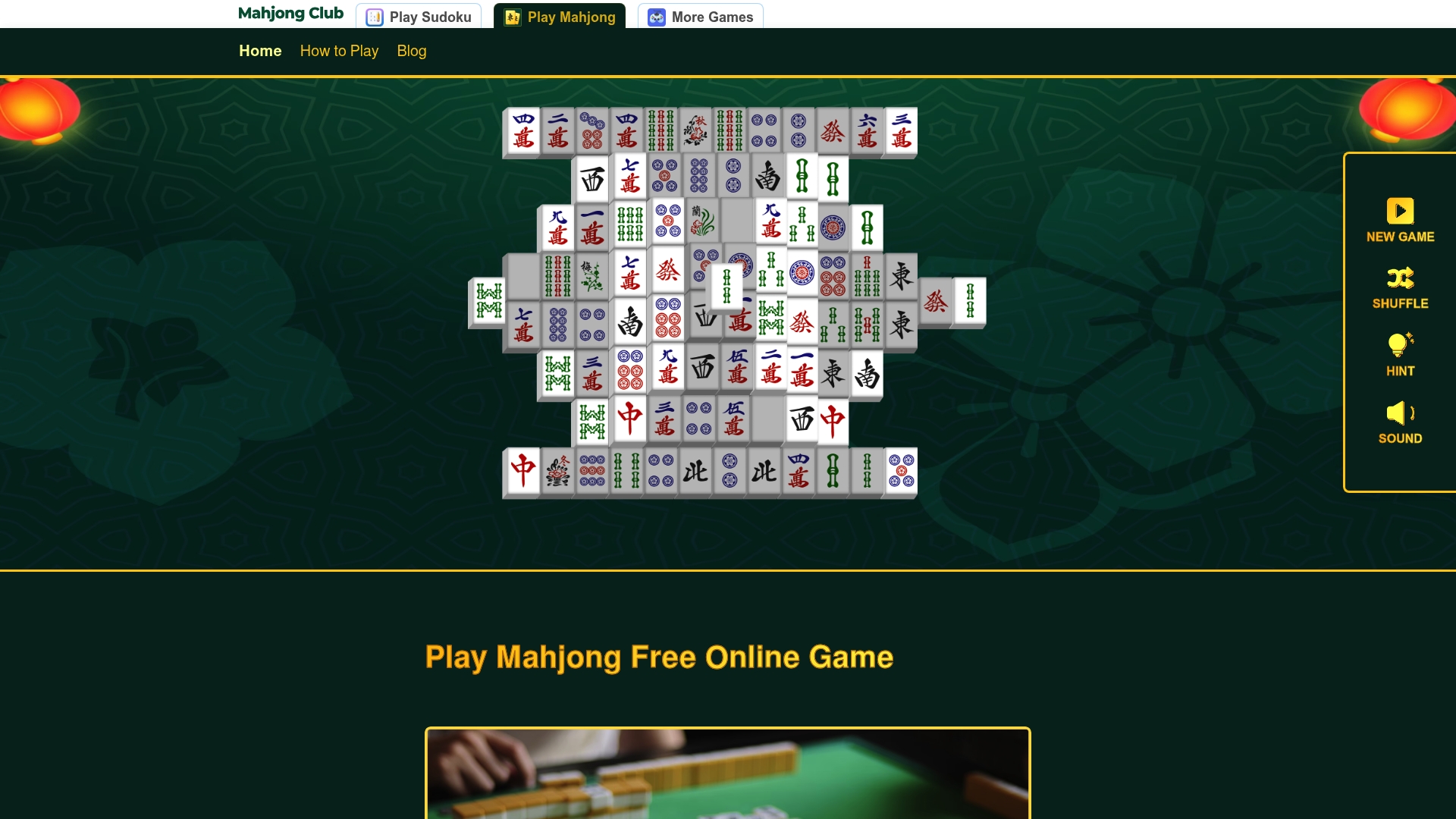
You can play free Mahjong directly in your browser with no registration required. The platform is built around a distraction-free experience designed to support focus and pattern recognition. If you want to put the algorithmic concepts here into practice, this is the place to do it.
FAQ
What is a mahjong solvability algorithm?
A mahjong solvability algorithm is a computational procedure that determines whether a Mahjong solitaire board can be completely cleared by matching and removing all tile pairs. The decision version of this problem is formally NP-complete under perfect information.
How does mahjong solvability work mathematically?
Solvability depends on pairing choices across 36 tile categories, each offering 3 possible pairings, producing roughly 150 quadrillion total configurations. Because move order does not change the outcome once pairings are fixed, solvers focus on pairing constraints rather than move sequences.
Why can't software solve mahjong boards exactly every time?
Exact solvability checking requires worst-case exponential computation, which is impractical for real-time game engines. Production systems use constructive generators with retry loops of up to 2,000 attempts and fallback stages to guarantee a playable board without exact proof.
What is the difference between np-complete and pspace-complete in mahjong?
The decision problem (can this board be cleared?) is NP-complete. The optimization problem (what sequence maximizes clearing probability?) is PSPACE-complete, which is a strictly harder class that also rules out efficient approximation algorithms.
How do mahjong game strategies connect to solvability algorithms?
Players who prioritize tiles with limited accessible partners and avoid isolating tile groups are applying the same constraint-pruning logic that algorithmic solvers use. Understanding how solvability is structured makes strategic decisions more deliberate and less reliant on guesswork.
Recommended
Similar Articles

How Mahjong Circle Tiles Work: Beginner's Guide
Discover how Mahjong circle tiles work in this beginner's guide. Master the Dots suit to enhance your game strategy and win more hands!
Riichi mahjong rules: A step-by-step beginners guide
Expert guide to Riichi mahjong rules with step-by-step instructions, scoring basics, and pro tips. Data-backed, trusted references, and practical examples.
Riichi Mahjong Yaku List: Examples, Points, and Tips
Expert guide to Riichi Mahjong yaku list with clear examples, points, and scoring. Data-backed tips and pro insights to improve results fast.