What Is the Goal of Mahjong? Rules and Strategy

What Is the Goal of Mahjong? Rules and Strategy
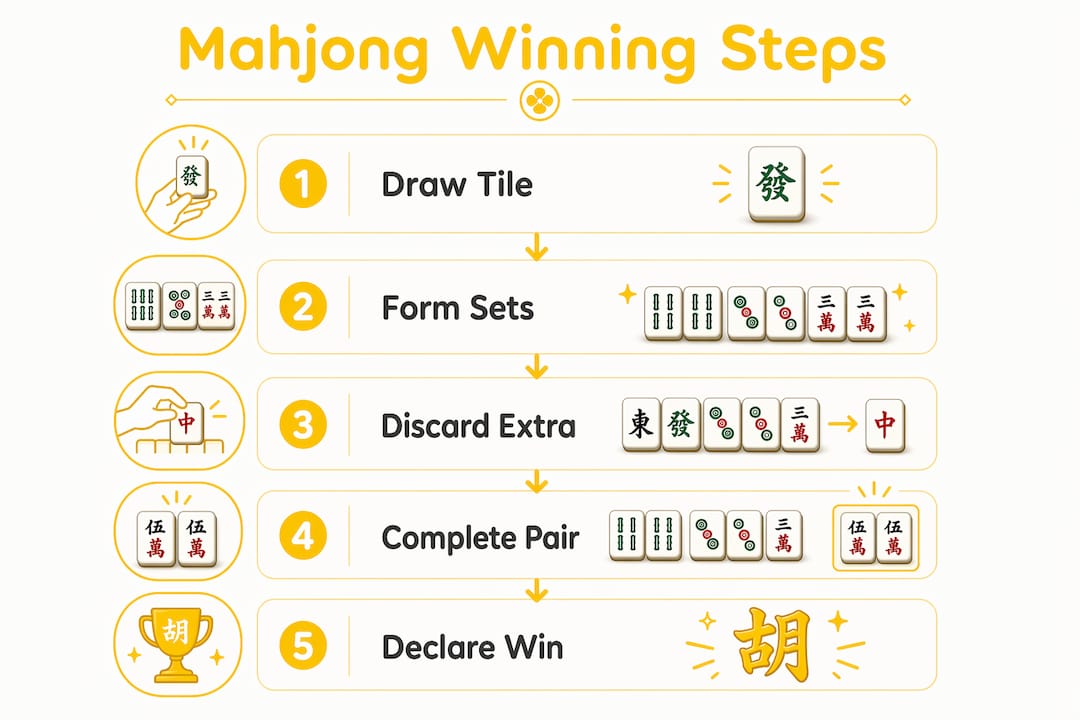
The goal of Mahjong is to be the first player to complete a legal winning hand of 14 tiles, arranged as four sets and one pair. This objective, known formally as a "winning hand" or "hu" in Chinese variants, drives every draw, discard, and decision you make at the table. The sets are called melds, and the pair is called the eyes. Before you can think about strategy or scoring, you need to understand this core structure. Everything else in Mahjong, from reading opponents to calculating points, builds on top of this single objective.
What is the goal of Mahjong and how does a winning hand work?
A legal winning hand requires 14 tiles arranged as four sets of three tiles each, plus one pair, totaling 14 tiles. This structure is the foundation of every Mahjong variant you will encounter, from Hong Kong to Riichi to American Mahjong. The pair, often called the "eyes," is the glue that holds the hand together.
The three types of sets you can form are:
- Chow: Three consecutive numbered tiles from the same suit. For example, 3, 4, and 5 of Bamboo.
- Pung: Three identical tiles. For example, three Red Dragons.
- Kong: Four identical tiles. A Kong counts as a set of three but requires an extra tile draw to compensate.
You build your hand by drawing tiles from the wall on your turn and discarding one tile you do not need. You can also claim certain tiles discarded by opponents to complete a meld, though the rules for claiming vary by variant. Winning happens in two ways: self-draw, where you complete your hand by drawing the final tile yourself, or a discard win, where an opponent discards the tile you need to complete your hand.
Pro Tip: Track which tiles you have already seen discarded. If three copies of a tile are already on the table, the fourth will never appear, so drop any partial set depending on that tile immediately.
How do Mahjong game objectives shape winning strategy?
Understanding the mahjong game objectives is not enough on its own. You need to translate that objective into a practical plan each round. Winning in Mahjong depends on completing a specific hand shape before your opponents while balancing speed against scoring potential. These two factors are constantly in tension.
Here are the four strategic principles that flow directly from Mahjong's core objective:
Prioritize tile efficiency. Every tile you hold should either complete a set, contribute to a partial set, or serve as your pair. Tiles that do none of these are discard candidates. Holding onto "maybe useful" tiles slows your tempo and gives opponents more time to complete their own hands.
Aim for flexible hand shapes early. The Mixed One Suit hand, which uses tiles mostly from one suit plus honor tiles, is a strong intermediate choice because it meets minimum scoring thresholds in many variants while remaining achievable. Locking yourself into a rare, high-value hand early in the game is a common beginner mistake.
Shift from offense to defense when needed. Reading opponents' discards to deduce what they need and adjusting your own discards defensively is as critical to winning as assembling your own hand. If an opponent is clearly close to completing a hand, stop discarding tiles that could feed them a win.
Choose fast wins over ambitious ones. Experts recommend pursuing simpler hands that can be completed quickly rather than complex high-value hands that are less likely to be achieved first. A guaranteed win at lower points beats a failed attempt at a spectacular hand every time.
Pro Tip: When you are two or three tiles away from completing your hand, count how many copies of your needed tiles are still live. If fewer than two remain unseen, pivot to an alternative hand shape rather than waiting.
The strategic depth of Mahjong comes from the fact that multiple skill domains interact simultaneously. Hand construction, reading opponents, defensive play, and scoring awareness all connect. Improving one area accelerates improvement in the others.
How do Mahjong variants differ in their objectives and rules?
The core mahjong winning conditions stay consistent across variants: form a legal hand first. What changes is how "legal" is defined and how points are calculated. Understanding these differences helps you adapt when you switch between versions.
| Variant | Core objective | Key difference | Scoring system |
|---|---|---|---|
| Hong Kong Mahjong | Four melds plus one pair | Minimum faan (point) threshold required to declare a win | Fan-based; each hand element adds points |
| American Mahjong | Match a hand from the official card | Must match one of the National Mah Jongg League (NMJL) pattern cards exactly | Fixed point values per card pattern |
| Riichi Mahjong | Four melds plus one pair | Players can declare "riichi" when one tile away, locking their hand for bonus points | Han and fu system; complex multipliers |
| Traditional Chinese | Four melds plus one pair | Fewer restrictions; simpler scoring thresholds | Varies by regional rules |
American Mahjong is the most structurally different variant. Instead of freely building any valid meld-and-pair combination, players must match one of the hands printed on the annual NMJL card. This makes the game more pattern-dependent and less improvisational. If you want to learn American Mahjong patterns in depth, the NMJL card guide at Mahjong-online is a practical starting point.
Riichi Mahjong, popular in Japan and growing internationally, adds a declaration mechanic. When you are one tile away from winning and your hand is closed, you can declare "riichi," which locks your hand but awards bonus scoring multipliers. This creates a risk-reward decision that does not exist in other variants. You can explore the full Riichi Mahjong rules to see how the declaration system works in practice.
What cognitive benefits come from pursuing Mahjong's goal?
The goal of playing Mahjong is not purely competitive. The mental demands of the game produce measurable cognitive benefits, particularly for older adults. Playing Mahjong regularly helps develop mental agility and provides social interaction benefits that few other games can match. This is one reason Mahjong-online specifically researched the cognitive effects of tile-matching gameplay when designing its platform.
The five core cognitive and social benefits of Mahjong are:
- Working memory: Tracking which tiles have been discarded, which are still live, and what your opponents might need requires holding multiple data sets in mind simultaneously.
- Pattern recognition: Identifying partial sets and projecting which tiles complete them trains the brain to spot structure within complexity.
- Probability calculation: Estimating the likelihood that a needed tile will appear based on visible discards is an applied math skill that sharpens with practice.
- Strategic thinking: Balancing offense and defense, and deciding when to pivot your hand shape, builds executive function and decision-making under uncertainty.
- Social engagement: In multiplayer formats, reading opponents, managing table dynamics, and communicating through gameplay creates meaningful social interaction.
"Mahjong involves multiple skill domains — hand construction, reading, defense, scoring, and mental game — with winning relying on linking several skills, not just hand-building." — Mahjong Pros
These benefits compound over time. The more rounds you play, the more automatic your pattern recognition becomes, which frees up mental bandwidth for higher-level decisions like reading opponents and managing risk.
Key takeaways
Mahjong's goal is to complete a legal 14-tile hand of four melds and one pair, and every strategic decision in the game flows from that single objective.
| Point | Details |
|---|---|
| Core winning condition | Complete four sets (Chow, Pung, or Kong) plus one pair totaling 14 tiles. |
| Speed beats complexity | A fast, simple win outperforms a slow, high-scoring hand in most situations. |
| Defense is half the game | Reading opponent discards and protecting your own position is as important as building your hand. |
| Variants change the rules | American Mahjong uses pattern cards; Riichi Mahjong adds declaration mechanics; scoring systems differ significantly. |
| Cognitive payoff is real | Regular play builds working memory, pattern recognition, and strategic thinking across all age groups. |
Why most beginners misunderstand what Mahjong is actually asking of them
I have watched a lot of new players sit down at a Mahjong table with the same assumption: the goal is to score as many points as possible. That framing causes more losses than any other single mistake. The actual goal is to win the hand first. Points are secondary.
This distinction matters more than it sounds. When you chase a high-scoring hand, you hold tiles longer, discard less efficiently, and give opponents more time and information. I have seen players lose winnable rounds because they were three tiles into building a beautiful hand that had maybe a 10% chance of completing before someone else declared victory.
The players who improve fastest are the ones who internalize that Mahjong rewards disciplined decision-making, not ambition. Flexibility is the real skill. Knowing when to abandon a promising hand shape and pivot to something faster is what separates consistent winners from players who occasionally get lucky. You can read more about building that kind of disciplined approach in the beginner strategy guide at Mahjong-online.
The cognitive benefits I described earlier are not a side effect of playing Mahjong. They are a direct result of the game forcing you to make these kinds of trade-off decisions under pressure, round after round. That is what makes Mahjong worth learning properly.
— Dmytro
Practice the goal of Mahjong directly in your browser
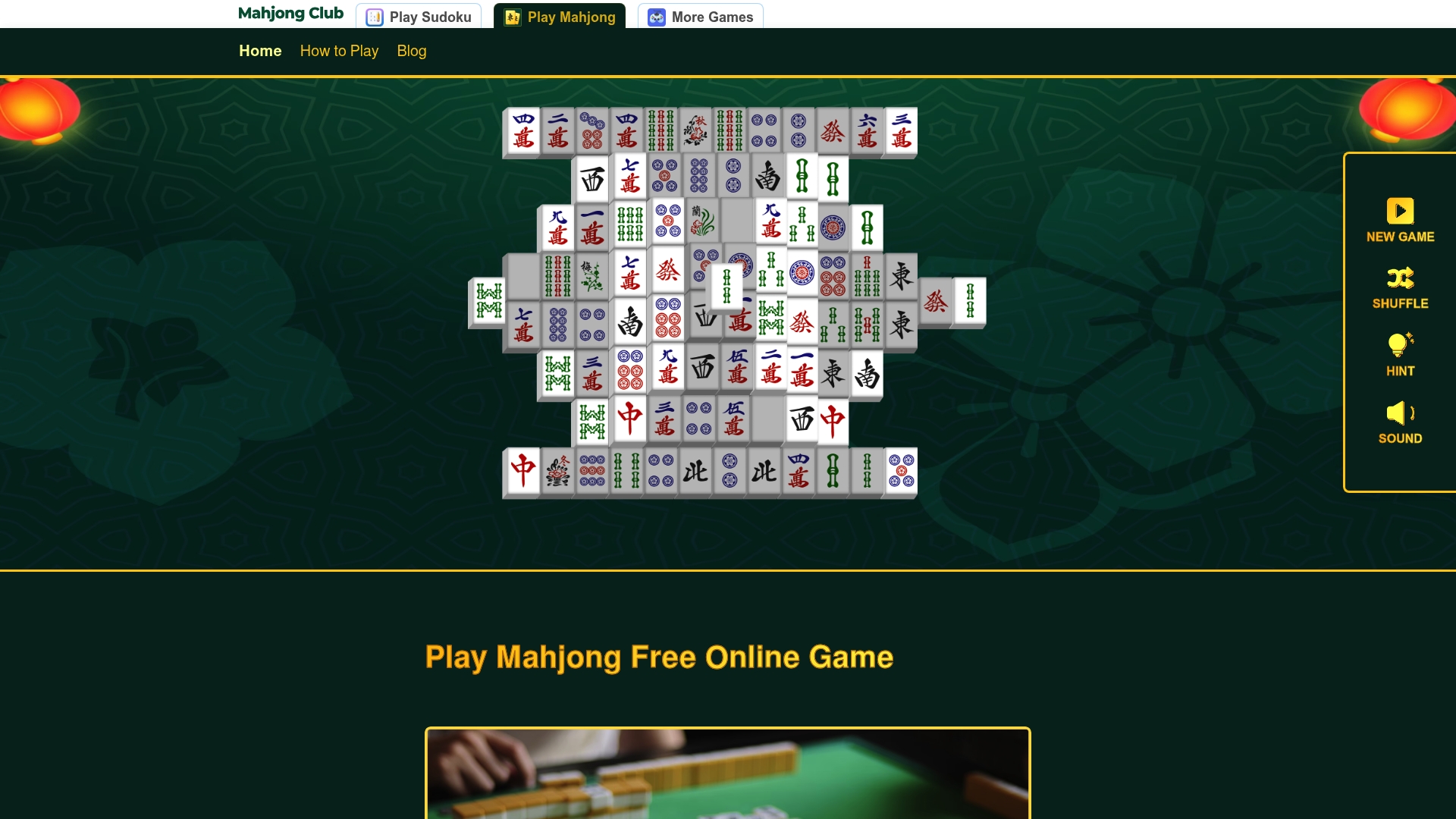
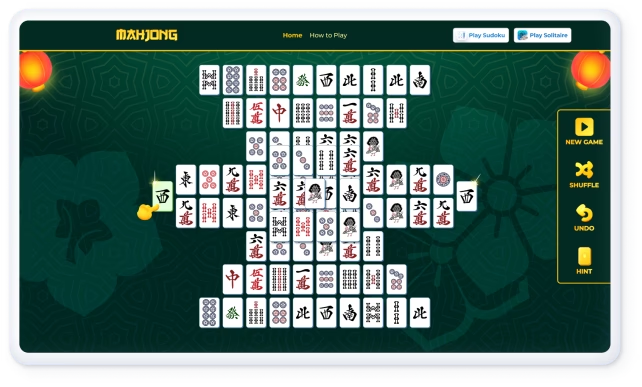
The fastest way to internalize Mahjong's objectives is to play. Mahjong-online offers a free, browser-based tile-matching experience with no registration required and no ads interrupting your focus. The platform uses classic tile sets and a clean interface designed specifically for players who want to build pattern recognition and strategic thinking without distraction. Every concept covered in this article, from identifying valid sets to managing tile efficiency, becomes clearer after a few rounds of actual play. Start playing now and put the rules into practice immediately. If you want a structured introduction to the mechanics first, the how to play guide walks you through every rule step by step.
FAQ
What is the main goal of Mahjong?
The goal of Mahjong is to be the first player to complete a legal winning hand of 14 tiles, arranged as four sets (melds) and one pair (eyes). Sets can be Chows, Pungs, or Kongs depending on the tiles available.
How many tiles do you need to win at Mahjong?
A winning hand requires exactly 14 tiles: four sets of three tiles each and one pair. In the case of a Kong, the set uses four tiles but an extra draw compensates for the additional tile.
Do Mahjong rules differ between variants?
Yes. Hong Kong Mahjong requires a minimum point threshold to declare a win, American Mahjong requires matching a hand from the official NMJL card, and Riichi Mahjong allows players to declare "riichi" when one tile away from winning for bonus scoring.
Is Mahjong a game of skill or luck?
Mahjong combines skill, strategy, and luck. Tile draws involve chance, but hand construction, defensive play, and reading opponents are learnable skills that consistently improve your win rate over time.
What is the fastest way to win at Mahjong?
Pursuing simpler, faster hands rather than complex high-scoring ones produces the most consistent wins. Tile efficiency, two-sided waits, and flexible hand shapes all reduce the number of draws needed to complete a legal hand.