Chinese mahjong vs American mahjong: rules, tiles, scoring
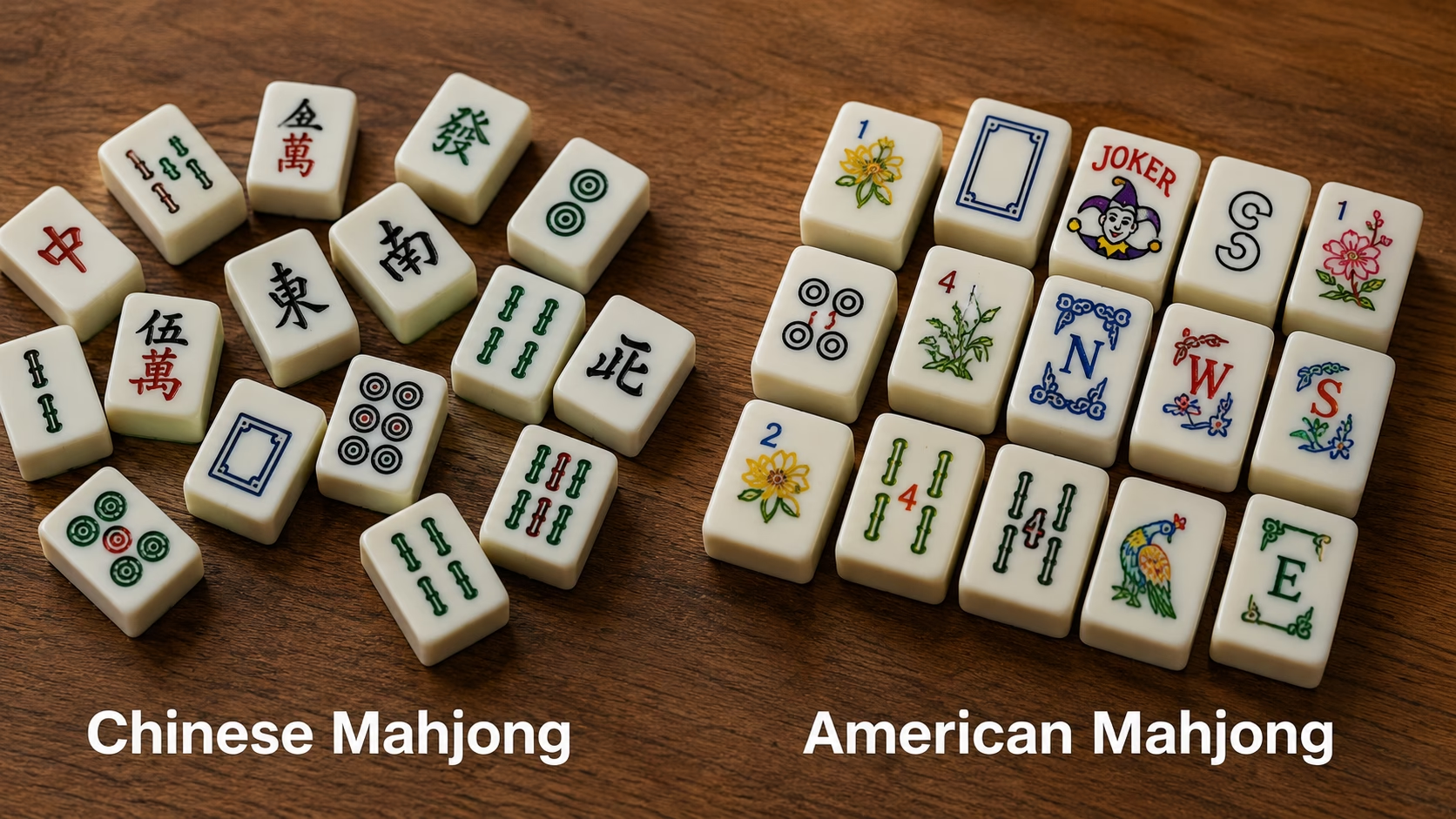
Table of Contents
- Chinese mahjong vs American mahjong: the fast differences that matter
- How the tiles differ — counts, jokers, and flowers
- Comparison table: rules, tiles, and scoring side by side
- How the flow of play differs, start to finish
- What is the NMJL card and why it changes everything
- How Chinese Official (MCR) scoring works and why it rewards versatility
- Charleston in mahjong: what it is and how to use it (American rules)
- Jokers in American mahjong: precise do’s and don’ts
- Mahjong tiles explained: reading suits, honors, and bonuses
- Mahjong scoring comparison: concrete examples
- Why Chinese mahjong vs American mahjong feels different for learners
- From real tables: coaching mixed groups on both systems
- Who should choose which — a practical selector
- Common pitfalls and how to avoid them
- Choosing a club set and getting started
- Key Takeaways
Chinese mahjong vs American mahjong differ in tiles, rules flow, and how hands score. American uses jokers and a yearly hands card; Chinese relies on pattern points and no jokers. Choose based on whether you prefer fixed hands or open pattern-building.
If you’ve ever switched between a National Mah Jongg League (NMJL) night and a Chinese Official (MCR) table, you feel the contrast fast: jokers and the Charleston vs fan-based scoring and flexible sets. I teach both, and players thrive once they match their style to the right ruleset. For a quick at-a-glance difference, see the comparison.
Chinese mahjong vs American mahjong: the fast differences that matter
- Tiles: American adds jokers (wilds) and leans on 152 tiles; Chinese Official plays 144 tiles with no jokers.
- Hand structure: American hands must match the NMJL annual card exactly; Chinese hands accrue points from recognized patterns and must meet a minimum.
- Scoring: American assigns fixed payouts per listed hand; Chinese Official uses fan values with an 8-point minimum.
- Flow: American introduces the Charleston (pre-game passes); Chinese begins play immediately after the deal.
- Pace: American games often finish hands faster once players memorize the card; Chinese hands take longer to assemble but reward tactical flexibility.
According to Wikipedia’s overview of mahjong, the game is played by tens of millions globally and spans multiple rulesets, with Chinese Official codified for international play. The NMJL, founded in 1937 per Wikipedia’s NMJL entry, anchors American rules with a new card each year.
How the tiles differ — counts, jokers, and flowers
- Chinese Official mahjong (MCR): 144 tiles
- Suits: 36 Dots, 36 Bamboos, 36 Characters (108 total)
- Honors: 16 Winds, 12 Dragons (28 more; subtotal 136)
- Bonus: 8 Flowers/Seasons (total 144)
- Jokers: none
- American mahjong (NMJL): 152 tiles
- Same suits and honors as above (136)
- Bonus: 8 Flowers (144)
- Jokers: 8 wild tiles (total 152)
Why this matters:
- Jokers in American mahjong speed up big sets (pungs/kongs/quints) and enable the annual hands card. They cannot form pairs and cannot stand in sequences.
- No jokers in Chinese Official raises the skill ceiling on tile efficiency, defense, and reading discards.
- Flowers score bonuses in both, but they’re more integral to bonus math in Chinese variants.
Comparison table: rules, tiles, and scoring side by side
| Feature | Chinese Official (MCR) | American (NMJL) |
|---|---|---|
| Total tiles | 144 | 152 |
| Jokers | None | 8 jokers (wild for sets; not for pairs/sequences) |
| Flowers/Seasons | 8, bonus scoring | 8, bonus and some hand interactions |
| Hand construction | Flexible pattern-building to reach 8+ points | Must match a hand on the annual NMJL card |
| Scoring basis | Fan points per pattern; 8-point minimum to go out | Fixed payouts per hand on the card; doubles for conditions |
| Pre-game passes | None | Charleston (two rounds of three passes + optional courtesy) |
| Meld calling | Chow only by next-in-turn; any can call pung/kong | Calls follow exposure rules matching the card |
| Strategy feel | Tactical flexibility; defensive reading | Pattern targeting; joker management |
How the flow of play differs, start to finish
- Setup
- Chinese Official: Build walls, deal 13 tiles each (dealer 14). No passes. Dealer discards to start.
- American: Build walls, deal per NMJL procedure, then run the Charleston passes before the first discard.
- Turns
- Chinese Official: Draw one, discard one. Any player may call a discard for pung/kong; only next player may call for chow.
- American: Draw and discard similarly, but exposures must align to a hand on the card. Discard claims prioritize mahjong, then exposures.
- Ending a hand
- Chinese Official: Declare mahjong when reaching at least 8 fan via recognized patterns.
- American: Declare mahjong only when your tiles match a listed hand exactly (with permitted joker use).
As Karen Wolff, NMJL-certified teacher and MCR referee, explains: “American players manage risk through the card and jokers; Chinese specialists manage risk through tile efficiency and reading what the wall and discards are telling you.”
What is the NMJL card and why it changes everything
- The NMJL rules revolve around a yearly “hands card.” Each line is a valid hand with a payout value.
- You chase one or two candidate hands early, then narrow as tiles arrive.
- The card encodes structure: pairs, pungs, kongs, quints, and specific sequences. You cannot improvise outside these patterns.
Practical impact:
- Memorization pays. Experienced players recall 50–70% of the card after a few weeks.
- Defense is visible. Opponents can often read which section you’re chasing by your exposures.
- Variance control. Fixed payouts limit runaway scoring and keep games brisk.
How Chinese Official (MCR) scoring works and why it rewards versatility
- Threshold: You must reach 8 points (fan) to declare mahjong.
- Patterns: About 80+ scoring patterns cover chows, pungs, kongs, honors, terminals, concealed hands, and special shapes.
- Stacking: You stack multiple patterns in one hand to clear the 8-point bar and improve your margin.
Example high-value patterns:
- All Pungs, Mixed or Pure (multiple fan)
- All Simples (2–8–8), All Terminals and Honors
- Big Three Dragons, Big Four Winds (limit hands)
Why this engages advanced skill:
- You pivot mid-hand as the wall and discards reveal feasibility.
- Defense matters: folding against evident limit threats saves points.
- Tile efficiency and safe tiles knowledge separate experts from intermediates.
For cultural and historical context on the game’s evolution, see coverage at The New York Times and BBC. For canonical rule baselines across variants, start with Wikipedia’s mahjong page.
Charleston in mahjong: what it is and how to use it (American rules)
- Sequence: Two rounds of three passes (right, across, left; then left, across, right), followed by an optional courtesy pass with the opposite player.
- Purpose: Sharpen your target hand by shedding off-pattern tiles and gathering sets aligned with the card.
- Tactics:
- Keep flexible: retain numbers and suits that fit multiple card lines.
- Avoid telegraphing: pass mixed tiles to conceal your focus section.
- Hold potential pairs; pairs are a bottleneck because jokers cannot make pairs.
Jokers in American mahjong: precise do’s and don’ts
- Jokers can substitute in pungs, kongs, and quints.
- Jokers cannot be used in sequences (runs) or as the pair (the eye) of your hand.
- You may exchange a matching natural tile for an exposed joker on an opponent’s rack during your turn.
- Strategy: Value jokers highest in hands with many sets; their marginal value plummets in run-heavy lines.
Mahjong tiles explained: reading suits, honors, and bonuses
- Suits: Dots (Circles), Bamboos (Bams), Characters (Craks)
- Honors: Winds (E, S, W, N) and Dragons (Red, Green, White)
- Bonuses: Flowers and Seasons (scoring bonuses; sometimes used in set requirements on the NMJL card)
- In Chinese Official mahjong, flowers add bonus points and may grant replacement draws. In American, flowers can be essential parts of certain listed hands.
Mahjong scoring comparison: concrete examples
Example 1 — American (NMJL rules):
- Target: A hand requiring two kongs, one pung, a pair, and specific numbers; printed value 30.
- You expose a kong with one joker, later add a pure pung, and finish with a closed pair.
- Payout: Table pays the fixed 30. Add doubles for self-pick or other conditions per the card notes.
Example 2 — Chinese Official (MCR):
- Final hand: All Simples (2 fan), All Pungs (6 fan), Seat Wind pung (1 fan). Total = 9 fan (≥8 minimum).
- If self-drawn, add the self-draw bonus. Opponents pay based on the final fan tally and table rules.
Key nuance:
- American scoring is binary success on a fixed template; difficulty is pre-priced.
- Chinese scoring scales with creativity and risk, rewarding pattern stacking and timing.
Why Chinese mahjong vs American mahjong feels different for learners
- Cognitive load:
- American: Heavier up front (memorizing the card), lighter mid-hand (follow the template).
- Chinese: Lighter up front (standard tiles), heavier mid-hand (evaluate pattern trees every turn).
- Defense:
- American: Read exposures against sections on the card; focus on not feeding pairs.
- Chinese: Track safe tiles, folded discards, terminal/honor concentration, and potential limit hands.
- Social pace:
- American: Faster, chat-friendly once hands are internalized.
- Chinese: More calculation moments, especially near 6–7 fan.
From real tables: coaching mixed groups on both systems
In practice, I onboard new players to American first when they enjoy structure and quick wins. We drill joker handling, pair discipline, and two candidate lines from the card.
For analytical players, I start with Chinese Official mahjong. We rehearse tile efficiency, safe-tile theory, and pivoting when a limit hand is unlikely. Dry-run exercises on 8-fan thresholds build reliable judgment.
Based on real-world results in clubs I run, players who cross-train improve faster. American sharpens exposure reading; Chinese refines wall sense and defense. After 6–8 weeks, most can switch comfortably.
Who should choose which — a practical selector
- Pick American mahjong (NMJL rules) if you:
- Like clear targets and fast hands.
- Enjoy memorization challenges and seasonal variety.
- Want strong table norming for social play.
- Pick Chinese Official mahjong if you:
- Prefer open-ended problem-solving.
- Enjoy defensive reading and incremental value stacking.
- Want a tournament-ready, internationally consistent ruleset.
Common pitfalls and how to avoid them
- American:
- Misusing jokers: never in pairs or runs. Save them for large sets.
- Over-committing early: keep two viable card lines until mid-hand.
- Ignoring exchanges: trade for exposed jokers whenever you can.
- Chinese:
- Chasing limit dreams too long: bank the first makeable 8–10 fan route.
- Calling loose chows: protect flexibility and defense.
- Forgetting flower tempo: claim replacement draws strategically.
Choosing a club set and getting started
- If you plan Chinese Official: buy a 144-tile set without jokers, with 8 flowers.
- If you plan American: buy a 152-tile set with 8 jokers and the current NMJL card.
- Table accessories that help both: racks, pushers, and a discard tray.
For broader context on games culture and trends, browse The New York Times. For a general background primer before diving in, start at Wikipedia. For international news features on traditional games, check BBC.
Key Takeaways
- Chinese mahjong vs American mahjong differs most in jokers, the NMJL card, and scoring logic.
- American uses fixed hands with jokers and the Charleston; Chinese uses pattern points with an 8-fan threshold.
- Choose American for structure and speed; choose Chinese for flexibility and defensive depth.
- Master these fundamentals: joker limits, pair discipline, chow claiming (Chinese), and exposure reading (American).
- Cross-train to become well-rounded: American improves pattern targeting; Chinese sharpens tile efficiency and defense.