Mahjong Game History: Origins, Evolution, and Variants
Mahjong Game History: Origins, Evolution, and Variants
Mahjong is defined as a four-player tile-based strategy game that originated in 19th-century China and has since become one of the world's most widely played games. The name itself comes from the Cantonese word máquè, meaning "game of the sparrows," a reference to the twittering sound tiles make when shuffled. Understanding what is mahjong game history means tracing a path from Qing Dynasty parlors to American living rooms and Japanese professional leagues. Over 100 million players across dozens of countries now play some version of the game, each variant carrying its own rules, rituals, and cultural identity.
Where and how did Mahjong originate in China?
Mahjong emerged during the Qing Dynasty in the mid-to-late 1800s, most likely in the coastal provinces surrounding Shanghai, Ningbo, and Anhui in the Yangtze River Delta region. This was not a sudden invention. It was a gradual fusion of older Chinese games that had been played for centuries.
The clearest predecessors include:
- Madiao, a Ming Dynasty card game that introduced the concept of suits and numbered tiles
- Paigow, a Chinese domino game that shaped the draw-and-discard mechanic central to Mahjong
- Ya Pei, another domino-style gambling game that contributed to tile design and hand-building logic
These earlier card and domino games gave Mahjong its structural DNA. The key innovation was combining the tile format with a draw-and-discard mechanic, which created a game that balanced luck, skill, and social interaction in a way none of its predecessors had achieved alone.
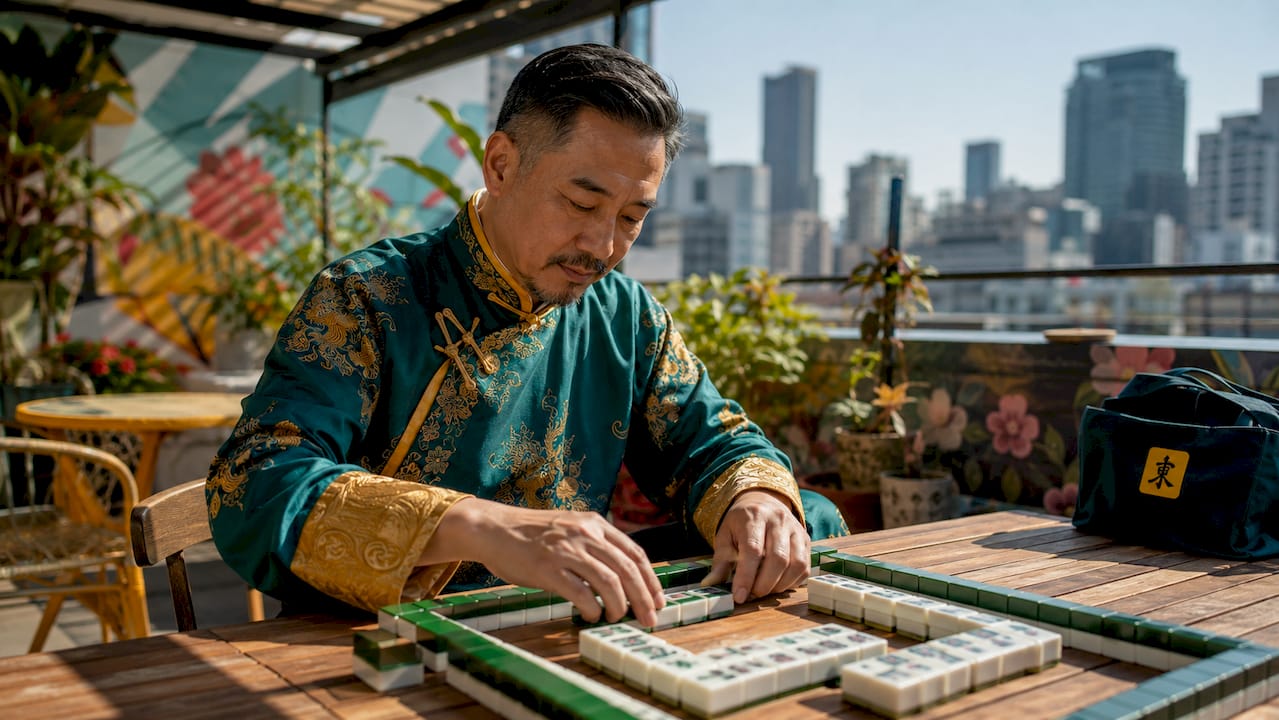
The standard set that emerged from this period contained 144 tiles organized into suits, honor tiles, and bonus tiles. That 144-tile baseline remains the most recognized format worldwide today. Early sets were hand-carved from bone and bamboo, which gave the game a distinct tactile and auditory quality that modern plastic sets cannot fully replicate. That craftsmanship contributed directly to Mahjong's cultural prestige.
By the 1870s, the game had a recognizable form. By the early 1900s, it had spread across China's major cities and trading ports, carried by merchants, soldiers, and travelers.
Pro Tip: If you want to understand why certain tiles feel more "traditional," look for sets that still use bamboo or bone-style materials. The sensory experience was part of the original game design.
How did Mahjong spread internationally?
Mahjong's international spread followed trade routes and migration patterns in the early 20th century. The game reached the United States, Europe, and Japan within a few decades of leaving China's coastal provinces.
- Early 1900s export to the West. American businessman Joseph Babcock is widely credited with introducing Mahjong to the US market around 1920. He simplified the rules for Western audiences and published an English-language rulebook.
- The 1920s American craze. Mahjong became a social phenomenon in the United States during the 1920s, played in parlors and clubs across the country. Demand for tile sets was so high that manufacturers in China struggled to keep up.
- Formation of the National Mah Jongg League. The National Mah Jongg League was established in 1937 to standardize American Mahjong rules and promote the game among women's social clubs. It remains active today and publishes an updated winning hands card each year.
- Japanese adoption and Riichi Mahjong. Mahjong arrived in Japan through soldiers and businessmen returning from China in the early 1900s. By the 1950s, Riichi Mahjong had developed into a distinct variant with its own formal scoring system and competitive professional leagues.
- Global tournament play. The first international Mahjong tournaments were organized in the early 2000s, with major events held in Tokyo and China. These tournaments promoted the International Tournament Rules, also known as Guobiao Majiang, as a standardized competitive format.
- Digital expansion. Online platforms and mobile apps brought Mahjong to new audiences in the 2000s and 2010s, accelerating the game's reach far beyond any physical community.
| Era | Key development |
|---|---|
| 1870s | Mahjong takes recognizable form in coastal China |
| Early 1900s | Game spreads across China and reaches Japan |
| 1920s | American Mahjong craze; Western rules simplified |
| 1937 | National Mah Jongg League founded in the US |
| 1950s | Riichi Mahjong formalized in Japan |
| Early 2000s | First global tournaments; International Tournament Rules introduced |
Pro Tip: When you read about Mahjong rules online, always check which variant the source is describing. American, Chinese, and Japanese rules differ enough that mixing them up will produce a confusing and unplayable game.
What are the key differences among Mahjong variants?
The mahjong game timeline produced three dominant variants, each shaped by the culture that adopted it. Knowing the differences helps you choose the right ruleset and respect the game's origins.
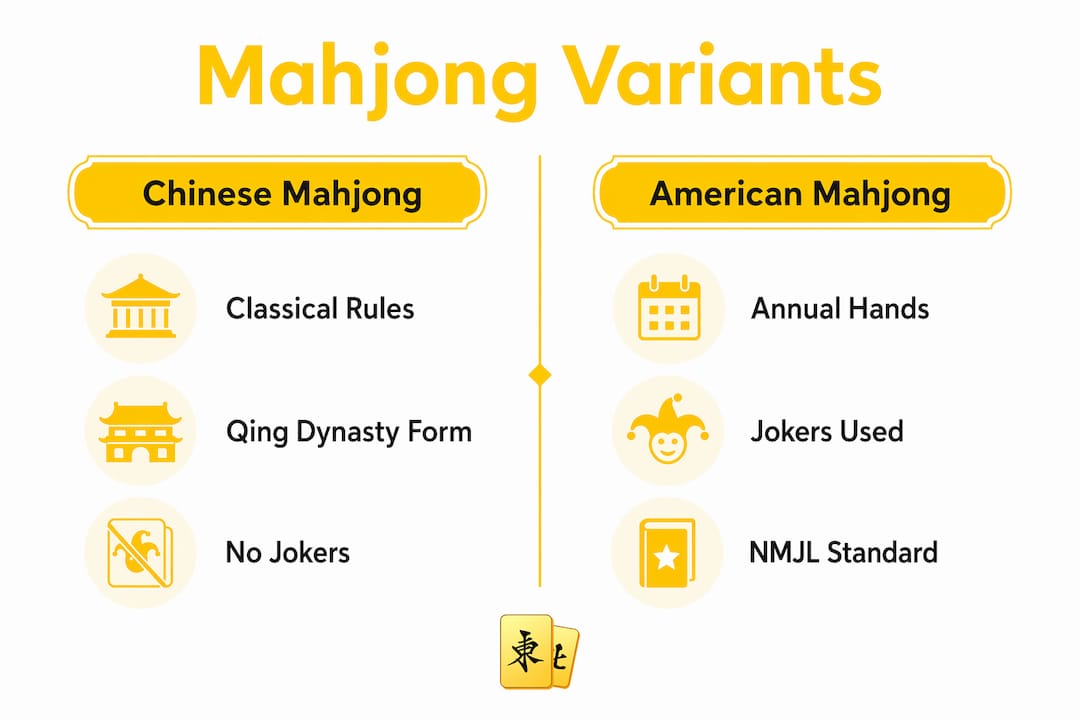
Chinese classical Mahjong stays closest to the original Qing Dynasty format. Players build winning hands from melds of three or four tiles, and scoring is based on the specific combinations achieved. The rules allow for a wide range of winning hands, which rewards deep strategic knowledge. There is no annually updated card telling you which hands are valid. The combinations are fixed by tradition.
American Mahjong, standardized by the National Mah Jongg League, uses a winning hands card that changes every year. This means valid winning hands shift annually, which adds a layer of memorization that Chinese Mahjong does not require. American Mahjong also uses joker tiles, which are absent in the Chinese version. The scoring system differs substantially, favoring a point-based structure tied to the hands card rather than meld-based calculation.
Japanese Riichi Mahjong introduces the riichi declaration, a mechanic where a player announces they are one tile away from winning and locks their hand in place. This creates a formal tension that drives competitive play. Japan has professional Mahjong leagues, televised matches, and a dedicated competitive culture built around this variant.
Key differences at a glance:
- Tile count: Chinese and Japanese sets use 136–144 tiles; American sets add jokers, bringing the count higher
- Winning hands: Fixed by tradition in Chinese Mahjong; updated annually by the NMJL in American Mahjong; defined by formal scoring tables in Riichi
- Joker tiles: Present in American Mahjong; absent in Chinese and Japanese versions
- Competitive scene: Most developed in Japan; growing internationally through Guobiao Majiang tournaments
- Cultural context: Chinese Mahjong carries deep family and community ritual significance; American Mahjong developed largely in women's social clubs; Japanese Riichi Mahjong is tied to a professional sports culture
Recognizing these differences matters beyond gameplay. Mahjong's Chinese origins are the foundation that every variant builds on. Playing any version without that awareness risks treating a culturally significant game as a generic pastime.
Why does knowing Mahjong's history matter for players?
Historical knowledge makes you a better, more respectful Mahjong player. This is not just a philosophical point. It has direct practical effects on how you understand the game.
Knowing the mahjong game origins helps you understand why rules differ across variants. American Mahjong did not change the rules arbitrarily. It adapted them for a different social context, a different era, and a different audience. When you know that history, the differences make sense rather than feeling random or confusing.
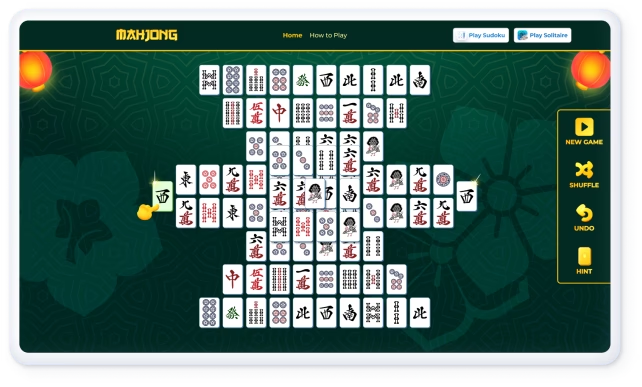
Understanding the distinction between Mahjong and Mahjong Solitaire is one of the most practical pieces of knowledge a new player can have. Mahjong Solitaire is a single-player tile-matching computer game developed in the 1980s. Traditional Mahjong is a four-player social game built on drawing, discarding, and reading your opponents. Confusing the two leads to completely wrong expectations about what you are learning.
Historical context also enriches the sensory experience. When you know that early sets were hand-carved from bone and bamboo, the weight and sound of quality tiles carry meaning. When you know that the shuffling sound inspired the game's name, you hear the table differently.
- Cultural appreciation: Recognizing Mahjong's Chinese roots prevents the kind of casual appropriation that strips meaning from cultural practices
- Rule clarity: Understanding why variants diverged explains which rules are traditional and which are modern adaptations
- Community respect: Players who know the history engage more thoughtfully with Chinese Mahjong communities and traditions
- Deeper enjoyment: Tile meanings, ritual practices, and hand names all carry historical weight that makes the game richer
Pro Tip: Before learning any specific variant, read at least a short overview of Mahjong's Qing Dynasty roots. It takes 10 minutes and permanently changes how you see the tiles.
Key Takeaways
Mahjong is a 19th-century Chinese tile game whose history directly shapes every variant played worldwide, from American Mahjong to Japanese Riichi.
| Point | Details |
|---|---|
| Qing Dynasty origins | Mahjong emerged in coastal China during the mid-to-late 1800s, combining Madiao, Paigow, and domino mechanics. |
| 144-tile standard | The baseline set of 144 tiles established in 19th-century China remains the most recognized format globally. |
| Three dominant variants | Chinese classical, American (NMJL), and Japanese Riichi Mahjong each have distinct rules, tile counts, and cultural contexts. |
| History prevents confusion | Knowing Mahjong's origins separates the traditional four-player game from Mahjong Solitaire, a separate 1980s computer game. |
| Cultural respect | Understanding Chinese roots is necessary for appreciating rather than appropriating Mahjong across its global variants. |
Why I think most players skip the most important part of learning Mahjong
Most new players go straight to rules. They want to know what a pung is, how to declare riichi, or which hands score points. That is understandable. Rules feel urgent when you are sitting at a table with three other people.
But skipping the history creates a specific blind spot. You end up treating Mahjong as a neutral game, like chess or checkers, with no particular cultural ownership. That is factually wrong and leads to real misunderstandings. I have seen players argue about "correct" rules without realizing they were comparing two entirely different variants with separate historical lineages. The argument was unresolvable because neither player knew where their version came from.
The Chinese and American Mahjong comparison is a perfect example. American Mahjong is not a simplified or inferior version of Chinese Mahjong. It is a culturally specific adaptation that developed in a particular American social context during the 1920s and 1930s. Knowing that makes you a more generous and accurate player.
My honest recommendation is this: learn the history first, then pick your variant. You will understand the rules faster, respect the game more deeply, and engage with other players more thoughtfully. The 150-year arc from Qing Dynasty parlors to global online platforms is not background noise. It is the game itself.
— Dmytro Romaniuk
Mahjong Online Club: play with history in mind
Knowing where Mahjong comes from makes every session more meaningful. Mahjong Online Club lets you put that knowledge into practice right away, with a free browser-based tile game that requires no registration and no downloads.
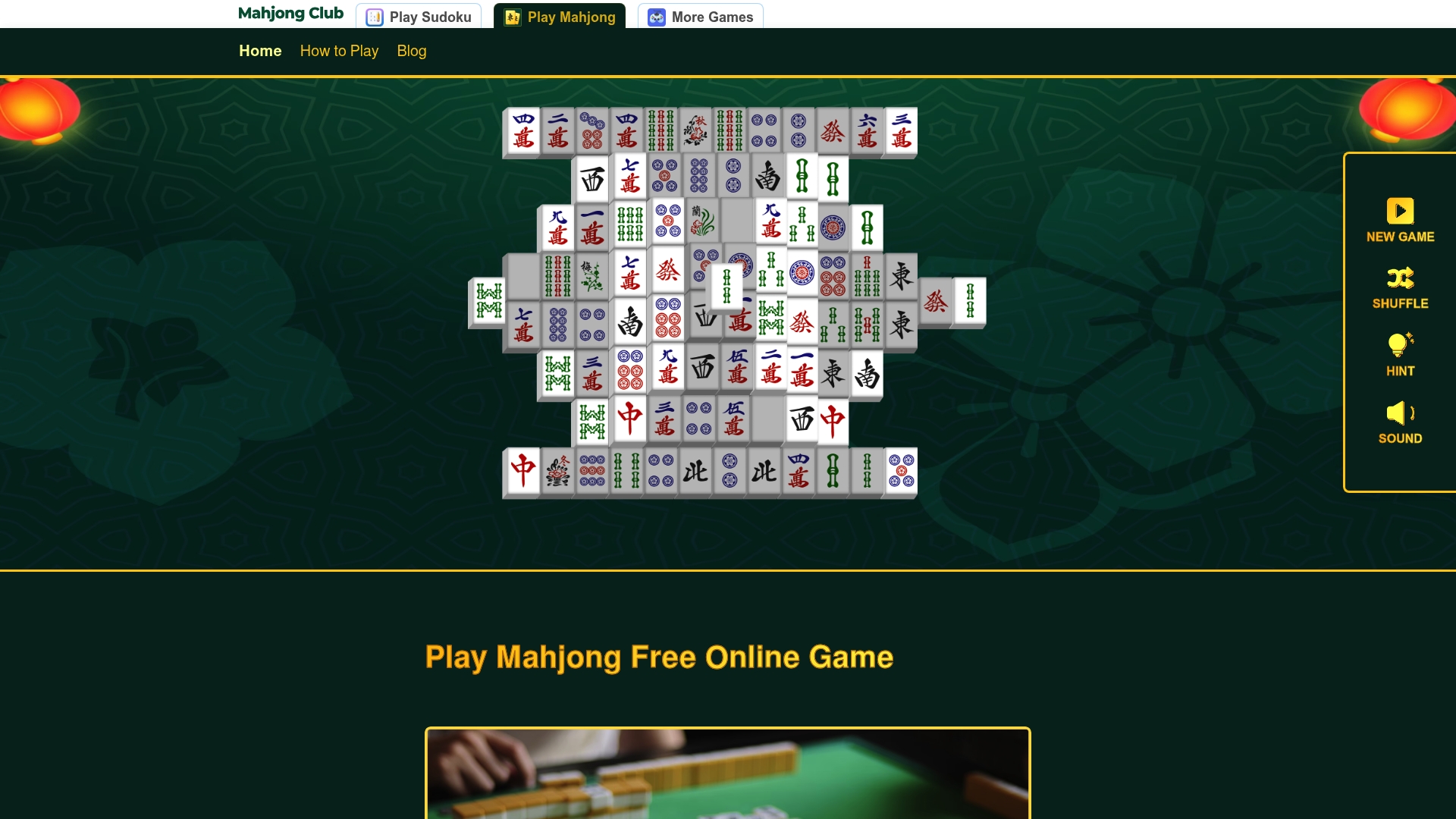
The platform is built for focused, distraction-free play, with a clean interface that reflects the calm, deliberate pace of traditional Mahjong. Whether you are a new player building pattern recognition or an enthusiast who wants a quick session between deeper study, Mahjong Online Club fits both. You can play classic Mahjong free directly in your browser, or read the rules and strategy guide to sharpen your approach before you start.
FAQ
What does the name "Mahjong" mean?
Mahjong means "game of the sparrows," derived from the Cantonese word máquè. The name refers to the twittering sound tiles make when shuffled on the table.
When and where did Mahjong originate?
Mahjong originated in China during the mid-to-late 1800s, in the Qing Dynasty period. It developed in coastal provinces near Shanghai, Ningbo, and Anhui, drawing from earlier games like Madiao and Paigow.
How is American Mahjong different from Chinese Mahjong?
American Mahjong uses joker tiles and an annually updated winning hands card published by the National Mah Jongg League. Chinese classical Mahjong uses fixed traditional hand combinations and a meld-based scoring system without jokers.
Is Mahjong Solitaire the same as traditional Mahjong?
No. Mahjong Solitaire is a single-player tile-matching computer game developed in the 1980s. Traditional Mahjong is a four-player social game with complex drawing, discarding, and scoring mechanics.
When did Mahjong become a competitive international sport?
The first global Mahjong tournaments were organized in the early 2000s, with major events held in Tokyo and China. These tournaments promoted the International Tournament Rules, known as Guobiao Majiang, as a standardized competitive format.
Recommended
Similar Articles
What Is Mahjong Explained: Rules, Tiles & Variants
Discover what is Mahjong explained: learn the rules, tile types, and variants of this strategic game that rivals chess in complexity.
What Does Free Tile Mean in Mahjong Solitaire?
Learn what does free tile mean in Mahjong Solitaire. Discover how understanding this concept can improve your game strategy and enhance your play.
Matching Pairs Mahjong Step by Step for Beginners
Learn matching pairs mahjong step by step! Master tile-matching strategies to clear the board effectively and enhance your gameplay.