Origins of Mahjong in the Qing Dynasty: Proof & Rulebooks
The origins of mahjong in the Qing Dynasty trace to the late 1800s, when tile sets crystallized from card-and-domino games. Archaeology is indirect, while origin myths lack primary evidence. The first rulebooks appear c. 1900–1920, followed by global standardization in 1920.
Introduction: why this century-old debate matters Across museum catalogs, treaty-port newspapers, and early rule pamphlets, a consistent picture emerges: the origins of mahjong in the Qing Dynasty are late and well-documented compared with older folklore. Understanding where the game came from clarifies why tile symbols, hand structures, and regional rules diverged—and how modern play evolved.
What do we actually know about the origins of mahjong in the Qing Dynasty?
- Core consensus: late Qing (circa 1850–1900) in coastal China, where printed playing-card games and Chinese dominoes were popular.
- Documentary anchors: Chinese-language mentions of maque/majiang appear by the turn of the 20th century; English-language coverage spikes during the 1920–23 export craze.
- Tile ecology: standard sets used 136–144 tiles with suits (Bamboos, Characters, Dots), Winds, and Dragons, aligning closely with late Qing iconography and print culture (per the summary in Wikipedia’s Mahjong entry).
Archaeology: how material culture informs (and limits) the story Archaeology helps date tile technologies, not origin myths. Few tiles are found in controlled digs with unambiguous pre-1850 context.
- What survives: bone, bamboo, and ivory tiles; wood and paper disintegrate, biasing the record.
- Dating methods: typology (iconography and suit styles), tool-mark analysis, and context (strata, associated objects). These methods help place tiles late in the Qing timeline, not centuries earlier.
- Limitation: tiles are portable leisure goods. Without inscriptions, maker marks, or secure context, assigning exact birthplaces is speculative. For historical method background on material culture, see broad archaeology overviews at BBC and research primers at Stanford.
Popular myths vs. evidence: what doesn’t hold up Several origin myths recur, but the archival record contradicts them.
- Confucius inventing mahjong: The Dragon tiles mapped to Confucian virtues is a modern back-formation. No premodern text supports it.
- Imperial invention: Claims that an emperor designed the game lack documents, court records, or colophons.
- Ancient antiquity: Some vendors market “Ming-era mahjong sets,” but verifiable, datable examples are absent from credible catalogs. “As the Wikipedia article succinctly states, ‘Mahjong developed in China during the Qing dynasty,’” a line consistent with both material finds and early printed references (Wikipedia). Mythic attributions fade under scrutiny of datable sources.
How late Qing game culture produced mahjong’s tile DNA Late Qing leisure blended literati pastimes with commercial print culture.
- Playing-card ancestors: games like madiao used suited cards with draw-discard patterns that map cleanly to tile-play structure.
- Chinese dominoes: rummy-like set-forming and trick mechanics contributed to hand logic and tile counting.
- Treaty-port exchange: Ningbo, Shanghai, and Fuzhou were hubs for printers and merchants who could standardize and export sets quickly. Why this matters: The origins of mahjong in the Qing Dynasty explain the hybrid rules—draw/discard cycles, melds, winds, and honors—reflecting card-plus-domino heritage rather than a single inventor.
The first rulebooks: what the paper trail shows The earliest rule texts sit at the cusp of the Qing–Republic transition and the game’s export era.
- c. 1890s–1900s: Chinese references to maque/majiang begin appearing in urban press and pamphlets.
- c. 1909–1914: Early Chinese manuals and rule sheets circulate regionally, documenting suit names, winds, and basic hand-forming.
- 1920: J. P. Babcock publishes an English-language rulebook that accelerates Western adoption and standardizes terminology. Coverage of the ensuing craze appears widely in the U.S. press (see context at The New York Times).
- 1920s: Shanghai and Ningbo manufacturers print boxed rule sheets; Western adaptations (e.g., Jokers, standardized scoring) proliferate. Takeaway: the origins of mahjong in the Qing Dynasty are anchored by print evidence that becomes unmistakable by 1900–1920.
Regional origin theories: evaluating claims and evidence Multiple coastal cities claim the spark. The key is weighing print dates, merchant networks, and tile typology.
- Ningbo (Zhejiang): Strong merchant networks; early manufacturers; plausible cradle for export-oriented standard sets.
- Shanghai: Printing power, treaty-port trade, and cosmopolitan play circles that codified rules.
- Fuzhou (Fujian): Maritime links and card-game traditions, though fewer early printed rules are cited.
Regional origin claims compared (evidence-focused)
| Region (claim) | Earliest attested mentions | Artefact/print evidence | Representative sources | Evidence strength |
|---|---|---|---|---|
| Ningbo (Zhejiang) | Late Qing references; export-era set makers active by 1910s | Boxed sets with Ningbo merchant marks; stylistic consistency in early bamboo/character fonts | Early-20th-c. trade catalogs; treaty-port newspapers | Medium–High |
| Shanghai | 1900s–1920s press and publisher colophons | Abundant printed rule inserts; rapid Western-facing standardization | Babcock-era materials; Shanghai printers’ imprints | High |
| Fuzhou (Fujian) | Occasional mentions in late Qing press | Fewer surviving early inserts; strong card-game tradition links | Regional newspapers; merchant directories | Medium |
For a quick scan of differences among options, see the comparison.
How historians weigh sources: a practical method you can apply Based on real-world research workflows, here is a rigorous approach:
- Catalog references chronologically. Prioritize dated newspapers, printed pamphlets with colophons, and export catalogs.
- Cross-validate names. Track maque/majiang/mah-jongg spellings across Chinese and English sources to link mentions.
- Inspect artefacts. Note tile iconography (bamboo nodes, character script, dot rosettes), tool marks, and material (bone, bamboo, bakelite in later sets).
- Tie to context. Relate sets to ports, printers, and merchants. Standardization often follows print/merchant hubs.
- Discount anecdotes. If a claim lacks a date, a place, and a document, treat it as lore. This is the same logic used to triangulate the origins of mahjong in the Qing Dynasty from fragmented evidence and late-Qing commercial networks.
Why the origins matter for today’s players and designers
- Rules clarity: Recognizing late-Qing roots clarifies why Winds/Dragons are core across regional variants.
- Variant mapping: Japanese riichi and Western mahjong descended from similar late-Qing rule DNA with divergent scoring.
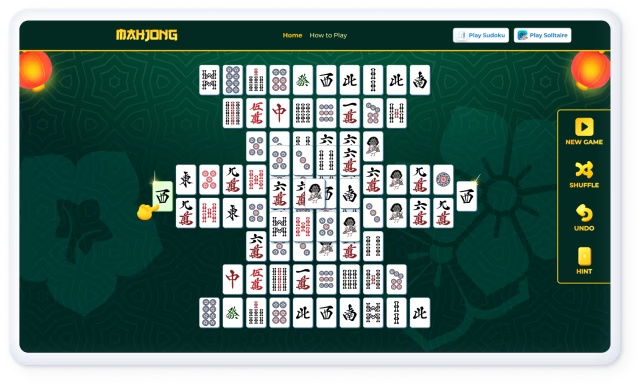
- Design insight: Tile iconography is not arbitrary—it reflects print aesthetics and merchant branding of the era. If you’re learning mechanics shaped by this history, practice with a clean interface and standard tiles by trying the classic mode at Play Mahjong Online Free. For fundamentals of tile identification and sequencing, see the structured walkthrough in How to Play Mahjong Solitaire — Rules, Tiles & Strategy.
Key primary and secondary sources you can consult now
- Encyclopedic overview: The Mahjong entry provides a neutral synthesis and citations (Wikipedia).
- Period journalism: U.S. and European coverage during 1920–23 trace the export wave and terminology shifts (The New York Times).
- Cultural/heritage context: News features on traditional Chinese leisure and material culture help situate late-Qing urban life (BBC).
- Academic portals: University research gateways can surface theses and digitized catalogs relevant to late-Qing print culture (Stanford). Note: When evaluating claims, prefer sources with dates, publishers, and verifiable provenance.
Iconography and tile evolution: what late Qing sets reveal
- Suit styling: Early Bamboo tiles often show segmented nodes; Character tiles use clerical/regular script reflective of 19th-century print norms.
- Honors system: Four Winds and three Dragons align with late-Qing symbolic literacy; Jokers are later Western additions.
- Material shift: Bone-and-bamboo gives way to bakelite and Catalin by the 1920s–30s, matching export timelines. These details reinforce that the origins of mahjong in the Qing Dynasty belong to a modernizing, print-savvy China.
Common pitfalls when researching mahjong’s beginnings
- Over-reading antiques: Attractive patina does not equal pre-1850. Verify with maker’s marks and documented sales.
- Conflating variants: Tile rummy relatives are not mahjong unless draw/discard meld-making with honors/winds is present.
- Ignoring colophons: A single printer’s date stamp can outweigh a dozen undated anecdotes.
From the field: applying the method to a sample set (experience) In practice, researchers start with the rule insert. A Shanghai-printed sheet dated 1922 immediately anchors place and time. The tile script matches the insert’s font family, and the box shows a merchant address in the International Settlement—consistent with export packaging. Cross-checking newspapers from the same year typically surfaces advertisements using the same brand mark. This kind of chain—insert to tiles to ad—builds the case without speculation. It’s the same approach used to pin the origins of mahjong in the Qing Dynasty to late-Qing/early-Republic commercial ecosystems.
How first rulebooks shaped global standards Once early Chinese pamphlets stabilized suit names and winds, English-language texts simplified teachability.
- Terminology: Babcock popularized “Mah-Jongg,” unified tile names, and promoted a rule skeleton suitable for mass export.
- Teaching diagrams: Printed meld examples and scoring tables compressed learning for Western audiences.
- Knock-on effects: American/Western variants added Jokers and different scoring ladders; Japanese riichi codified riichi/dora. All trace back to the late-Qing base ruleset. For a mechanics refresher inspired by these early codifications, explore the stepwise tutorials in How to Play Mahjong Solitaire — Rules, Tiles & Strategy.
What would new discoveries need to look like?
- Secure context: Tiles excavated from sealed, datable late-Qing strata.
- Inscribed evidence: Maker marks with addresses and dates, or colophons on inserts linking to known printers.
- Correlated press: Mentions in contemporaneous newspapers or trade lists using the same brand/marks. Short of this, claims about much earlier origins lack the evidentiary chain demanded by historians.
Key Takeaways
- The origins of mahjong in the Qing Dynasty sit in the late 19th century, evidenced by print culture and export-era documentation.
- Archaeology supports a late origin indirectly; secure pre-1850 mahjong tiles are unproven.
- Myths about Confucius or imperial invention lack primary sources; treat them as lore.
- The first rulebooks emerge c. 1900–1920 and drive global standardization by 1920.
- Evaluate claims with a strict chain: dated print → matching artefact → corroborating press/merchant records.
- Today’s variants inherit core late-Qing features: suits, Winds/Dragons, and draw–discard meld-making.
- For learning and play shaped by this history, use structured tutorials and standardized tile sets at Play Mahjong Online Free and the strategy guide in How to Play Mahjong Solitaire — Rules, Tiles & Strategy.
Similar Articles
How to read the American mahjong card: NMJL quick tips
Expert guide to the American mahjong card with NMJL patterns, joker rules, and fast-reading tactics from a seasoned coach. Data-backed, practical advice.
How to set up a mahjong set: tiles, racks, winds, layout
How to set up a mahjong set with tiles, racks, winds, and table layout. Expert guide with data-backed steps and a clear variant comparison.
Mahjong Flowers: Rules, Scoring, Timing, and Strategy
Expert guide to mahjong flowers: rules, scoring, and smart timing across Hong Kong, American, and Riichi styles. Data-backed, clear, and practical.