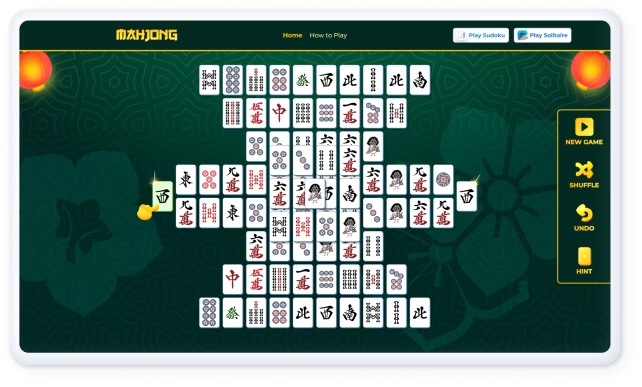
What Does Free Tile Mean in Mahjong Solitaire?
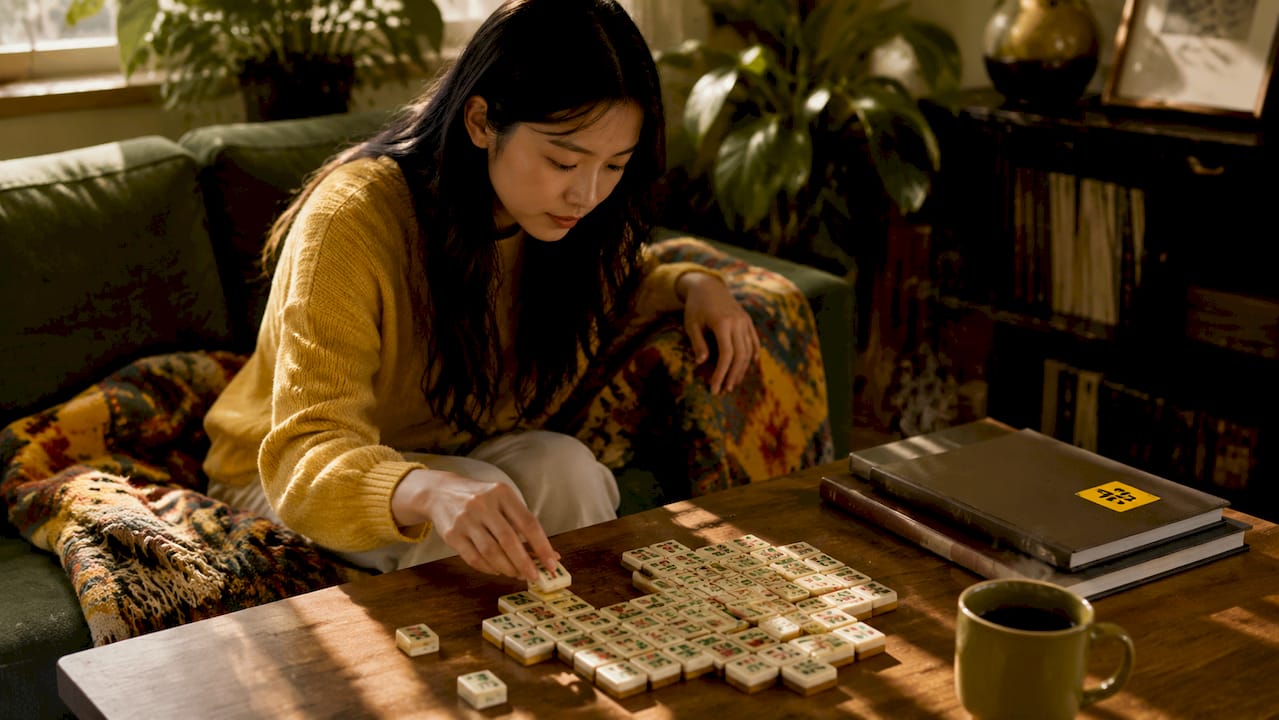
What Does Free Tile Mean in Mahjong Solitaire?
A free tile in Mahjong Solitaire is defined as any tile that has no other tile stacked on top of it and has at least one open side, left or right, allowing it to be matched and removed from the board. This concept is the foundation of every move you make in the game. Without understanding what does free tile mean in Mahjong, you cannot plan a single turn effectively. The term applies specifically to Mahjong Solitaire, the single-player puzzle variant, not to the traditional four-player game most people associate with the Mahjong name.
What does free tile mean in Mahjong Solitaire?
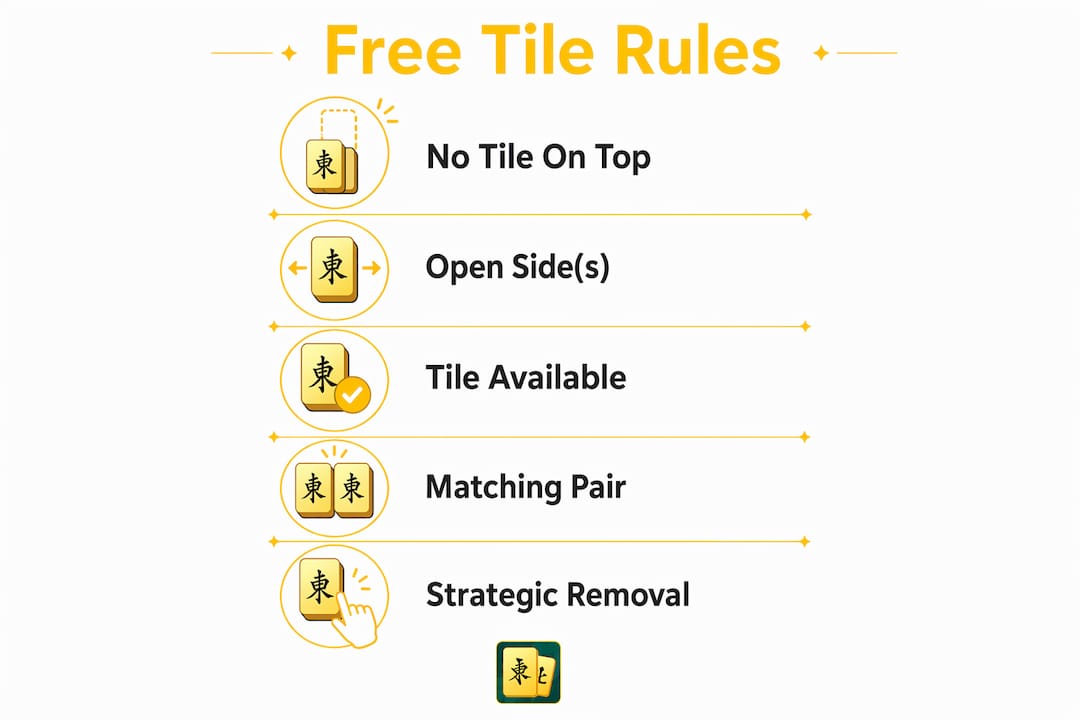
A free tile in Mahjong Solitaire meets two strict conditions at the same time. First, no tile sits on top of it. Second, at least one of its sides, either left or right, is completely open with no adjacent tile blocking it. Both conditions must be true. If even one fails, the tile is locked and cannot be selected.
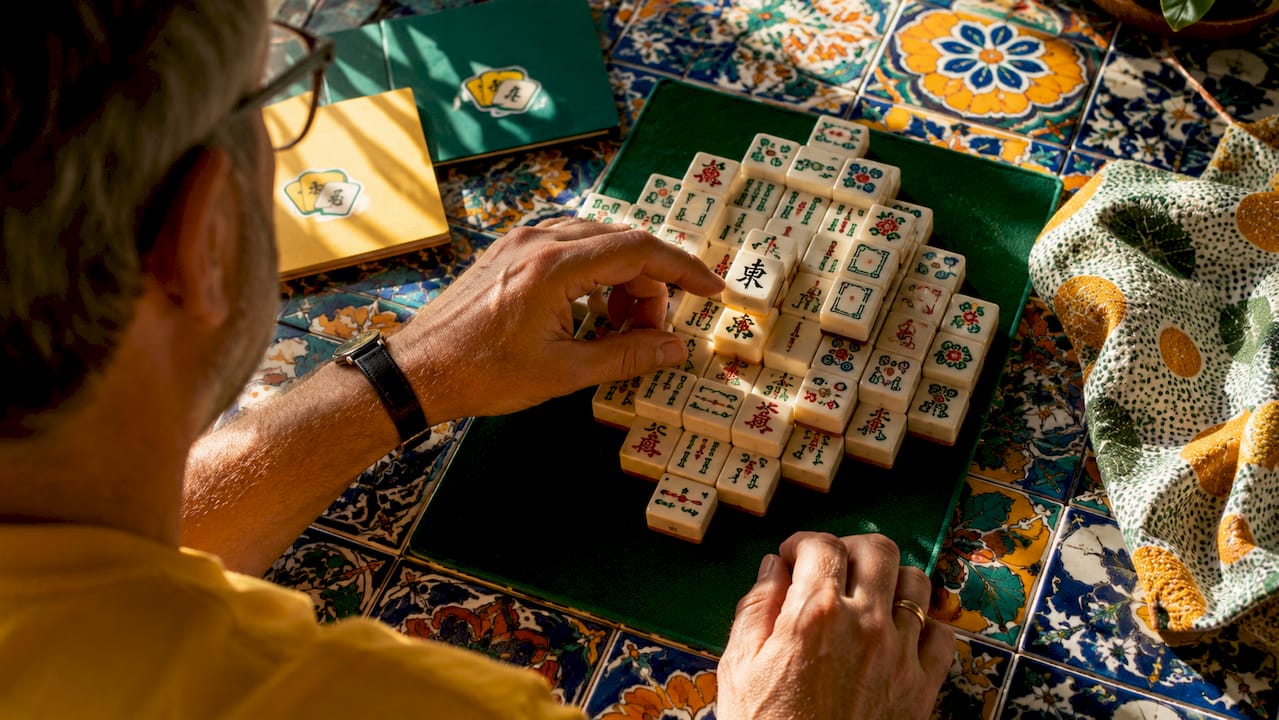
Think of it this way: a tile buried under another tile is physically trapped. A tile with tiles pressed against both its left and right sides is also trapped, even if its top is clear. The game only lets you interact with tiles that pass both tests.
Here is what blocks a tile:
- Tile on top: Any tile resting fully or partially on top of another locks the one below.
- Both sides blocked: A tile with adjacent tiles touching both its left edge and its right edge cannot be moved.
- Partial overlap counts: Even a tile that only partially overlaps from above still blocks the tile underneath.
A tile that passes both checks is called a free tile. You can click it, and if you find another free tile with a matching face, you remove the pair from the board.
Pro Tip: Scan the board before making any move. Count how many tiles are free at any given moment. The more free tiles you can see, the more options you have for your next match.
How does the free tile rule shape your strategy?
The free tile rule does more than define which tiles you can touch. It controls the entire flow of the game. Every match you make changes which tiles become free next. That chain reaction is where strategy lives.
Beginners often make the same mistake: they grab the easiest visible match without thinking about what that move unlocks or locks away. Removing a free tile too early can bury a critical tile under newly exposed layers, making it impossible to reach later. This is the most common reason players hit a dead end before clearing the board.
Removing easy matches too early is the single biggest beginner error in Mahjong Solitaire. The game rewards patience and forward thinking, not speed.
Follow this sequence of priorities when planning your moves:
- Identify which tiles are currently free. Only free tiles are playable. Build your mental map of the board from this list.
- Look for matches that free up buried tiles. A match that exposes two or three new free tiles is worth more than a match that changes nothing beneath it.
- Avoid clearing tiles that support others you still need. If removing a pair seals off a column of tiles you have not matched yet, hold off.
- Track duplicate tiles. Each tile design appears four times on a standard board. If you use two of the four copies early, you may not be able to match the remaining two if they become locked.
- Work from the top of stacks downward. Tiles near the top of tall stacks are usually free. Clearing them first opens up the layers below.
Pro Tip: When you spot two free tiles that match, pause before clicking. Ask yourself: does removing this pair open new tiles, or does it close off a section of the board? That one question separates average players from skilled ones.
The vertical and horizontal tension created by the free tile rule is what makes Mahjong Solitaire a genuine puzzle, not just a fast-paced matching exercise. The game slows you down on purpose. That slower, more deliberate pace is the point.
How does free tile differ from traditional Mahjong?
The free tile concept does not exist in traditional Mahjong. The two games share a tile set but almost nothing else. Understanding the difference helps you avoid confusion when reading rules or watching others play.
| Feature | Mahjong Solitaire | Traditional Mahjong |
|---|---|---|
| Number of players | 1 (solo puzzle) | 4 players |
| Free tile rule | Core mechanic for all moves | Does not apply |
| Goal | Clear all tiles from the board | Build a winning hand |
| Tile interaction | Match and remove pairs | Draw, discard, and claim tiles |
| Blocking concept | Central to gameplay | Not relevant |
Traditional Mahjong is a social game built around drawing tiles from a central wall, discarding unwanted tiles, and building specific combinations called hands. Players compete against each other. There is no stacked layout and no concept of a tile being blocked from removal.
Mahjong Solitaire, the version popularized in the 1980s, takes the same 144-tile set and arranges it in a layered pattern. The single-player puzzle format introduced the free tile rule as its central mechanic. You can read a full breakdown of game version differences to see exactly how the two variants split apart over time.
How do Season and Flower tiles interact with free tile rules?
Season and Flower tiles are special tiles in Mahjong Solitaire that follow the same free tile rules as every other tile on the board. They must have no tile on top and at least one open side before you can select them. The difference is in how they match.
Standard tiles must match an identical face to be removed as a pair. Season and Flower tiles work differently:
- Any Season tile matches any other Season tile. The four Season tiles, Spring, Summer, Autumn, and Winter, can be paired with each other regardless of which specific season is shown.
- Any Flower tile matches any other Flower tile. The four Flower tiles work the same way, matching across the group rather than requiring identical faces.
- They act as wildcards within their category. This gives you more pairing flexibility when these tiles are free.
- They still must be free to be selected. A Season tile buried under another tile or blocked on both sides is just as locked as any other tile.
Season and Flower tiles offer strategic flexibility precisely because they match across a category. When one of these tiles becomes free, you have a higher chance of finding a valid match elsewhere on the board. That makes freeing them a priority worth planning around.
Key Takeaways
A free tile in Mahjong Solitaire is the only tile you can play, defined by two conditions: no tile on top and at least one open side.
| Point | Details |
|---|---|
| Free tile definition | A tile with no tile on top and at least one open side, left or right. |
| Both conditions required | A tile blocked on both sides is locked even if its top is clear. |
| Strategy over speed | Removing easy matches too early can lock critical tiles and end the game prematurely. |
| Season and Flower tiles | These special tiles match any tile in their category, but still must be free to select. |
| Solitaire only | The free tile rule applies to Mahjong Solitaire, not to traditional four-player Mahjong. |
What I have learned from watching beginners misread free tiles
I have seen the same pattern repeat with nearly every new player who sits down with Mahjong Solitaire for the first time. They scan the board, spot two matching tiles, and click immediately. The match works. They feel good. Then three moves later, the board is stuck and they cannot figure out why.
The problem is almost always a free tile they removed too soon. That tile was acting as a kind of keystone. Pulling it out collapsed access to a whole section of the board. The player never saw it coming because they were not thinking one move ahead, let alone three.
The mental shift that changes everything is simple: stop thinking about what you can match and start thinking about what each match opens up. A free tile is not just a move. It is a gate. Removing it either opens a new path or closes one. Your job is to know which before you click.
I also see players ignore tile order strategy entirely in the early game. They treat the first ten moves as warm-up. Those moves are actually the most consequential. The board is most complex at the start, and the decisions you make then shape every move that follows.
The rewarding part is that this skill builds fast. After a few focused sessions, you start reading the board differently. You see chains of consequence instead of isolated pairs. That shift from reactive to deliberate play is when Mahjong Solitaire stops feeling like luck and starts feeling like a real puzzle you are solving.
— Dmytro Romaniuk
Practice free tile recognition with Mahjong Online Club
Knowing the theory is one thing. Recognizing free tiles in real time, under the pressure of a live board, is a skill that only comes from practice.
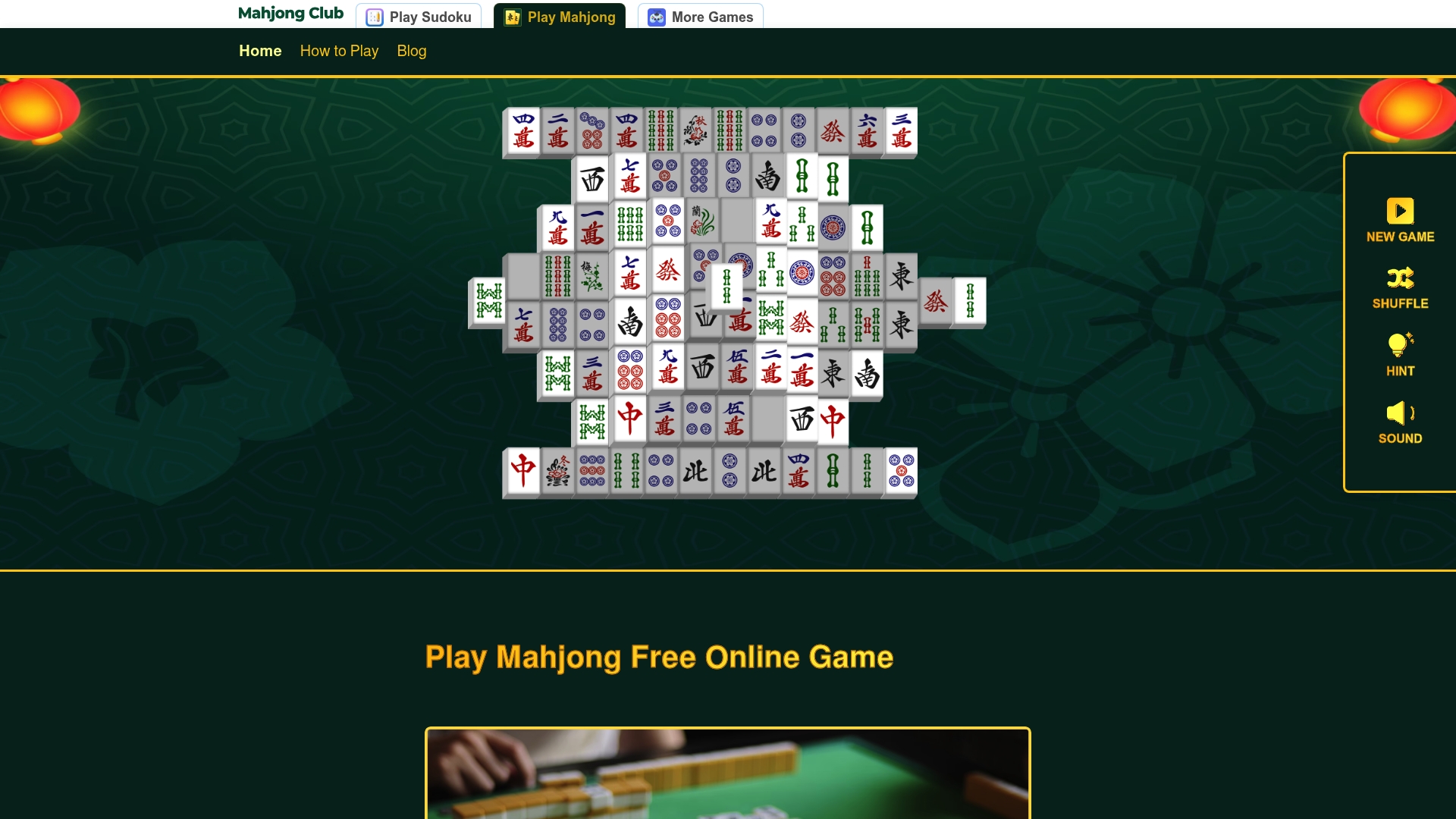
Mahjong Online Club lets you play Mahjong free directly in your browser with no registration required. The classic tile layout gives you a real board to apply everything covered here: spotting free tiles, planning sequences, and avoiding the early-match trap. The interface is clean and distraction-free, so you can focus entirely on reading the board. If you want a structured starting point, the step-by-step beginner guide walks you through identifying and removing free tiles from your very first game.
FAQ
What is a free tile in Mahjong?
A free tile is any tile in Mahjong Solitaire that has no tile stacked on top of it and has at least one open side, left or right. Both conditions must be met before the tile can be selected and matched.
Can a tile be free if it has tiles on both sides?
No. A tile with adjacent tiles blocking both its left and right sides is locked, even if its top is completely clear. At least one side must be open for the tile to count as free.
Does the free tile rule apply to traditional Mahjong?
The free tile rule does not apply to traditional Mahjong. Traditional Mahjong is a four-player game where players draw and discard tiles to build hands. There is no stacked layout and no blocking mechanic.
Do Season and Flower tiles follow the same free tile rules?
Yes. Season and Flower tiles must be free, meaning no tile on top and at least one open side, before you can select them. The difference is that they match any other tile in their category, not just identical faces.
What happens when no free tiles can be matched?
The game alerts you that no more moves are available. This state is usually caused by removing tiles in the wrong order, which locks remaining free tiles into positions where no valid pairs exist.
Recommended
Similar Articles
Chinese Numbers on Mahjong Tiles: 1–9 Beginner Guide
Expert guide to Chinese numbers on mahjong tiles. Learn 1–9 Characters (wan) fast with pro tips, mnemonics, and a reference table you can trust.
How to Clean Mahjong Tiles: Step-by-Step Care Guide
Expert guide on how to clean mahjong tiles by material—Bakelite, bone/bamboo, and plastic—with safe steps, pro tips, and data-backed care advice.
Mahjong Flowers: Rules, Scoring, Timing, and Strategy
Expert guide to mahjong flowers: rules, scoring, and smart timing across Hong Kong, American, and Riichi styles. Data-backed, clear, and practical.