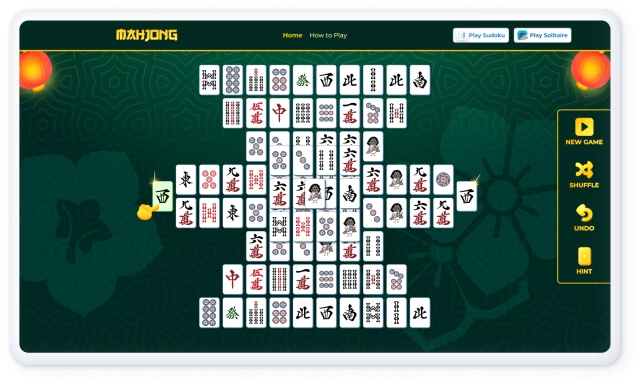
Mahjong Pattern Mastery: Advanced Tips for Relaxed Play

Mahjong Pattern Mastery: Advanced Tips for Relaxed Play
The fastest way to sharpen your mahjong pattern mastery is to work four high-leverage moves into a single 10-minute session: pattern snap drills, five-block flexibility training, timed discard reading, and a five-turn decision rule. Mahjong Online Club's ad-free, single-player environment is built for exactly this kind of focused practice, and both Mahjong Academy and Mahjong Pros have documented why these specific drills produce the biggest skill jumps.
Four quick actions to try right now:
- Set a 2-minute timer and scan a fresh board for every matchable pair before touching a tile.
- Count your active blocks. If you have more than five, drop the weakest one immediately.
- Read the visible discard pile for 10 seconds before your next move. Note which suits are absent.
- By your fifth discard, commit to one clear pattern direction.
Table of Contents
- Why pattern mastery is the fastest route to calmer, higher-skill play
- The core advanced skills to practice
- Step-by-step drills you can run in single-player sessions
- Common mistakes that create plateaus and how to fix them
- Endgame rules and the decision checklist for committing to a pattern
- How to organize practice into a relaxing single-player routine
- Where to practice and how to set up your training environment
- How to read tiles and use visible information defensively
- How to avoid chasing high-value patterns too early
- How tile visibility and probability shape pattern recognition
- How to manage multiple simultaneous pattern options
- Advanced mental mapping for anticipating tile releases
- How pattern recognition helps you avoid deadlocks
- Key Takeaways
- Why focused drills beat unfocused play every time
- Ready to run your first drill on Mahjong Online Club?
- Useful sources for deeper study
Why pattern mastery is the fastest route to calmer, higher-skill play
Pattern mastery delivers faster wins and more relaxing sessions because it shifts your brain from reactive counting to confident, automatic recognition. When recognition becomes instinctive, you stop burning mental energy on tile identification and start using that capacity for strategic observation.
"Pattern snap-recognition is the skill that separates confident players from hesitant ones. When you can read your hand at a glance, you free up mental space to observe the table and make better decisions." — Mahjong Academy
The cognitive payoff extends beyond the game itself. Regular pattern-recognition practice supports attention, working memory, and processing speed, benefits that research has linked specifically to tile-matching play in older adults. Mahjong Online Club's distraction-free, no-registration interface removes every friction point so you can focus entirely on the drills below.
The core advanced skills to practice
These six skills produce the biggest gains. Each includes a one-sentence drill you can run in under five minutes.
- Pattern snap-recognition: Flash a board for 3 seconds, then list every pair you spotted. Directly improves processing speed and reduces hesitation.
- Five-block management: At any point mid-game, count your blocks. If you hold six, identify and discard the weakest. See the five-block approach for the full framework.
- Shanten-style distance awareness: Before each move, ask how many tiles separate you from a complete hand. Keeps decisions grounded in reality, not optimism.
- Discard-river reading: Run a 10-second scan of visible discards and name the dominant suit before touching a tile.
- Wait-quality evaluation: Favor two-sided waits (e.g., a 4-5 tile pair waiting on 3 or 6) over single-tile waits. Two-sided waits accept more completing tiles than single-tile waits.
- Tempo control: Track whether you are ahead or behind the board's pace. If stacks are thinning fast, simplify your target pattern immediately.
For a deeper look at winning pattern examples across skill levels, Mahjong Online Club's guide maps each skill to concrete hand shapes.
Step-by-step drills you can run in single-player sessions

The most efficient practice routine fits three drills into 20–30 minutes. Structured progressive learning moves from fundamentals to speed to endgame commit, and your weekly plan should mirror that arc.
7-session progression:
- Session 1: Pattern snap drill — 10 minutes of timed board scans, 3 seconds per board.
- Session 2: Five-block juggling — play a full game keeping a running block count aloud.
- Session 3: Discard-river replay — after each game, replay the last 10 discards and identify what they revealed.
- Session 4: Speed run — complete a board as fast as possible while tracking hesitation pauses.
- Session 5: Flexibility drill — start each game targeting two different patterns simultaneously, commit only at move 10.
- Session 6: Endgame commit practice — apply the five-turn rule on every game (see the checklist below).
- Session 7: Integrated session — combine snap recognition, five-block management, and the five-turn rule in one 30-minute game.
Pro Tip: Track one metric per session: your average time to first match, or the percentage of moves made without a pause longer than 3 seconds. A single consistent number reveals progress faster than general impressions.
Common mistakes that create plateaus and how to fix them
The three most common plateau drivers are chasing rare patterns, failing to manage five blocks, and skipping timed drills. Each has a direct corrective.
- Chasing high-value patterns too early. Hey Mahjong notes that committing to high-value hands prematurely reduces completion rates. Fix: run a 10-minute "no-pattern-chase" drill where you complete a board using only the first viable pattern that appears.
- Holding too many blocks. Six or more active blocks create decision paralysis. Fix: before every third move, count blocks and drop the weakest one without hesitation.
- Skipping timed practice. Untimed play lets bad habits hide. Fix: add a visible countdown timer to every session, even a relaxed one.
Mahjong Pros recommends deliberately studying the skill you avoid most and integrating it with other skills rather than drilling it in isolation. That cross-skill approach breaks plateaus faster than any single-focus repetition. Your plateau-breaking assignment: pick your weakest skill from the list above and run a focused 10-minute micro-drill on it every day for one week. Small, targeted changes compound quickly.
Endgame rules and the decision checklist for committing to a pattern
Use this five-step checklist in the final third of any game. Run it in 10 seconds before committing to a pattern.
- Outs: How many tiles can still complete this pattern? If fewer than three remain visible, reconsider.
- Visible copies: Count how many copies of your needed tiles are already matched or buried. Two or more gone means low probability.
- Wait quality: Is your current wait two-sided or single-tile? Downgrade single-tile waits unless the board strongly supports them.
- Remaining stacks: How many unmatched stacks are left? Fewer than eight stacks means commit now or abandon.
- Relaxation goal: Will chasing this pattern stress you out? If yes, simplify. A completed board at lower complexity beats a stalled board every time.
Example — commit: You need a 5-bamboo to close a two-sided wait, three copies are still unmatched, and 12 stacks remain. Commit.
Example — fold: You need a rare honor tile, two copies are already matched, and only six stacks remain. Fold and pivot to your backup pattern.
Pro Tip: When your relaxation goal conflicts with your scoring goal, always choose calm. A stress-free completed board builds the habit stack that makes you faster in the long run.
How to organize practice into a relaxing single-player routine
A balanced practice session is short (15–30 minutes), focused, and ends with a calm cool-down. Three templates cover most schedules:
- 10-minute micro session: One snap drill (5 min) + one block-count game (5 min). No score tracking.
- 20–30 minute focused session: Snap drill (5 min) + speed run with block counting (15 min) + 5-minute cool-down game with no timer.
- 45-minute deep session: Full 7-session progression drill (30 min) + two cool-down games (15 min) with sound on and no performance tracking.
Quick mindfulness cues to keep sessions relaxing:
- Take one slow breath before starting each board.
- Sit back from the screen; avoid hunching toward tiles.
- Run at least one "no-score" session per week where you play purely for enjoyment.
Cognitive benefit shows up indirectly: you will notice fewer hesitation pauses, faster first-match identification, and a growing sense of calm confidence rather than reactive scrambling.
Where to practice and how to set up your training environment
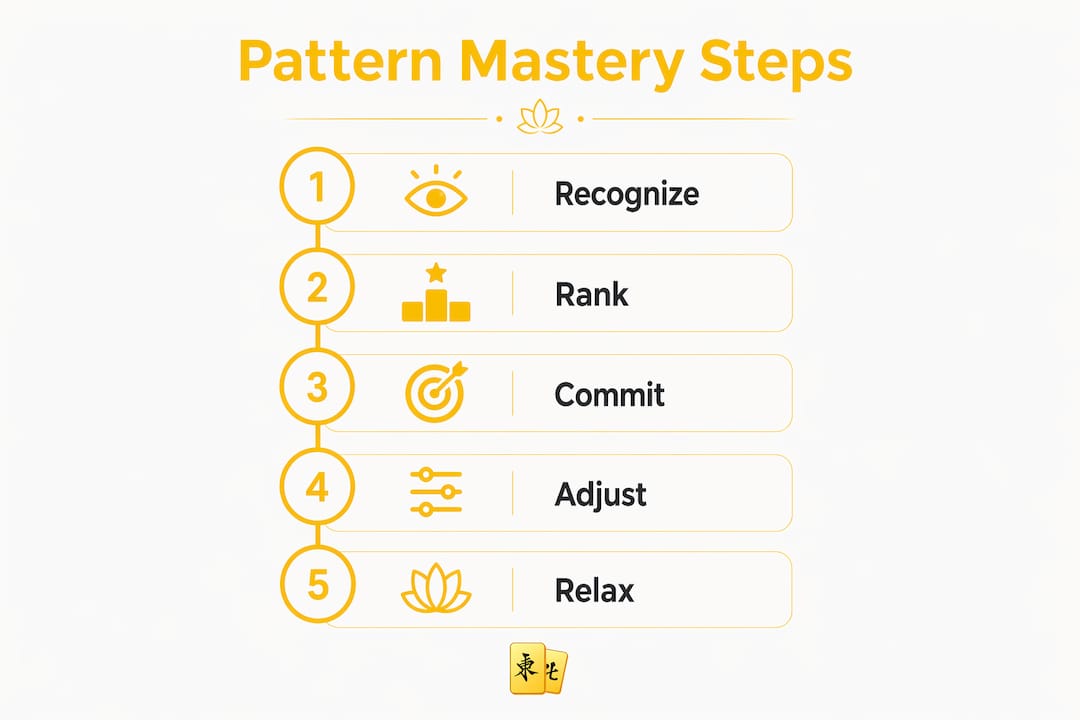
Pick a distraction-free browser session with adjustable timers and undo options. Mahjong Online Club meets all of these needs: no ads, no sign-up, and a clean interface designed for focused single-player play.
Platform features worth prioritizing:
- Ad-free mode (eliminates interruptions mid-drill)
- Layout variety (different board shapes train different pattern-recognition angles)
- Undo option (lets you replay a decision and study it)
- Full-screen mode (reduces peripheral distraction)
Setup steps: open Mahjong Online Club in full-screen, mute notifications on your device, set an external timer for your chosen session length, and keep a notepad nearby to log your one tracking metric. That's the complete training environment.
How to read tiles and use visible information defensively
In solitaire play, "defensive reading" means using visible tile information to protect your pattern from deadlocks rather than from opponents. Before each move, scan the full board for tiles that appear only once in an accessible position. Those are your highest-risk tiles: if you match away their only accessible partner prematurely, you may strand a needed tile permanently. Prioritize freeing buried tiles early, and treat any tile with only one accessible copy as a bottleneck. The bottleneck tile concept is one of the most underused defensive tools in solitaire.
How to avoid chasing high-value patterns too early
The core rule: maintain flexibility until natural tile structure supports a commit. If you are in the first third of a board and a high-value pattern requires three specific tiles that are not yet visible, do not reorganize your entire strategy around it. Instead, keep two or three viable patterns alive simultaneously and let the board tell you which one to pursue. Mahjong Playbook advises committing by turn five and prioritizing useful shapes over early pursuit of high-value tiles. Chasing rare patterns early is the single fastest way to create an unwinnable board.
How tile visibility and probability shape pattern recognition
Every tile you can see is information. Before committing to a pattern, count how many copies of your key tiles are still accessible. If three of four copies are already matched or buried, the probability of completing that pattern drops sharply. Build a quick mental habit: for each pattern you are considering, identify its two most critical tiles and check their availability. This takes about five seconds and prevents the most common form of wasted effort in solitaire play. Tile efficiency principles from competitive mahjong translate directly here: favor patterns where your needed tiles are plentiful and accessible.
How to manage multiple simultaneous pattern options
Holding two or three viable patterns simultaneously is a skill, not a sign of indecision. The key is to rank them. At any point, you should know which pattern is your primary (best tile availability, fewest moves to complete) and which is your backup. When a move advances both patterns, take it. When a move advances only one, check whether it closes off the other permanently before committing. The sequence optimization guide on Mahjong Online Club walks through exactly this kind of move-ordering logic.
Advanced mental mapping for anticipating tile releases
Mental mapping means tracking which tiles are locked under others and predicting when they will become accessible. As you clear the top layer of a board, visualize which tiles will open next. If a tile you need is two layers deep, plan a clearing sequence that exposes it without stranding other critical tiles. This forward-looking habit is what separates players who react to the board from those who direct it. Practice it by pausing for 10 seconds at the start of each game to trace two or three clearing paths before making your first move.
How pattern recognition helps you avoid deadlocks
Deadlocks happen when accessible tiles have no valid matches left, usually because earlier moves created isolated pairs. Pattern recognition prevents this by keeping the full board in view rather than focusing only on the current match. Before each move, ask whether the tiles you are about to match are also needed to unlock other tiles deeper in the stack. If yes, look for an alternative match first. The guide on identifying blocked tile patterns covers the most common deadlock configurations and how to spot them before they form.
Key Takeaways
Advanced pattern mastery in Mahjong Solitaire comes down to four repeatable habits: snap recognition, five-block discipline, timed decision-making, and the five-turn commit rule.
| Point | Details |
|---|---|
| Four core moves | Pattern snap drills, five-block management, discard reading, and the five-turn rule cover the highest-leverage skills. |
| Five-turn commit rule | By your fifth discard, commit to one clear pattern direction to avoid being too rigid or too late. |
| Timed drills build speed | Running sessions with a visible timer trains automatic recognition and frees working memory for strategy. |
| Avoid early pattern chasing | Keep two to three viable patterns alive and commit only when natural tile structure supports it. |
| Mahjong Online Club | Ad-free, no-signup single-player environment built for the focused, relaxing drill sessions described here. |
Why focused drills beat unfocused play every time
Most players plateau not because they lack knowledge but because they practice without a target. Unfocused play reinforces existing habits, including the bad ones. Short, deliberate drills with a single measurable goal, like reducing hesitation pauses or maintaining a five-block count, compound into real skill gains faster than hours of casual play. The drills in this guide are designed to feel calm and manageable, not like homework. That balance between discipline and enjoyment is exactly what makes the practice sustainable. If you build just one habit from this guide, make it the five-turn rule: it forces clarity, prevents drift, and keeps every session purposeful without adding stress.
Ready to run your first drill on Mahjong Online Club?
No other practice environment matches what Mahjong Online Club offers for these drills: no ads interrupting your focus, no account to create, and a clean board that loads in seconds. Start with the 10-minute micro session: one 5-minute snap drill followed by one block-count game. Track one metric, your time to first match, and note it after the session.
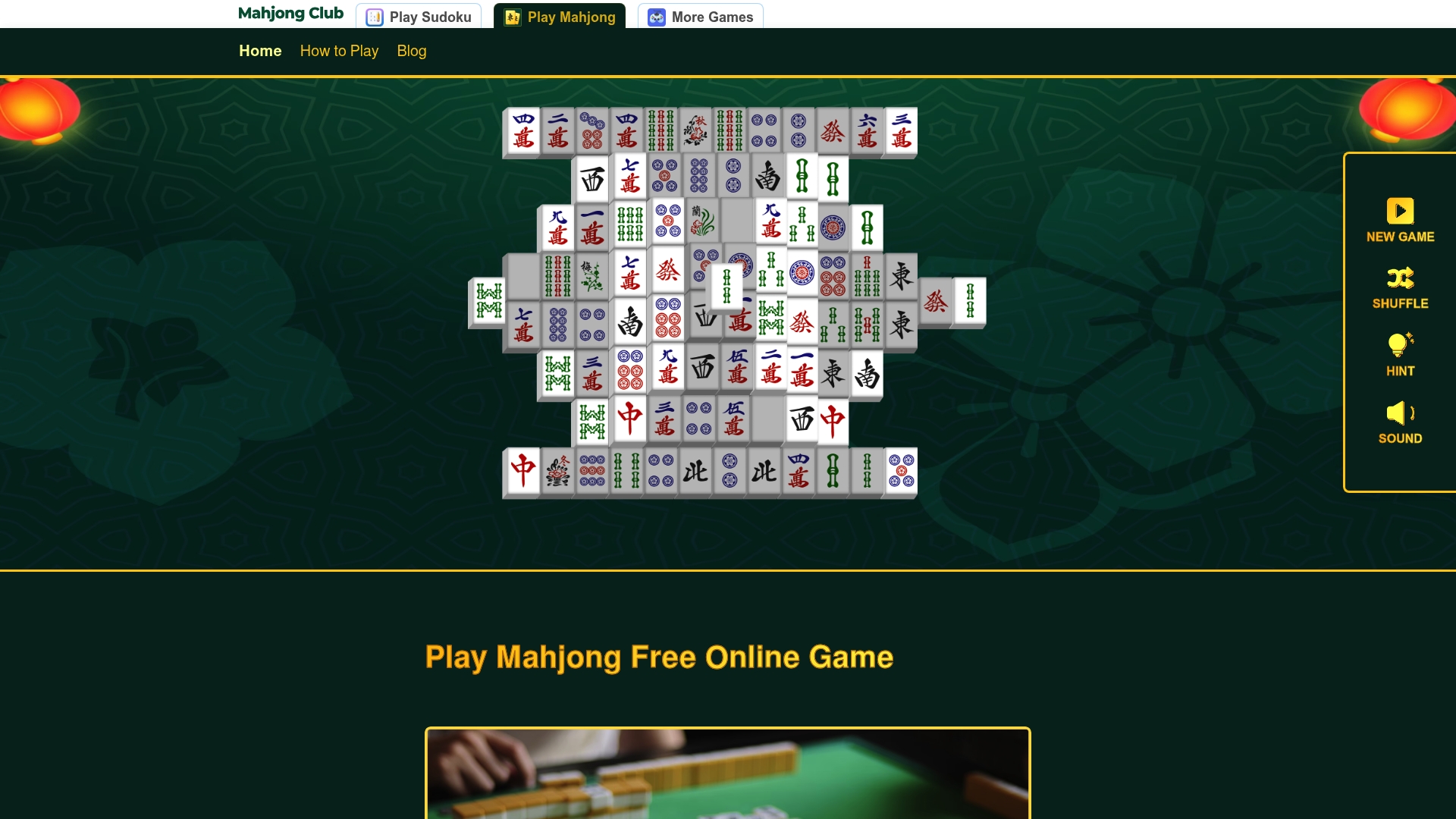
Open a fresh board at Mahjong Online Club, go full-screen, set a 10-minute timer, and run the snap drill right now. The board is free, the session is yours, and the first improvement shows up faster than you expect.
Useful sources for deeper study
- Pattern snap-recognition — Mahjong Academy: Core evidence for timed speed drills and how automatic recognition frees working memory.
- Advanced winning hands — Mahjong Playbook: Source for the five-block approach and the five-turn commit rule.
- How to read mahjong discards — Hey Mahjong: Teaches the 10-second discard scan and how visible tile patterns reveal hand direction.
- Mahjong fan pattern cheat sheet — Hey Mahjong: Explains why early commitment to high-value patterns reduces completion rates.
- How to get better at Mahjong — Mahjong Pros: Recommends cross-skill integration drills as the fastest plateau-breaker.
- Best Mahjong strategy tips — Mahjong Master: Covers tile efficiency, shanten counting, and wait-quality evaluation.
- How to learn Mahjong fast — Hey Mahjong course: Outlines progressive module sequencing from fundamentals to advanced reading.
- Mahjong winning patterns — Mahjong Online Club: Maps winning patterns from beginner to advanced with concrete examples.
- Identifying blocked tile patterns — Mahjong Online Club: Covers deadlock configurations and how to spot them before they form.
- Bottleneck tile concept — Mahjong Online Club: Explains how bottleneck tiles create deadlocks and how to manage them defensively.
Recommended
Similar Articles
Why Tile Isolation Ruins Mahjong Games for All Players
Discover why tile isolation ruins mahjong games and learn strategies to improve your gameplay. Transform your hand efficiency today!

Mahjong Tile Frequency Awareness: Your Strategic Edge
Learn what is mahjong tile frequency awareness and how tracking tile locations can give you a strategic advantage in your game.

Mahjong Strategies for Beginners: 15 Tips to Win More
Expert guide to Mahjong Strategies for Beginners: 15 data-backed tips, pro tactics, and a clear comparison table to help you win more games with confidence.