Why No Registration Games Matter for Casual Gamers

Why No Registration Games Matter for Casual Gamers
No-registration games are instant-play digital games that let you start playing immediately without creating an account or entering personal information. That single design decision changes everything about how you experience casual gaming. Understanding why no registration games matter means recognizing that the barrier between you and fun is almost always artificial. Registration gates exist primarily to collect data, not to improve your gameplay.
Why no registration games matter: the access advantage
Instant-play browser games start in under 5–10 seconds, compared to the multi-minute process of creating a traditional account. That gap is not trivial. When you want to decompress for five minutes between meetings, a two-minute signup form consumes nearly half your available time before you've played a single move.
Traditional account creation stacks friction point on friction point. You enter an email, choose a password, confirm the password, verify your email, accept terms of service, and sometimes complete a tutorial before the game even loads. Each step is a decision point where you can abandon the process entirely.
The friction removed by no-registration design includes:
- Email verification delays
- Password creation and storage requirements
- Mandatory profile setup screens
- Forced tutorial sequences before gameplay
- Cookie consent flows tied to account tracking
- Age verification forms requiring personal data
Pro Tip: If you want to test a new game genre without commitment, no-registration play is the fastest way to know within 60 seconds whether the game suits you.
Registration gates block players before they experience core gameplay, causing significant drop-off. The first 30 seconds dictate whether a player stays or leaves. Every second spent on account setup is a second stolen from that critical window.

How privacy and security improve without an account
Zero-data design is the practice of building games that collect no personally identifiable information and run no background analytics. This approach has moved from a niche indie philosophy to a genuine competitive advantage. Privacy shifted from a backend concern to a front-facing selling point as players grew more aware of how their data gets used.
The security benefit on shared devices is concrete and underappreciated. When you play on a library computer, a work machine, or a family tablet, a standard account-based game leaves login credentials stored in the browser. No-registration games eliminate that risk entirely because there are no credentials to store. The session ends, and nothing persists.
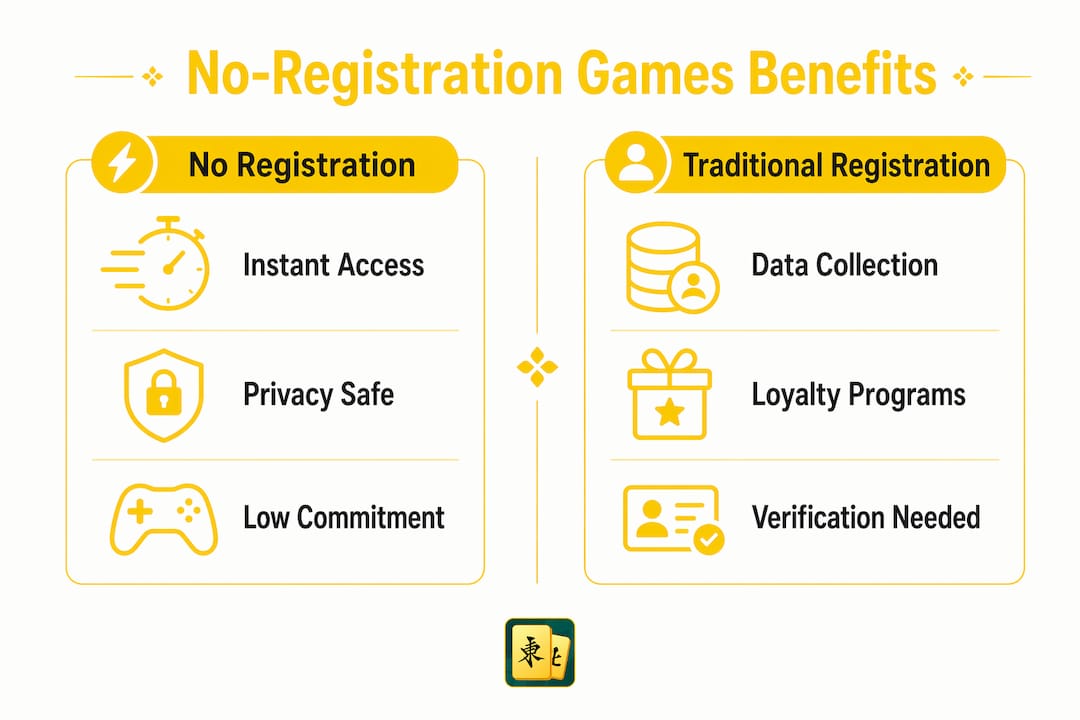
| Feature | No-registration games | Standard account systems |
|---|---|---|
| Personal data collected | None | Email, password, often more |
| Risk on shared devices | None | Stored credentials, session hijacking |
| Background analytics | Absent | Common |
| Progress storage | Local browser storage | Server-side account |
| Data breach exposure | Zero | Proportional to platform size |
Pro Tip: Modern browsers support localStorage and IndexedDB, which means a well-built no-registration game can save your progress, high scores, and settings locally without ever touching a server.
Registration gates primarily serve data collection and marketing rather than essential game functionality. Local storage can handle progress saving just as effectively. That means the account requirement you encounter on most gaming platforms is a business decision, not a technical necessity.
Do no-registration games fit modern casual gaming lifestyles?
Instant-play games fit modern lifestyle micro-moments by allowing gaming in short breaks without commitment or sunk-cost pressure. This matters because most casual gamers do not have 45-minute blocks of free time. They have five minutes on a lunch break, ten minutes waiting for a call to start, or a brief window before sleep.
Casual gaming without registration also reduces the psychological weight of trying something new. When there is no account to create and no profile to maintain, switching to a different game carries zero cost. You can try a tile-matching puzzle, decide it is not for you today, and move on without having created yet another account you will never use again.
The cognitive and emotional benefits of casual play are real. Short sessions of pattern-recognition games like Mahjong solitaire calm the mind and support working memory, particularly in older adults. The no-registration format amplifies those benefits by removing the stress of setup entirely.
Typical scenarios where no-registration games deliver clear value:
- A 10-minute commute with spotty connectivity and no time to log in
- A lunch break at work where you want mental relief, not another account to manage
- An older adult trying a browser puzzle game for the first time without tech support
- A parent letting a child try a game quickly without creating a child account
- A traveler using a hotel computer for a short session
Games that respect user time and privacy by enabling fast access and minimizing data collection achieve higher engagement and trust. That is not a coincidence. When you feel respected as a player, you return.
What design principles make no-registration games work?
Effective no-registration games rely on intuitive, emergent gameplay to teach players rather than front-loading instructions. The design philosophy is simple: put the player inside the game as fast as possible, then let the game teach itself through play. Effective no-registration games use emergent mechanics to reduce onboarding time to near zero.
The numbered steps below show how the best no-registration games reduce friction and increase immersion:
- Remove the gate entirely. The game loads directly to a playable state. No splash screen asking you to sign in.
- Teach through the first move. The interface highlights valid actions so players learn by doing, not by reading.
- Deliver instant feedback. A correct move produces an immediate visual or audio response. Players feel progress within seconds.
- Save locally by default. Browser storage captures progress automatically. Players do not lose their session when they close the tab.
- Offer optional account linking later. After a player is engaged, a gentle prompt to save progress to an account feels helpful rather than coercive.
Instant-play games succeed by reducing time-to-fun and adapting to quick, repeated short sessions rather than long continuous play. Players value repeated enjoyable moments over single marathon sessions. A game that delivers a satisfying five-minute experience ten times a week outperforms one that demands a two-hour commitment.
Guest modes improve retention by removing sign-up pressure upfront. Some platforms even reward players who skip verification with exclusive perks, then offer account linking once the player is already invested. That sequence, play first and commit later, mirrors how trust actually builds between a player and a platform.
Key Takeaways
No-registration games matter because they remove artificial barriers, protect privacy, and deliver immediate cognitive and emotional value to casual players.
| Point | Details |
|---|---|
| Instant access is the core benefit | Play starts in under 5–10 seconds, compared to multi-minute traditional signups. |
| Privacy is a design feature, not an afterthought | Zero-data games collect no PII and eliminate credential risk on shared devices. |
| Micro-session design fits real life | Short, commitment-free sessions suit commutes, breaks, and casual stress relief. |
| Friction-free design improves retention | The first 30 seconds determine whether a player stays; every gate before gameplay costs engagement. |
| Optional accounts beat mandatory ones | Offering account linking after play begins builds trust without blocking the experience. |
The case for frictionless play: a perspective worth considering
I have spent years watching people abandon games before they ever played a single move. The registration screen is where that happens. You arrive curious and leave frustrated, not because the game was bad, but because the game never got the chance to prove itself.
The argument I hear most often against no-registration design is that platforms need accounts to build loyalty. I disagree with that framing. Loyalty comes from a game that earns your return visit, not from a database entry with your email address. When a platform forces you to create an account before you know whether you even like the game, it is asking for trust it has not earned yet.
Privacy-first design does something more subtle than just protecting data. It signals respect. When a game does not ask for your email, it is telling you that your time matters more than your contact details. That signal lands. Players notice it, even if they cannot articulate why the experience feels different.
My prediction is straightforward: no-registration gaming will become the expected standard for casual play, not the exception. As players grow more aware of data practices and more protective of their attention, platforms that demand accounts upfront will lose ground to those that lead with the game itself. The freedom in online gaming that no-registration design provides is not a feature. It is the baseline players will come to expect.
The best version of this model also includes optional account linking for players who want to sync progress across devices. That balance, instant play by default and optional commitment later, is the design standard worth building toward.
— Dmytro Romaniuk
Mahjong Online Club: play instantly, no account needed
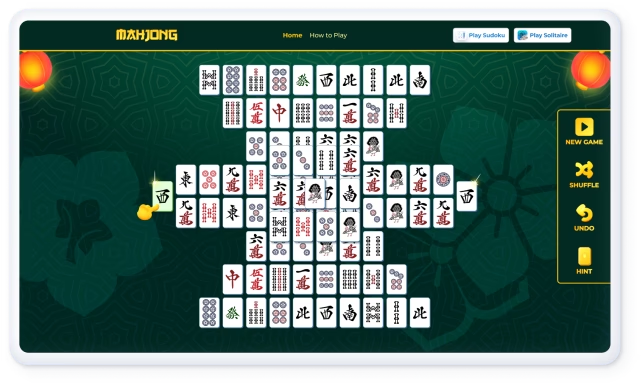
Mahjong Online Club is built around exactly the principles covered here. You open the browser, and the game is ready. No email. No password. No tutorial gate. Just tiles.
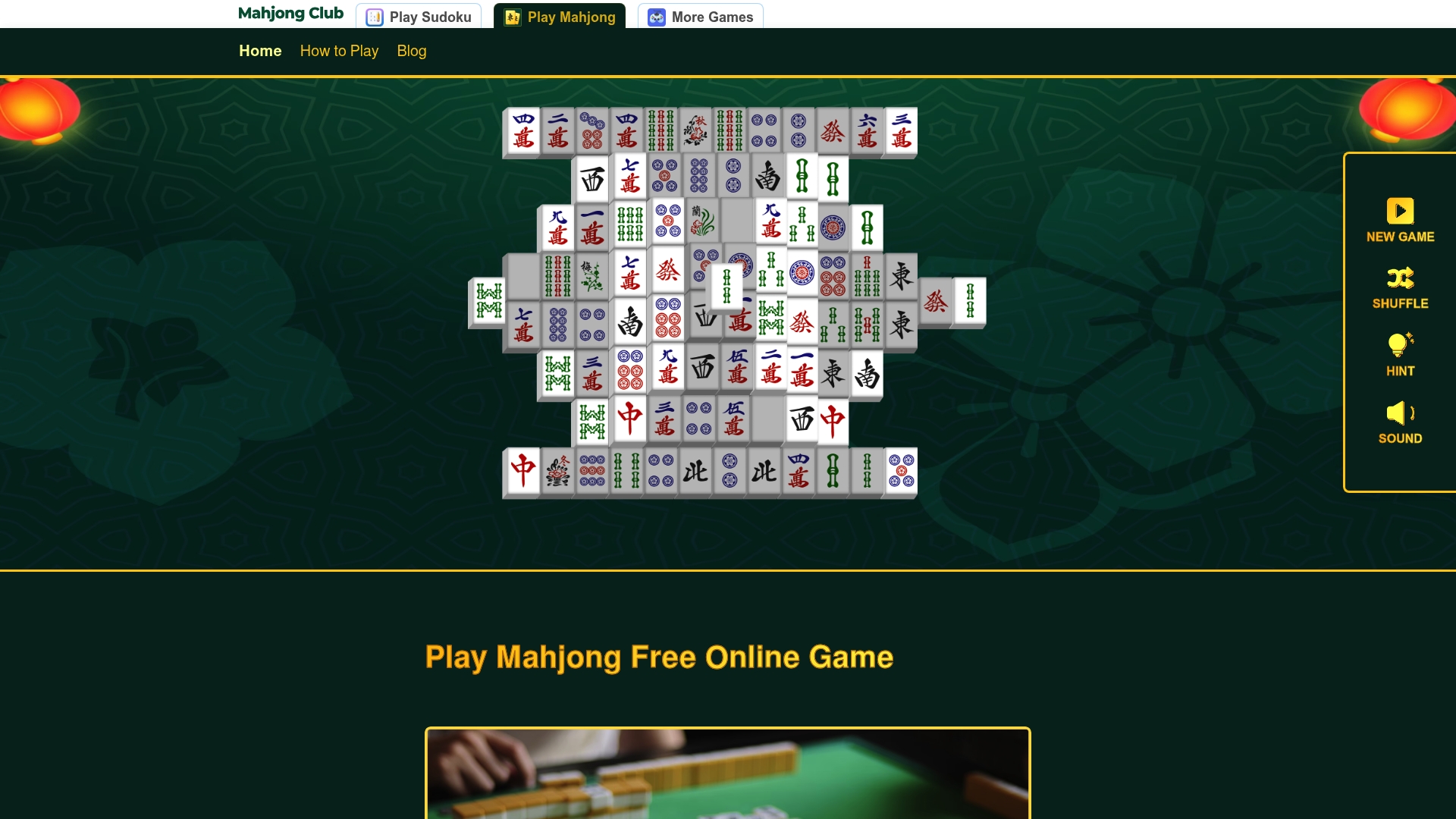
The platform offers a classic tile-matching Mahjong solitaire experience designed for focus and calm. It runs entirely in your browser, stores your progress locally, and carries no ads to interrupt your session. The cognitive benefits of Mahjong, including improved pattern recognition and working memory, are well documented, and the no-registration format means you can access those benefits in the time it takes to make a cup of coffee. Play free Mahjong now and experience what frictionless casual gaming actually feels like.
FAQ
What are no-registration games?
No-registration games are browser-based games that start immediately without requiring an account, email, or personal information. Play begins in under 5–10 seconds with zero setup.
Are no-registration games safe on shared devices?
No-registration games are more secure on shared devices because they store no login credentials. When the session ends, nothing persists in the browser.
Can no-registration games save my progress?
Many no-registration games use local browser storage to save progress automatically. No account is needed because the data stays on your device rather than a server.
Why do most games require registration if it is not necessary?
Registration gates primarily serve data collection and marketing purposes, not core game functionality. Local storage handles progress saving just as effectively without collecting personal data.
Are no-registration games good for stress relief?
Short sessions of no-registration casual games, particularly pattern-recognition puzzles like Mahjong solitaire, support stress relief and working memory. The absence of signup friction means you reach the calming gameplay faster.
Recommended
Similar Articles

Why Mahjong Needs Open Tiles First: Strategy Guide
Learn why mahjong needs open tiles first to win strategically. Master this key concept to improve your game and increase your chances of victory.
Mahjong strategy for beginners: 15 tips to win more games
Mahjong strategy for beginners: expert, data-backed tips to raise your win rate fast. Clear drills, examples, and a comparison table you can apply today.

Mahjong Game Versions: Key Differences Explained
Explore the key differences between mahjong game versions to choose the best one for you. Master the rules and enhance your gameplay!