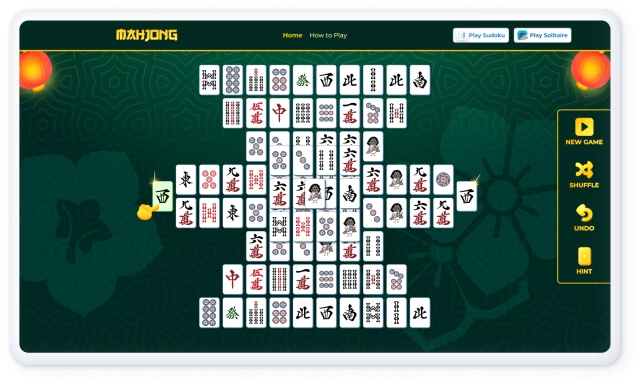
Mahjong Turtle Layout: Structure, Rules, and Strategy
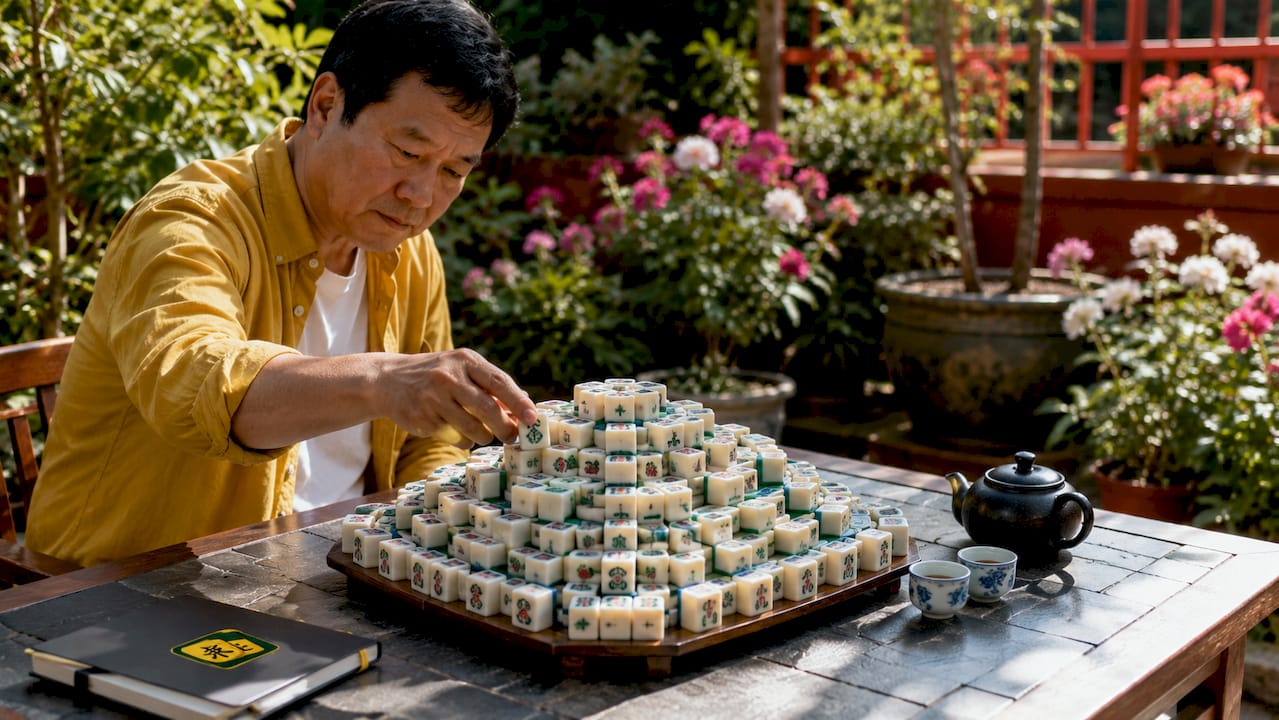
Mahjong Turtle Layout: Structure, Rules, and Strategy
The Mahjong Turtle layout is a layered, turtle-shaped tile configuration used in Mahjong Solitaire that requires players to match free tile pairs to clear the board. Unlike symmetric layouts such as the Pyramid or Cross, the Turtle's asymmetric design creates structural traps that catch even experienced players off guard. A typical session runs about 10 to 15 minutes under focused play, making it a satisfying challenge for a short break or a deliberate practice session. Mahjong Online Club features the Turtle layout as part of its free, no-registration browser game library, paired with guides designed to build real skill rather than luck.
What is the Mahjong Turtle layout?
The Mahjong Turtle layout is defined as a four-layer pyramid arrangement of 144 tiles with perimeter extensions that visually resemble a turtle shell, head, and four limbs. That structure is what separates it from simpler configurations and gives it a recognizable silhouette on screen. The goal is identical to all Mahjong Solitaire variants: remove every tile from the board by matching identical free pairs until none remain.
Mahjong Solitaire itself is a modern invention. Brodie Lockard created the game in 1981 for screen play, not as a continuation of the traditional Chinese tile game. That origin matters because the Turtle layout, like all Solitaire layouts, was designed with visual clarity and puzzle logic in mind rather than cultural ritual. Understanding this helps you approach it as a puzzle with solvable rules rather than a game of chance.
The Turtle layout sits at a medium-to-high difficulty level among common Mahjong Solitaire configurations. Its combination of deep stacking in the center and irregular extensions at the edges means you rarely have a clear, obvious path forward. That ambiguity is exactly what makes it worth learning.

How does the Turtle layout differ from other Mahjong Solitaire layouts?
The Turtle layout's most defining structural feature is its asymmetry. Most beginner-friendly layouts, such as the Pyramid or Cross, use mirrored tile placement so that clearing one side gives you a reliable read on the other. The Turtle does not work that way.
Here is what makes the Turtle layout structurally distinct:
- Four stacked layers in the center. The central pyramid rises to four tile layers, creating deep blocking chains that restrict access to tiles buried underneath.
- Irregular perimeter extensions. The head, tail, and limb extensions add tiles outside the main pyramid body. These extensions look simple but often hold critical pairs that unlock the center.
- 144 tiles total. That count matches the standard full set used in traditional Mahjong, but the Turtle's arrangement distributes those tiles unevenly across the board.
- No mirrored wing structure. Unlike symmetric layouts, the left and right sides of the Turtle do not mirror each other. A move that works on the left side has no guaranteed equivalent on the right.
- Variable tile accessibility. Because of the layering and asymmetry, the number of free tiles at any given moment is lower than in flatter layouts, which shrinks your available moves faster.
That combination of deep stacking and asymmetric extensions is why the Turtle layout demands a different mental model than most players bring to it. You cannot rely on visual balance to guide your decisions. You have to read the actual structure.
What are the core rules for playing the Turtle layout?
The rules for the Turtle layout follow the standard Mahjong Solitaire ruleset, but understanding them precisely is what separates players who clear the board from those who get stuck.
Identify free tiles first. A tile is free only if no tile rests on top of it and at least one side, left or right, is unblocked. Both conditions must be true simultaneously. A tile with one side open but another tile stacked on it is not free.
Match free tiles in identical pairs. Two free tiles match when they belong to the same suit and rank, or when they are from the special Flower or Season sets, which match any tile within their own group. Matched pairs are removed together.
Clear all 144 tiles to win. The game ends in a win when the board is empty. It ends in a loss when no free matching pairs remain, even if tiles are still on the board.
Respect the stacking order. Tiles in the upper layers of the Turtle's central pyramid block every tile directly beneath them. You cannot access a buried tile until all tiles above it are removed. This stacking chain is the primary source of difficulty.
Monitor your free tile count actively. As you remove pairs, new tiles become free. Each removal can open or close future moves depending on what it exposes. Tracking this in real time is the core skill the Turtle layout develops.
Recognize a stuck board early. When no free matching pairs exist, the game is over regardless of how many tiles remain. Roughly 3% of Turtle layout games cannot be solved even with perfect play due to tile arrangement. Knowing this prevents frustration when a board simply cannot be cleared.
A typical Turtle session under these rules runs 10 to 15 minutes. That window is long enough to require sustained focus but short enough to complete in a single sitting.
What are the common strategic pitfalls in the Turtle layout?
The Turtle layout punishes players who rely on instinct rather than analysis. The most common mistakes follow predictable patterns, and recognizing them early saves you from repeated dead ends.
The symmetry instinct trap is the single biggest pitfall. The symmetry instinct misleads players into clearing tiles on both sides of the board in a mirrored sequence, as if the layout were balanced. The Turtle is not balanced. Clearing symmetrically creates asymmetric traps where one side runs out of accessible pairs while the other side still has tiles locked under blockers.
Asymmetric traps occur when you deplete one wing of the board faster than the other. Once a wing is exhausted, the tiles it would have unlocked in the center remain blocked. You end up with free tiles on one side and no matching partners available because their pairs are buried under the opposite side's remaining stack.
Other frequent issues include:
- Ignoring the extensions. The head, tail, and limb tiles look peripheral, but they often hold the only accessible copy of a tile whose partner is buried deep in the center. Clearing extensions early can unlock critical center pairs.
- Chasing obvious matches. Matching the first free pair you see feels productive but often removes tiles that were protecting a buried blocker. The visual satisfaction of a quick match can cost you three moves later.
- Tile isolation. Isolated tiles get trapped without accessible matching partners, which ends the game prematurely. This happens most often when players clear one tile type too aggressively without confirming both copies are accessible.
Pro Tip: Before making any match, scan the entire board for tiles that have only one accessible copy. If the second copy is buried, that tile is a structural blocker. Protect it until you can free the buried partner.
How do you clear the Turtle layout successfully?
Clearing the Turtle layout consistently requires a disciplined approach built around analysis before action. Speed is not the goal. Board reading is.
The table below compares two common approaches and their outcomes:
| Approach | Method | Typical Outcome |
|---|---|---|
| Visual clearing | Match the first obvious free pair available | Creates asymmetric traps; high failure rate |
| Blocker-first analysis | Identify structural blockers before matching | Preserves critical pairs; higher clear rate |
The "boring-move-first" habit is the most effective technique for the Turtle layout. Spend the first two minutes counting free tiles, identifying which tiles appear only once in the free zone, and mapping which center tiles are buried deepest. This analysis feels slow, but it prevents the irreversible mistakes that end games early.
Practical steps for a successful Turtle layout session:
- Count how many copies of each tile type are currently free. If only one copy is accessible, that tile is a priority blocker.
- Clear the extensions first when they hold tiles whose center partners are visible. This creates a chain of unlocks moving inward.
- Avoid clearing both wings symmetrically. Work one side until you hit a blocker, then shift to the other side to unlock it.
- Pace your removals. Remove a pair, then pause and reassess the board before making the next match.
- Track your progress by layer. Once the top layer of the central pyramid is gone, the second layer becomes your new priority map.
Pro Tip: If you find yourself with fewer than six free tiles and no matching pairs among them, restart the board. The game is statistically unlikely to be solvable from that position, and restarting costs less time than searching for a move that does not exist.
The tile order principle applies directly here: the sequence in which you remove tiles determines which future moves exist. Every match is a decision about what you will be able to do three moves from now, not just what you can do right now.
Key Takeaways
The Turtle layout rewards players who analyze the board structure before making any move, not those who clear tiles quickly.
| Point | Details |
|---|---|
| Turtle layout structure | 144 tiles in a four-layer asymmetric pyramid with head, tail, and limb extensions. |
| Free tile rule | A tile is free only when nothing rests on top and at least one side is unblocked. |
| Symmetry trap | Clearing both wings symmetrically creates asymmetric traps that end games early. |
| Boring-move-first habit | Spend the opening minutes counting blockers and mapping buried tiles before matching. |
| Unsolvable boards exist | Roughly 3% of Turtle layout games cannot be cleared even with perfect play. |
The Turtle layout taught me to stop trusting my eyes
The first time I played the Turtle layout seriously, I thought the shape was the challenge. It looked complicated, so I assumed clearing it quickly would feel like an achievement. I was wrong. The shape is not the challenge. The asymmetry is.
What I kept doing, and what I see most players do, is treat the Turtle like a symmetric layout. The brain wants balance. It sees a tile cleared on the left and reaches for its mirror on the right. That instinct is the enemy here. The Turtle's extensions are not decorative. They are functional blockers placed deliberately off-center, and the moment you ignore them in favor of the visually satisfying center pyramid, you have already lost the game you are still playing.
The real skill the Turtle layout builds is patience with ambiguity. You will often be three or four moves in before you understand what the board is actually asking you to do. That discomfort is the point. Players who learn to sit with an unclear board and read it carefully rather than act on the first available match develop a board-reading skill that transfers to every other layout they encounter.
My honest recommendation: play the Turtle layout when you have 15 uninterrupted minutes and a willingness to restart without frustration. The 3% of boards that are genuinely unsolvable are not failures of skill. They are reminders that the puzzle, not the player, sometimes sets the terms. Accepting that is part of getting better.
— Dmytro Romaniuk
Practice the Turtle layout free at Mahjong Online Club
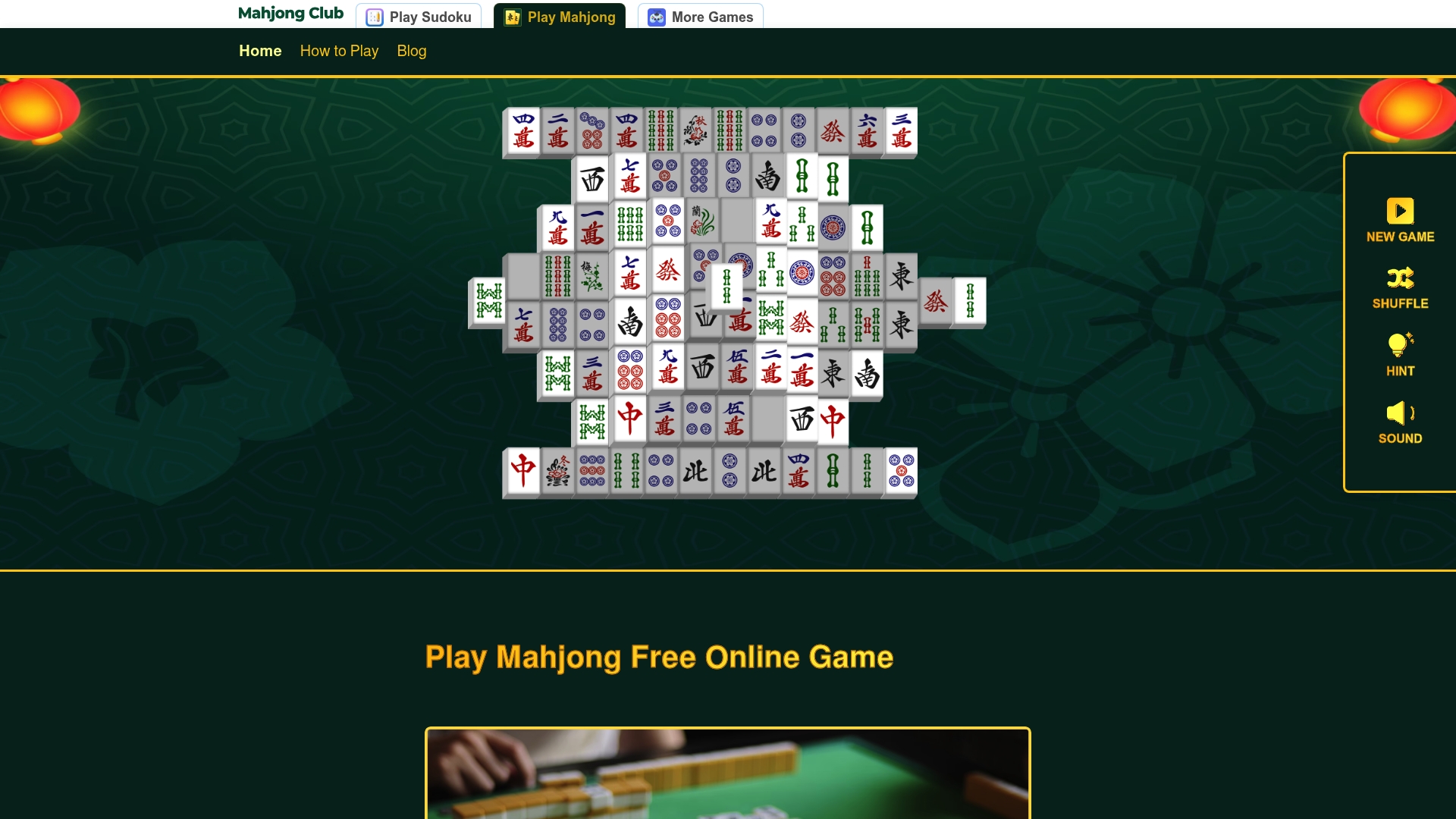
Mahjong Online Club offers the Turtle layout as a free browser game with no sign-up required. You can play Mahjong online directly, with a clean interface built for focus rather than distraction. The platform also provides a detailed rules and strategy guide covering free tile mechanics, blocker identification, and layout-specific tips that apply directly to the Turtle configuration. Whether you are working through your first Turtle session or refining your blocker-first approach, Mahjong Online Club gives you the tools and the practice space to improve at your own pace.
FAQ
What is the Mahjong Turtle layout made of?
The Turtle layout consists of 144 tiles arranged in a four-layer pyramid with perimeter extensions forming a head, tail, and four limbs. This structure resembles a turtle shell and creates the asymmetric blocking chains that define the layout's difficulty.
How do you know if a tile is free in the Turtle layout?
A tile is free when no tile rests on top of it and at least one side, left or right, is unblocked. Both conditions must be true at the same time before you can select and match the tile.
Why does the Turtle layout feel harder than other Mahjong layouts?
The Turtle layout is asymmetric, which means the clearing strategy that works on one side does not mirror to the other. Players who rely on symmetric clearing instincts fall into traps that block critical pairs and end the game early.
Can every Turtle layout game be solved?
No. Roughly 3% of Turtle layout games cannot be solved even with perfect play, due to how certain tile pairs are buried and blocked at the start. Recognizing an unsolvable board early and restarting saves time.
How long does a Turtle layout game typically take?
A focused Turtle layout session runs about 10 to 15 minutes. That duration makes it well-suited for deliberate practice, long enough to require sustained strategic thinking but short enough to complete in one sitting.
Recommended
Similar Articles

Why Some Mahjong Games Are Unsolvable: 2026 Guide
Discover why some mahjong games are unsolvable. This 2026 guide explores layout, strategy, and mechanics to enhance your gameplay.
What Are Honor Tiles in Mahjong: Beginner's Guide
Discover what honor tiles in Mahjong are and how they enhance your game. Learn to build winning hands and play with confidence!
Mahjong strategy for beginners: 15 tips to win more games
Mahjong strategy for beginners: expert, data-backed tips to raise your win rate fast. Clear drills, examples, and a comparison table you can apply today.