What Are Honor Tiles in Mahjong: Beginner's Guide
What Are Honor Tiles in Mahjong: Beginner's Guide
Honor tiles in Mahjong are defined as a distinct category of tiles that carry no numerical rank or suit, setting them apart from the three suited tile groups. Unlike bamboo, circles, or characters tiles, honor tiles cannot form sequences and are used exclusively to build triplets (pungs) or quads (kongs). Every Mahjong set contains two types of honor tiles: wind tiles and dragon tiles. Understanding what honor tiles are and how they function is one of the first skills that separates a confused beginner from a player who builds legal, high-scoring hands with confidence.
What are honor tiles in Mahjong and how are they categorized?
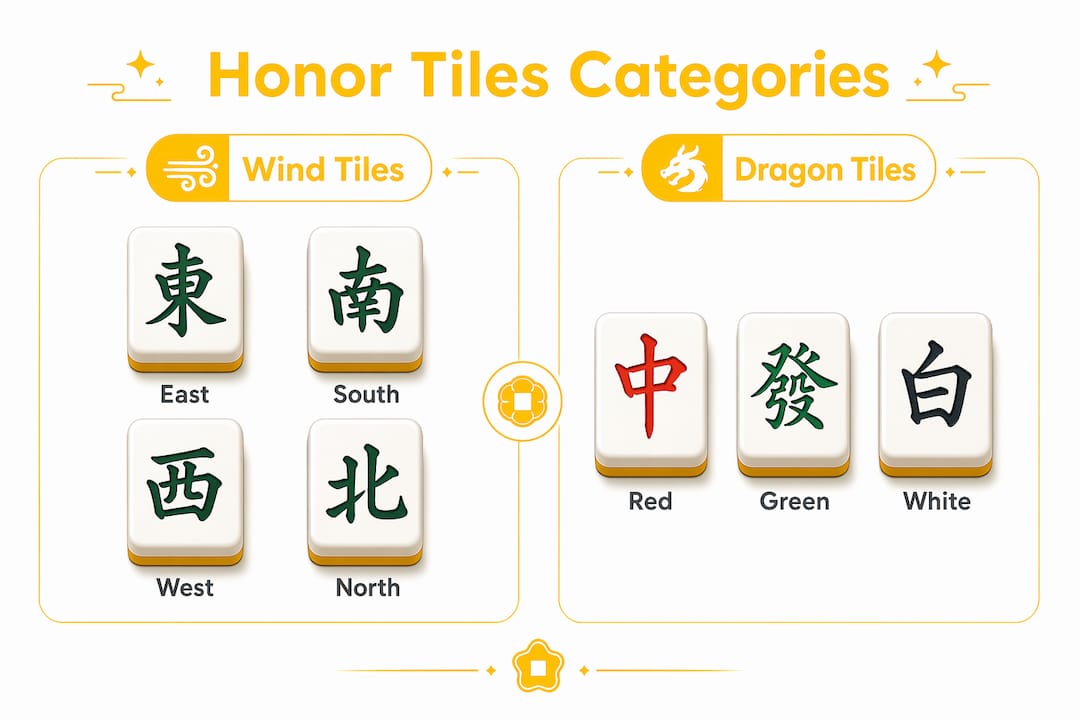
Honor tiles are split into two groups: wind tiles and dragon tiles. Together, these seven distinct tile types form the complete honor tile category, and each group plays a different role in hand construction and scoring.
Wind tiles: the four directions
Wind tiles represent the four cardinal directions: East, South, West, and North. A standard Mahjong set contains 16 wind tiles total, with four copies of each direction. Wind tiles carry strategic weight beyond their face value because each player at the table is assigned a seat wind, and the round itself has a prevailing wind. Forming a triplet of your seat wind or the round wind earns bonus points, which makes wind tiles more than decorative. You can read more about how wind tile roles shift depending on your seat position in a full setup guide.
Dragon tiles: the three types
Dragon tiles come in three varieties: Red Dragon (Chun), Green Dragon (Hatsu), and White Dragon (Haku). Each dragon type has four copies in a standard set, giving you 12 dragon tiles total. The Red Dragon is typically marked with a Chinese character meaning "center," the Green Dragon with a character meaning "prosperity," and the White Dragon is often a blank or lightly bordered tile. Forming a triplet of any dragon tile scores bonus points in most rule sets, making dragons reliable targets for scoring melds.
Here is a quick reference for all seven honor tile types:
- East Wind (4 tiles): Seat wind for the dealer; round wind in the East round
- South Wind (4 tiles): Seat wind for the player to the dealer's right
- West Wind (4 tiles): Seat wind for the player across from the dealer
- North Wind (4 tiles): Seat wind for the player to the dealer's left
- Red Dragon (4 tiles): Scores bonus points as a triplet in all major rule sets
- Green Dragon (4 tiles): Scores bonus points as a triplet in all major rule sets
- White Dragon (4 tiles): Blank or bordered tile; called "Soap" in American Mahjong
Pro Tip: When you first open a Mahjong set, sort the honor tiles into their seven groups before your first game. Physical familiarity with each tile's markings cuts recognition time in half during live play.
How do honor tiles work differently from suited tiles?
The single most important rule governing honor tiles is that they cannot form sequences. This restriction shapes every decision you make when holding them. To understand why this matters, you need to understand the two types of melds in Mahjong.
A sequence (called a chow) is a run of three consecutive numbered tiles from the same suit, such as 3, 4, and 5 of bamboo. A triplet (called a pung) is three identical tiles. A quad (called a kong) is four identical tiles. Suited tiles can form either sequences or triplets. Honor tiles can only form triplets or quads. There is no such thing as an East, South, West sequence.
This restriction has direct consequences for how you build your hand:
- Honor tiles require three identical copies. To complete a meld with an East Wind tile, you need all three remaining East Wind tiles in your hand or claimed from discards. This is harder than completing a sequence, which only requires two specific neighbors.
- Isolated honor tiles are often discard candidates. If you hold a single wind or dragon tile with no second copy in sight, that tile contributes nothing to your hand. Experienced players discard isolated honors early to improve tile efficiency.
- Holding two of the same honor tile is a calculated risk. Two matching honor tiles (a pair) can become a pung if you draw or claim the third, but they block two hand slots until that happens. Weigh the scoring bonus against the tempo cost.
- Honor tiles cannot rescue a broken sequence. If you hold 4 and 6 of bamboo, a 5 of bamboo completes your sequence. No honor tile can fill that gap. Beginners sometimes hold honor tiles hoping they will "fit somewhere," which they never will.
- Discarding honor tiles is a defensive tool. Because honor tiles are strategically discarded when they do not match a player's seat wind or target dragon, they are generally safer discards early in the round. Other players are less likely to complete a pung from a single discard unless they already hold two matching tiles.
Pro Tip: Treat any honor tile you hold as a binary decision: either you are actively building a triplet with it, or you discard it. Holding an honor tile "just in case" is one of the most common tempo mistakes beginners make.
Why honor tiles matter for scoring and strategy
Honor tiles often yield higher points than equivalent suited tile melds, and certain hands built entirely from them rank among the most valuable in the game. Understanding their scoring weight helps you decide when to pursue them and when to let them go.
A triplet of dragons or seat winds scores bonus points in Chinese Mahjong, Japanese Riichi Mahjong, and most American Mahjong rule sets. The exact point values vary by variant, but the principle is consistent: honor tile pungs are worth more than suited tile pungs of the same structure. This scoring premium exists because honor tiles are harder to complete, given that they require three identical tiles rather than three consecutive ones.
The highest expression of honor tile strategy is the "All Honors" hand, where your entire winning hand consists of honor tile melds. All Honors is a limit hand in most rule sets, meaning it scores the maximum possible points for a single win. Limit hands are rare by design, and All Honors is one of the hardest to achieve because it demands six or more honor tiles of matching types plus a pair.
Here is how honor tiles factor into both offensive and defensive play:
- Offensive use: Target dragon triplets early if you draw two matching dragons in your opening hand. Dragon pungs score reliably and do not require chasing specific suited tiles.
- Defensive use: Discarding your non-seat, non-target wind tiles in the first few turns reduces your hand size without giving opponents useful tiles. Most players are not building pungs of every wind simultaneously.
- Risk management: Holding two matching honor tiles past the midgame is a commitment. If the third copy has already been discarded, release your pair and redirect your hand.
- Pair value: One pair of honor tiles serves as the required pair (the "eyes") in a winning hand. A pair of dragons or your seat wind as the eyes adds no bonus points in most rule sets, but it satisfies the structural requirement without using a suited tile.
"Honor tiles are the clearest example of high risk, high reward in Mahjong. A single dragon triplet can swing the score of an entire round. Knowing when to chase one and when to fold is the mark of a player who understands the game beyond the basics."
For a broader look at how tile categories interact during hand construction, the full tile meanings guide covers suits, honors, and flowers together.
How do honor tiles differ in American Mahjong?
American Mahjong uses a modified tile set that changes how some honor tiles are counted, named, and used. Standard sets contain 144 to 152 tiles depending on the variant, with American sets reaching 152 tiles by including jokers. Wind and dragon tiles remain the core honor tiles across all variants, but the details shift.
The most notable difference is the White Dragon. In American Mahjong, the White Dragon is called "Soap" because the tile's blank or lightly etched surface resembles a bar of soap. Beyond its name, the White Dragon serves a dual role in American Mahjong: it functions as a standard honor tile and can also act as a zero in certain hands, adding a layer of strategic flexibility not found in Chinese or Japanese rule sets.
Flower tiles present another key difference. In Chinese and Japanese Mahjong, flower tiles are bonus tiles set aside when drawn, triggering a replacement draw rather than forming melds. In American Mahjong, flower tiles are treated like honor tiles and incorporated directly into hand construction. This distinction matters because beginners learning from Chinese Mahjong resources may mishandle flower tiles when switching to an American set.
| Feature | Chinese/Japanese Mahjong | American Mahjong |
|---|---|---|
| Wind tiles | 16 tiles (4 per direction) | 16 tiles (4 per direction) |
| Dragon tiles | 12 tiles (4 per type) | 12 tiles (4 per type) |
| White Dragon name | Haku or White Dragon | Soap |
| White Dragon function | Standard honor tile only | Honor tile and zero substitute |
| Flower tiles | Bonus tiles, set aside | Treated as honor tiles in hands |
| Joker tiles | Not included | 8 jokers included in 152-tile sets |
Design differences cause confusion for players switching between sets, but once you learn the symbols specific to your set, identifying honor tiles becomes as automatic as recognizing suited tiles. If you are playing American Mahjong, take time to study the National Mah Jongg League card, which defines legal hands each year and specifies exactly how honor tiles appear in scoring combinations. For a direct comparison of rule sets, the Chinese vs. American Mahjong breakdown covers the full structural differences.
Key takeaways
Honor tiles are the foundation of high-scoring Mahjong hands, and mastering their rules and recognition is the fastest path from beginner to confident player.
| Point | Details |
|---|---|
| Honor tiles defined | Wind and dragon tiles with no suit or number, forming only triplets or quads. |
| Seven tile types | Four wind tiles (East, South, West, North) and three dragon tiles (Red, Green, White). |
| No sequences allowed | Honor tiles cannot form chows; misusing them in sequences creates illegal hands. |
| Scoring premium | Dragon and seat wind triplets score bonus points; All Honors is a limit hand. |
| American Mahjong differences | White Dragon doubles as a zero tile; flower tiles are treated as honor tiles. |
Why beginners underestimate honor tiles
I have watched hundreds of new players make the same mistake: they treat honor tiles as filler, holding them too long or discarding them without a plan. That habit costs tempo and points in equal measure.
Recognizing honor tiles quickly is the skill that moves a player from beginner to intermediate, and it is more trainable than people expect. The moment you can glance at your rack and instantly categorize every tile as suited or honor, your decision speed improves across the whole game. You stop second-guessing discards and start reading the table instead.
The strategic depth of honor tiles surprises most beginners. They look simple because they have no numbers, but that simplicity is deceptive. A dragon triplet claimed at the right moment can anchor an entire hand. A well-timed discard of an off-wind tile can signal to experienced opponents that you know what you are doing. These are not advanced concepts. They are the natural result of understanding the rules clearly from the start.
My advice: before your next session, spend five minutes sorting a physical or digital tile set and naming every honor tile out loud. It feels basic, but tile symbol familiarity is the foundation that every other strategy builds on. You cannot make good decisions about tiles you cannot instantly identify.
— Dmytro
Practice honor tile recognition with Mahjong-online
The fastest way to internalize honor tile rules is to play with them repeatedly in a low-pressure setting. Mahjong-online offers free, browser-based Mahjong you can start immediately without creating an account.
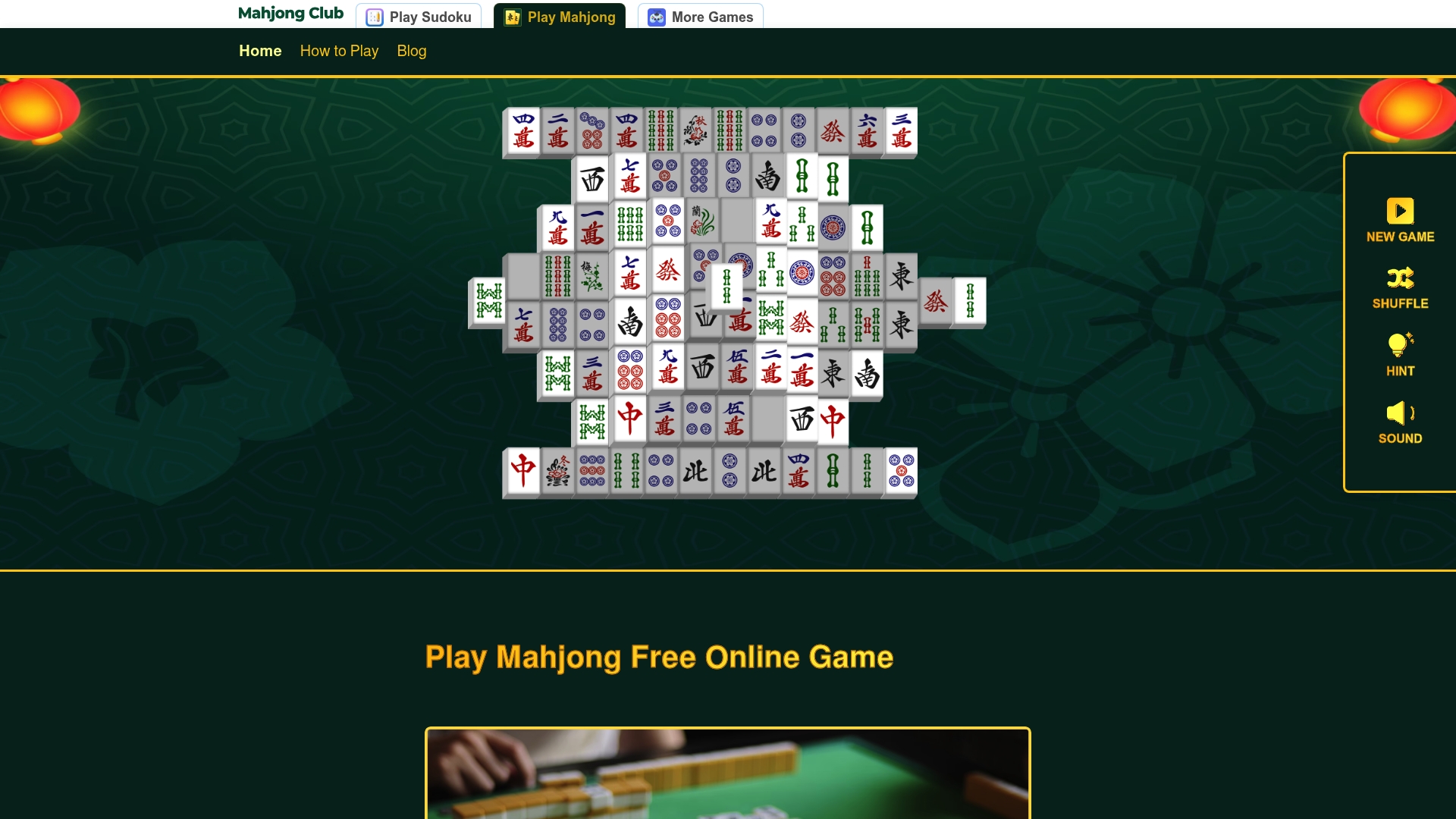
The platform at Mahjong-online is designed specifically for focused, distraction-free play, which makes it ideal for building tile recognition habits. You will see wind and dragon tiles in every game, and the repetition of matching and identifying them trains pattern recognition faster than reading alone. The how-to-play guide on the site also walks through tile functions in detail, giving you a reference point as you practice. No downloads, no sign-up, and no ads interrupting your focus.
FAQ
What are honor tiles in Mahjong?
Honor tiles are wind tiles (East, South, West, North) and dragon tiles (Red, Green, White) that carry no numerical rank or suit. They can only form triplets or quads, never sequences.
Can honor tiles be used in sequences?
No. Honor tiles cannot form sequences (chows) under any rule set. Placing them in a sequence creates an illegal hand that cannot be scored.
How many honor tiles are in a standard Mahjong set?
A standard set contains 28 honor tiles: 16 wind tiles (four copies of each direction) and 12 dragon tiles (four copies of each type).
What is the White Dragon in American Mahjong?
The White Dragon is called "Soap" in American Mahjong and can function as a zero tile in certain hands, giving it more strategic flexibility than in Chinese or Japanese rule sets.
Are flower tiles the same as honor tiles?
In Chinese and Japanese Mahjong, flower tiles are bonus tiles separate from honor tiles. In American Mahjong, flower tiles are treated like honor tiles and used directly in hand construction.