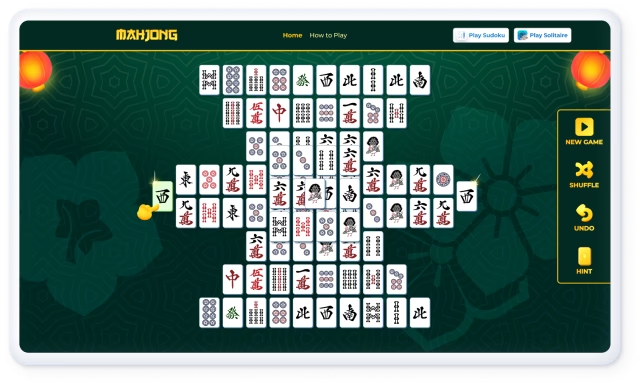
Mahjong High Score Optimization: A Complete Strategy Guide

Mahjong High Score Optimization: A Complete Strategy Guide
Mahjong high score optimization is the deliberate practice of maximizing your point total by balancing offensive hand-building with defensive risk management, guided by a clear understanding of scoring mechanics and game state. Most players treat scoring as an afterthought, but the players who consistently top the leaderboard treat every discard as a calculated decision. This guide covers the core principles of score optimization across variants, from tile efficiency and mahjong scoring strategies to situational awareness and tilt control, giving you a complete framework whether you are just starting out or refining an expert game.
What is Mahjong high score optimization?
Mahjong high score optimization is the recognized practice of structuring every decision around expected point gain relative to risk. The standard industry term for this discipline is "expected value play," and it applies across Chinese, Japanese Riichi, and American Mahjong variants. The core insight is simple: a moderate-value hand you actually win beats a high-value hand you never complete.
Scoring systems differ sharply by variant, and those differences shape every strategic choice you make. Japanese Riichi Mahjong uses Han and Fu to calculate base points, then multiplies by a power-of-two formula. Chinese Mahjong variants award flat point values for specific patterns. American Mahjong uses a fixed scoring card updated annually by the National Mah Jongg League. Each system rewards different hand types, which means the right optimization strategy in one variant can be completely wrong in another.
| Variant | Scoring unit | Key multiplier | Limit hand |
|---|---|---|---|
| Japanese Riichi | Han + Fu | Power-of-two formula | Mangan (8,000 pts) |
| Chinese Official | Fan points | Flat pattern values | None standard |
| American (NMJL) | Fixed card values | None | Card maximum |
| Hong Kong | Fan | Doubling per fan | Varies by table |
Scoring in Riichi Mahjong is non-linear with limit hands like mangan, which means once you hit the threshold, chasing additional Han adds zero extra payout. That single fact changes everything. A player who understands the mangan cliff stops burning tiles trying to add one more Han and instead shifts focus to speed or safety. Recognizing these scoring thresholds is the foundation of true score optimization.
How to build high-value hands with tile efficiency
Tile efficiency is the engine of offensive score optimization. Tile efficiency involves preferring two-sided waits, middle tiles, and pairs to speed hand completion and improve winning odds. A two-sided wait on 4-5 tiles, for example, accepts both 3 and 6, doubling your draw-in chances compared to a one-sided wait on 1-2 tiles. That difference compounds over a full game.
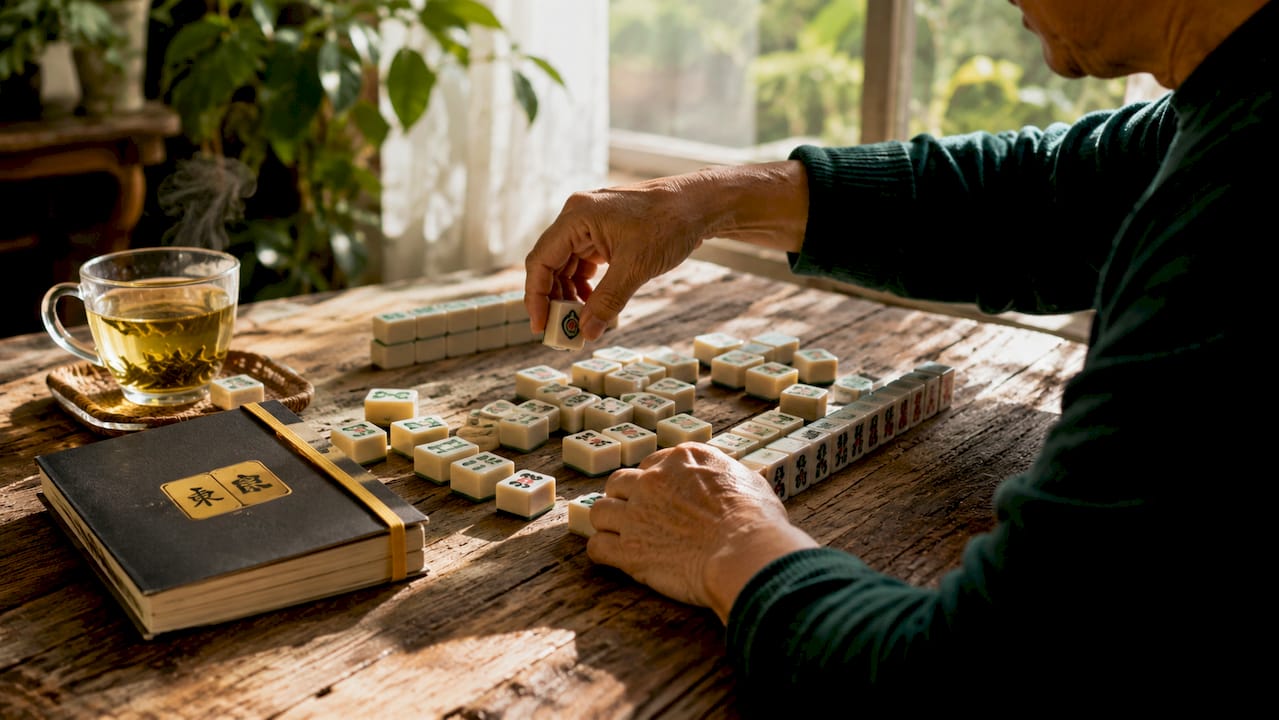
Building a high-value hand efficiently requires balancing hand value against speed based on where you are in the game. Early in the East round, you have time to build a complex hand. Late in the South round, speed wins. The most common mistake intermediate players make is locking into a hand shape too early and refusing to adapt when the board changes.
Key offensive principles for maximizing your score:
- Prioritize two-sided waits over one-sided or single-tile waits whenever possible, even if it means dropping a slightly higher-value tile.
- Keep middle tiles (4, 5, 6 in each suit) longer than terminal tiles (1, 9), because they connect to more combinations.
- Maintain at least one pair at all times to preserve your ability to declare a complete hand quickly.
- Target the mangan threshold in Riichi Mahjong rather than chasing yakuman, which is statistically rare.
- Recognize high-value hand patterns early so you can commit to them before your hand becomes too fragmented.
Intermediate players often fall into "chasing syndrome," pursuing unlikely high-value hands while neglecting safer guaranteed wins. Chasing syndrome is expensive. Every round you spend chasing a hand you never complete is a round your opponents use to build leads. Discipline in adjusting your hand goal mid-game separates consistent scorers from streaky ones.
Pro Tip: Use a scoring reference table during practice sessions to internalize which hand combinations cross the mangan threshold. Once that knowledge becomes automatic, your in-game decision speed increases noticeably.
What defensive tactics protect your score?
Defense is not passive play. Defense is active score protection, and it accounts for the majority of score optimization gains that players leave on the table. Dealing into an opponent's hand accounts for approximately 75% of losses in four-player Mahjong. That number means your single biggest scoring lever is not building better hands. It is avoiding paying out to opponents.
Safe discard selection follows a clear hierarchy:
- Discard tiles already on the table. A tile another player has already discarded is almost always safe to play. Opponents cannot win on a tile that is already visible in the discard pool.
- Apply suji theory. If a player has discarded a 4, the tiles 1 and 7 in the same suit are mathematically safer, because a two-sided wait on 4-5 or 4-3 would have already been satisfied.
- Avoid suits opponents are collecting. Watch call patterns carefully. A player who calls chi or pon on bamboo tiles is building a bamboo hand. Stop feeding bamboo into the pool.
- Fold when the math says fold. If your hand is two or more tiles from completion and an opponent is one tile away, the expected cost of dealing in exceeds the expected gain from winning.
Reading opponents through their discard patterns is a skill that compounds over time. Safe discards use already discarded tiles, suji theory, and suit avoidance as the three primary tools. Each tool gives you a different layer of information. Used together, they let you navigate a dangerous board without guessing.
Pro Tip: Track which suits each opponent has discarded in the first four turns. That early data tells you which suits are safe and which are being hoarded, giving you a defensive map for the rest of the round.
The 17 risk-reducing tactics documented by Mahjong Online Club cover the full defensive spectrum, from basic safe tile selection to advanced fold decisions. Studying that framework alongside your offensive game builds the cross-skill integration that separates good players from great ones.
How does game state change your scoring strategy?
Game state is the variable most players underweight. The right hand to build in round one is often the wrong hand to build in the final round. Score optimization is situational, meaning the best choice depends on your current placement, the round, and what your opponents need.
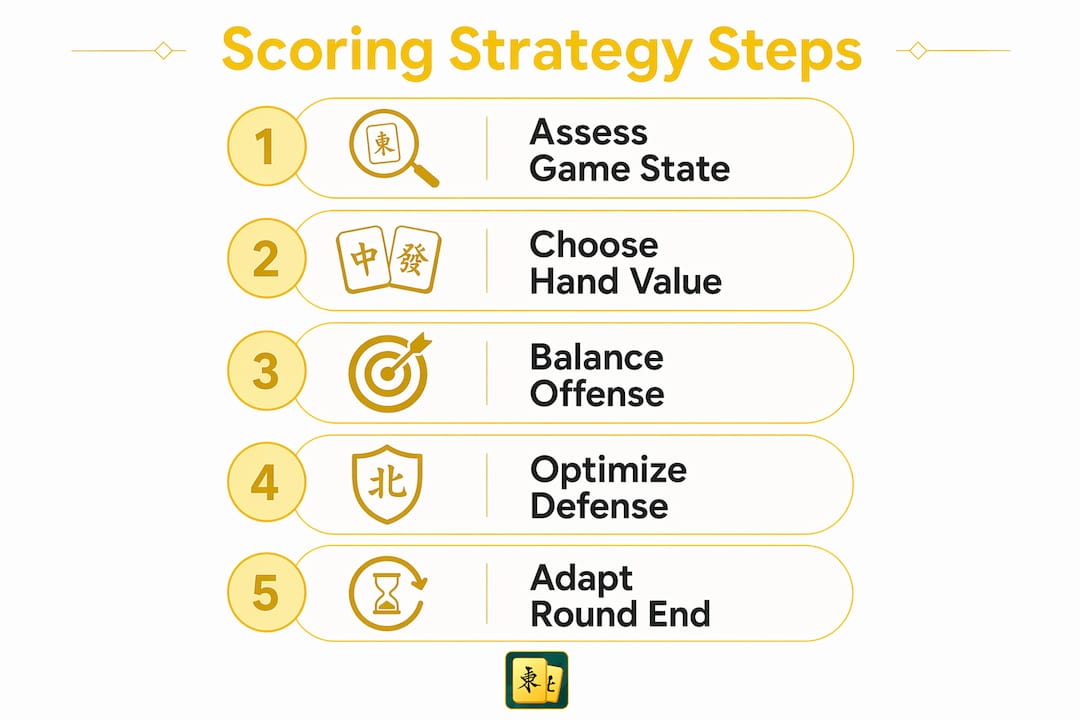
| Situation | Recommended approach | Reasoning |
|---|---|---|
| Leading in final round | Build fast, cheap hands | Protect lead; avoid dealing into comeback hands |
| Trailing by large margin | Target high-value hands | Only big wins close the gap |
| Dealer position | Push for wins aggressively | Dealer wins extend your turn and add bonus points |
| Non-dealer, mid-game | Balance speed and value | Consistent small wins accumulate effectively |
| All-last round, close scores | Calculate exact score needed | Math overrides normal hand-building logic |
The All-last round deserves special attention. All-last situations modify strategy fundamentally, because the mathematics of score and risk override normal hand-building logic. If you need exactly 3,200 points to move from third to second place, you do not need mangan. You need a hand worth 3,200 points, and you need it fast. Chasing a bigger hand in that spot is a mistake that costs placement.
Scoring cliffs work in both directions. Scoring curves have thresholds where incremental value no longer raises payout, so recognizing these cliffs shifts strategy from value to speed or defense. When you are already above the threshold, adding more value is wasted effort. Redirect that effort into winning faster or defending harder.
The puzzle-solving mindset that drives strong situational play is the same cognitive skill that benefits puzzle game players broadly, including improved pattern recognition and working memory. Those skills transfer directly to reading a Mahjong board under pressure.
Key Takeaways
Mahjong high score optimization requires combining tile efficiency, defensive discipline, and situational awareness, not just building the highest-value hand possible.
| Point | Details |
|---|---|
| Understand scoring thresholds | Recognize mangan and other limit hands to stop chasing value that adds no extra payout. |
| Prioritize tile efficiency | Use two-sided waits and middle tiles to complete hands faster and win more often. |
| Defense drives score gains | Avoiding the 75% of losses caused by dealing in is your biggest single scoring lever. |
| Adapt to game state | Adjust hand goals based on round, placement, and opponent threat level every turn. |
| Avoid chasing syndrome | Discipline in switching hand goals mid-game separates consistent scorers from streaky ones. |
Why most players optimize the wrong thing
I have watched hundreds of players obsess over hand value while ignoring the one stat that matters most: how often they deal into opponents. The 75% loss figure is not a footnote. It is the central fact of Mahjong scoring, and most players treat defense as a secondary concern they will "get to later." Later never comes.
The other trap I see constantly is studying one skill in isolation. Players spend weeks on tile efficiency and then wonder why their scores do not improve. Expert improvement requires mixing study of multiple skill areas simultaneously, including reading, scoring, and defense. When you practice reading discards while also tracking your own hand value, the two skills reinforce each other in ways that isolated study never produces.
Players improve scoring by internalizing hand values using scoring apps and reference tables, which speeds up in-game decision-making. I recommend keeping a scoring reference open during your first 20 practice sessions. You are not cheating. You are building the pattern fluency that eventually becomes automatic. Once you stop calculating and start recognizing, your tempo improves across every phase of the game.
Mental game matters more than most guides admit. Tilt, the state of making emotional decisions after a bad deal, is the fastest way to erase a good score. The best optimization habit I have built is a simple reset: after any round where I deal into a high-value hand, I spend 30 seconds reviewing what the safe discard would have been before the next deal starts. That habit keeps decisions analytical rather than reactive.
— Dmytro Romaniuk
Practice your scoring strategy at Mahjong Online Club
Knowing the theory is only half the work. The other half is repetition against real game conditions, where scoring decisions happen fast and mistakes cost points.
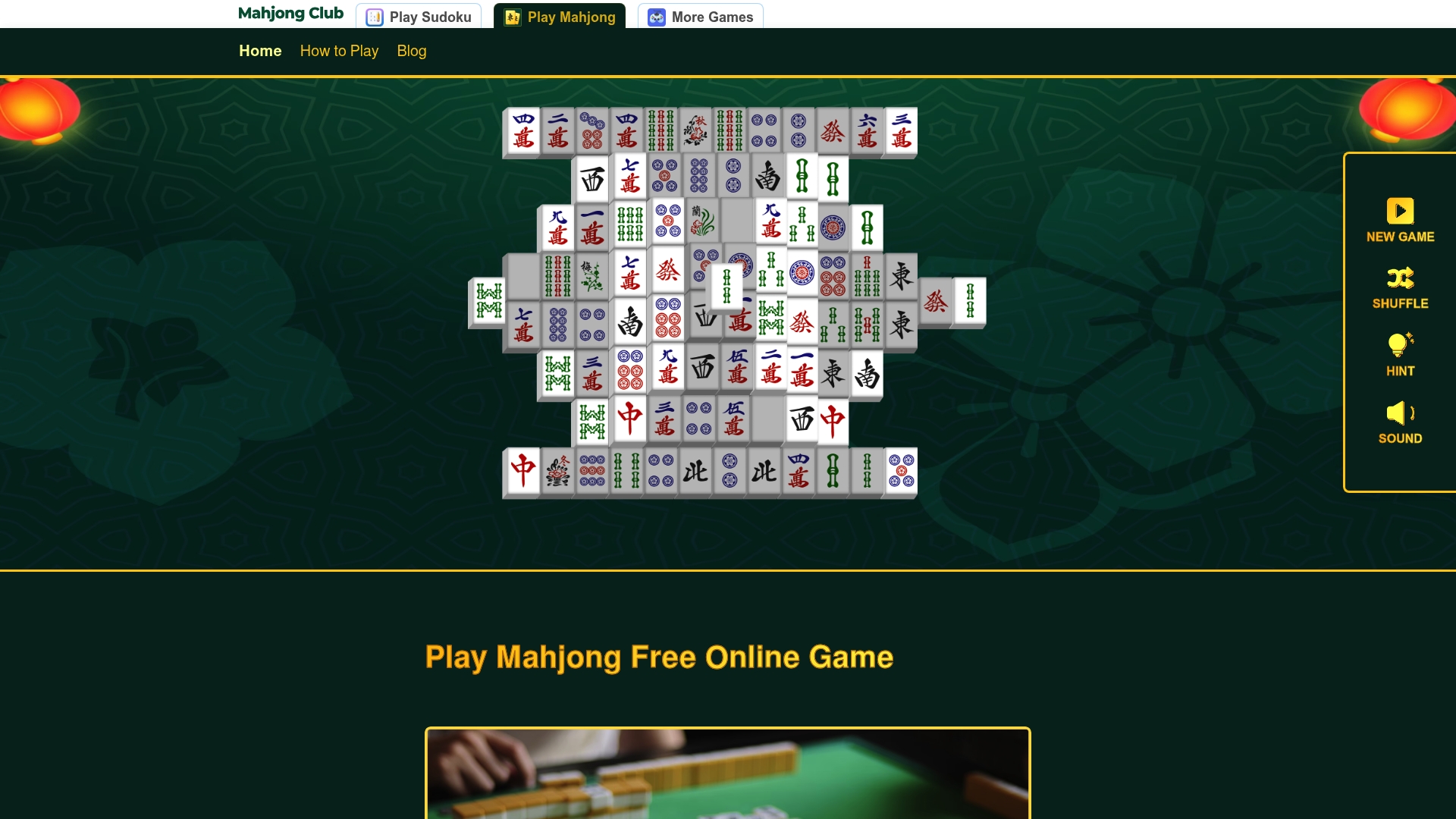
Mahjong Online Club offers a free, browser-based tile game with no registration required, giving you a distraction-free environment to practice pattern recognition and tile matching sequences at your own pace. The platform pairs gameplay with strategy guides and scoring references, so you can cross-reference concepts from this article directly in your sessions. Whether you are drilling tile efficiency or testing situational decisions, play free mahjong now and start building the pattern fluency that turns theory into consistent high scores.
FAQ
What is the definition of Mahjong high score optimization?
Mahjong high score optimization is the practice of structuring every discard and hand-building decision around maximizing expected point gain while minimizing the risk of dealing into opponents. It combines offensive tile efficiency with defensive safe discard techniques and situational awareness.
How does the mangan threshold affect scoring strategy?
Once a hand reaches the mangan limit in Riichi Mahjong, adding more Han produces no additional payout. Players should shift focus from chasing extra value to winning faster or playing more defensively once they cross that threshold.
What causes the most score losses in Mahjong?
Dealing into an opponent's winning hand accounts for approximately 75% of losses in four-player Mahjong. Reducing that rate through safe discard selection and timely folding produces more score improvement than any offensive adjustment.
What is chasing syndrome in Mahjong?
Chasing syndrome is the habit of pursuing unlikely high-value hands while passing up safer, guaranteed wins. It is one of the most common obstacles for intermediate players and directly lowers average scores over time.
How do I improve my Mahjong score as a beginner?
Start by learning the scoring thresholds for your variant, then practice tile efficiency using two-sided waits and middle tiles. Use scoring apps and reference tables to internalize hand values before focusing on advanced defensive reads.
Recommended
Similar Articles

Why Mahjong Calms the Mind: The Science Behind It
Discover why mahjong calms the mind. Explore how this engaging game enhances mental wellness, reduces stress, and boosts cognitive function.
Dragon Tiles in Mahjong: A Beginner's Complete Guide
Discover what are dragon tiles in Mahjong and learn how they can enhance your game. Unlock scoring potential with this beginner's guide!

Mahjong Tile Frequency Awareness: Your Strategic Edge
Learn what is mahjong tile frequency awareness and how tracking tile locations can give you a strategic advantage in your game.