Mahjong Defense Strategies: 17 Risk-Reducing Tactics
Table of Contents
- What does “dealing in” mean, and why it costs so much
- 17 Mahjong defense strategies to avoid dealing in
- How to read danger signals from discards and table flow
- Variant differences in defensive priorities (see the comparison)
- Training plan: drills and tools that build defensive instinct
- In practice: adjusting defense when ahead, behind, or dealer
- Why Mahjong defense strategies elevate long-term results
- Common defensive pitfalls you must cut
- Key Takeaways
Avoiding deal-ins starts with disciplined Mahjong defense strategies. Use table reading, safe tiles, and push–fold judgment to reduce risk without killing your win rate. Apply these 17 tactics consistently and your deal-in percentage will fall fast.
If you’ve ever watched a winning player survive dangerous rounds without freezing their offense, you’ve seen real defensive craft. After coaching club players and reviewing thousands of log hands, I’ve learned the best defense is systematic: read the table, know your thresholds, and execute clean folds when the math turns against you.
What does “dealing in” mean, and why it costs so much
Dealing in is discarding a tile that lets an opponent win immediately. In Riichi, that’s a discard claimed by ron; in Hong Kong and MCR, a discard can complete a pung/chow or a winning hand. According to the Mahjong overview on Wikipedia, tile sets and victory conditions differ by variant, but a single deal-in can swing thousands of points.
- Risk spikes late in the hand as waits narrow and more players reach tenpai.
- Open hands reveal threats early; closed hands hide waits and demand tighter defense.
- Penalty size varies by ruleset, but the principle is universal: one careless discard can erase multiple winning hands’ worth of gains.
17 Mahjong defense strategies to avoid dealing in
These Mahjong defense strategies apply across Riichi, Hong Kong, and MCR with small adjustments. Use them as a push–fold checklist.
- Track genbutsu (proven safe tiles)
- Discards visible from a player are genbutsu against that player. In Riichi, a tile they’ve discarded cannot win for them (except exotic edge cases with calls elsewhere). Bank these first when folding.
- Respect suji and anti-suji (Riichi focus)
- A discard blocks certain three-sided waits. If 4 is safe, 1 and 7 are statistically safer; if 6 is safe, 3 and 9 are safer. Anti-suji traps exist, so combine with other signals.
- Count the kabe (walls)
- If four copies of a number are visible (melds + discards), adjacent waits become impossible. For example, a kabe of 2 eliminates 13-side shapes and makes certain middles safer.
- Prioritize terminals and honors late
- When many 1/9 and honors are visible, the remaining ones are often safer than middles. Early game they’re volatile; late game they’re typically the lowest-risk tiles available.
- Dora awareness governs aggression
- Against visible dora or red fives, tighten up. A hand with dora multiples has high value; fold sooner if your hand’s expected value cannot compete. For a refresher on expected value, see Investopedia’s guide.
- Push only with winning equity
- Push when your hand will win often enough and score high enough to outweigh deal-in risk. Example: If your tenpai wins ~25% for 7700 and a deal-in costs 3900, pushing can be correct; reverse the value and folding dominates.
- Read discard rhythm and suit pressure
- Uniform, efficient discards suggest speed; erratic holds around a suit suggest a concealed wait. Three or more honors tossed early often signals an all-simples path; beware middle suit tiles.
- Guard edge waits in heated suits
- If many 2s/8s in a suit are missing, 3/7 edge waits are live. Avoid tossing the edge-completer when a player looks near-ready.
- Sequence a clean fold
- When you decide to fold, fold completely. Use a chain of safe tiles: own discards, then genbutsu to the threat, then kabe-driven safes, then terminals/honors.
- Value temp safes over informational leaks
- If you must break shape, discard a proven safe even if it reveals your fold. Information costs less than a ron payment.
- Track player tendencies
- Some opponents open fast and cheap; others chase value. Against value-chasers showing dora, your threshold to fold drops. Against cheap speed, defend but keep paths to re-attack.
- Use early honors to reduce late risk
- Cut isolated honors early to avoid being stuck with dangerous honors late when threats peak.
- Respect riichi pressure correctly (Riichi)
- Versus riichi, fold unless you have a high-value hand or multiple safes to maintain pressure. Single-sided waits into a riichi are a leak.
- Adjust to open hands (HK/MCR)
- Melds reveal suits and shapes. Don’t feed the obvious: avoid tiles that continue their exposed sequence lines.
- Count live tiles in the endgame
- With 4–6 draws left, fold more aggressively. The probability that any live middle tile hits a waiting hand rises steeply as choices shrink.
- Protect dealer rotations and point position
- When you’re dealer and ahead, prioritize survival to retain dealership. When behind late, accept slightly higher risk to chase.
- Rehearse standard danger tiles
- Keep a mental deck: late 5s, suit middles in hot suits, and tiles around dora are the top danger group. Drill these patterns until reflexive.
“As Alex Lee, tournament organizer at Bay City Mahjong, explains: ‘Defense isn’t passivity. It’s capital allocation under uncertainty—push when equity is real, fold the rest, and you’ll print points over a long season.’”
How to read danger signals from discards and table flow
- Two-suit focus: If a player consistently avoids a suit, assume value or a potential flush in the remaining suits.
- Stopped honors: Holding a lone dragon or round wind late signals risk; many players wait on honor pairs.
- Mid-suit hoarding: Reluctance to discard 4–6 suggests central waits. Switch to terminals/honors when possible.
- Melding near dora: Exposed melds that include or surround dora tiles escalate danger. Fold earlier.
According to the rules summary on Wikipedia’s Mahjong page, a standard set uses 136 or 144 tiles depending on variant. That tile volume makes inference essential—every visible tile shifts wait probabilities.
Variant differences in defensive priorities (see the comparison)
Different scoring systems change how tight your Mahjong defense strategies must be. The core is the same: weigh expected value, visibility, and opponent signals. For probability fundamentals that underpin these choices, consult introductory resources at MIT.
Comparison: Defensive emphasis by variant
| Variant | Key defensive cues | Push–fold threshold |
|---|---|---|
| Riichi (Japanese) | Riichi declaration, suji/kabe, red fives/dora, furiten rules | Tighter vs riichi; fold unless hand value or multiple safes justify push |
| Hong Kong (Cantonese) | Open meld speed, honor value hands, simple fast hands | Moderate; read exposed meld lines and avoid feeding sequences |
| Chinese Official (MCR) | Pattern/limit hands, exposed combinations, honor/terminal value | Contextual; defend hard vs visible pattern threats and high-fan potential |
See the comparison to choose adjustments that match your table.
Training plan: drills and tools that build defensive instinct
- Ten-tile safety drill: Take a midgame screenshot and identify 10 safest tiles for each opponent in order. Repeat daily.
- Suji/kabe flashcards (Riichi): Show a board state; mark safe-by-suji tiles in 8 seconds. Immediate feedback.
- Push–fold EV journal: After each hand, record your state, enemy threats, and why you pushed or folded. Calibrate with the expected value framework.
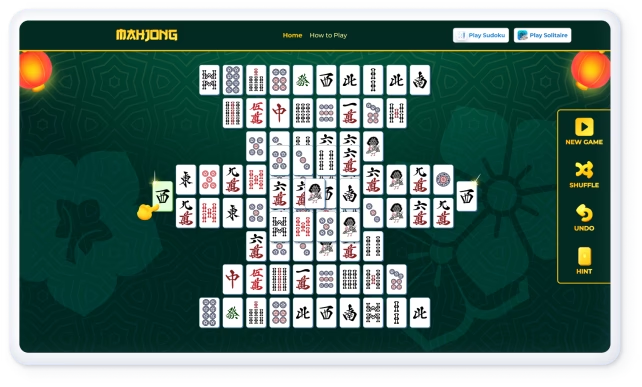
- Pattern recognition reps: Sharpen tile vision with solitaire patterning. The matching and blocking skills in Mahjong Solitaire carry over to reading live shapes; practice in-browser with our free Mahjong boards. For fundamentals on tile sets and sequences, scan the structured rules in How to Play Mahjong Solitaire — Rules, Tiles & Strategy.
Tip: Schedule 20-minute focused reps, three times a week. Consistency builds the split-second safety reads you need under pressure. For decision discipline under uncertainty in broader contexts, the discussion on risk trade-offs at Harvard Business Review is a useful parallel.
In practice: adjusting defense when ahead, behind, or dealer
From club coaching and tournament review, these patterns hold:
- Ahead by 10,000+: Tighten. Favor full folds versus any riichi or obvious value. Trade small hand opportunities for dealership retention and non-payments.
- Slightly behind: Push hands with dora or fast shapes; fold marginal middles into pressure. You need wins, not hero calls.
- Far behind late: Take calculated risks. Discard second-tier safes to preserve winning shapes when your hand’s value can swing the game.
- Dealer: Your payments hurt more and your wins pay more. Versus riichi from your left, fold sooner unless your hand is value-rich.
Why Mahjong defense strategies elevate long-term results
- Payments are asymmetric: One deal-in can erase several modest wins.
- Defense preserves comeback equity: Surviving bad rounds keeps you within striking distance.
- Good defense improves offense: Clean folds avoid wrecking structures, letting you re-attack next hand.
The game’s complexity—136 or 144 tiles, hidden information, and timing—rewards structured defense. That’s why disciplined Mahjong defense strategies are the hallmark of steady top-half finishes.
Common defensive pitfalls you must cut
- Half-folds: Mixing risky middles into a “mostly safe” stream invites ron.
- Dora blindness: Ignoring dora gravity turns standard tiles into traps.
- Endgame stubbornness: With 4 draws left, a fold is often correct even in tenpai.
- Over-trusting single-cue safety: Combine genbutsu, suji, kabe, and visible counts before acting.
Key Takeaways
- Build a repeatable push–fold system anchored in expected value and proven safes.
- Bank genbutsu, use suji/kabe, and prefer terminals/honors late to avoid dealing in.
- Tighten dramatically versus riichi or obvious value hands; open hands telegraph safer suits.
- Train with timed drills and pattern practice to speed up danger recognition.
- Use point position and dealership to adjust risk; defense protects wins as much as it prevents losses.
- Reinforce strategy by practicing online and reviewing structured rules: start with our free Mahjong boards and the tile-reading basics in this how-to.
Similar Articles
How to Clean Mahjong Tiles: Step-by-Step Care Guide
Expert guide on how to clean mahjong tiles by material—Bakelite, bone/bamboo, and plastic—with safe steps, pro tips, and data-backed care advice.
Riichi mahjong rules: A step-by-step beginners guide
Expert guide to Riichi mahjong rules with step-by-step instructions, scoring basics, and pro tips. Data-backed, trusted references, and practical examples.
Best Automatic Mahjong Table: 2026 Expert Buyer's Guide
Shopping for the best automatic mahjong table in 2026? Get expert picks, noise level decibels, tile compatibility, foldable options, and warranty guidance.