Mahjong Endgame Planning: Solitaire Tactics for Calm Play
Mahjong Endgame Planning: Solitaire Tactics for Calm Play
Mahjong solitaire endgame planning is the set of deliberate decisions you make when the board has roughly 20 or fewer tiles remaining and every match carries real consequences for solvability. At this stage, the goal shifts from clearing tiles quickly to preserving your ability to keep clearing them. Three actions matter most right now:
- Scan for mobility first. Count how many legal matches are still available before committing to any move.
- Protect isolated pairs. A lone pair with no accessible match partner can strand your board if removed carelessly.
- Free layered stacks before clearing flat tiles. Tiles buried under others are your biggest deadlock risk.
Mahjong Academy's endgame curriculum, Mahj Mind's practitioner guidance on composure, and Mahjong Online Club's strategy guides all converge on the same principle: avoiding deadlocks is an active strategic victory, not a consolation prize.
Table of Contents
- What does endgame planning actually look like on the board?
- Heuristics you can memorize for late-game decisions
- Common late-game mistakes and how to fix them
- A step-by-step late-game sequence with decision rationale
- Drills that build endgame planning skills
- How solitaire endgame planning differs from multiplayer tactics
- Key Takeaways
- Why calm repetition beats memorizing tricks
- Practice endgame planning on Mahjong Online Club today
What does endgame planning actually look like on the board?
The endgame begins when the board's remaining matches drop to a point where one wrong choice can make the puzzle unsolvable. Your three operational goals are mobility (keeping legal matches available), deadlock avoidance (never stranding a tile with no accessible partner), and layer clearance (freeing buried tiles before they become unreachable).
Reading the board quickly comes down to four signals. Orphan tiles, those with no visible match anywhere on the board, are immediate red flags. Singleton stacks, a single tile sitting alone on a layer with its pair buried two levels down, demand priority attention. Exposed pairs that share a layer with no other matches nearby are your safest moves. Blocked layers, stacks where the top tile's match is itself covered, are the positions that create unsolvable configurations.
"In the final turns, you do not have time to analyze everything in detail. You rely on pattern recognition and disciplined thinking." — Mahjong Academy, Lesson 39
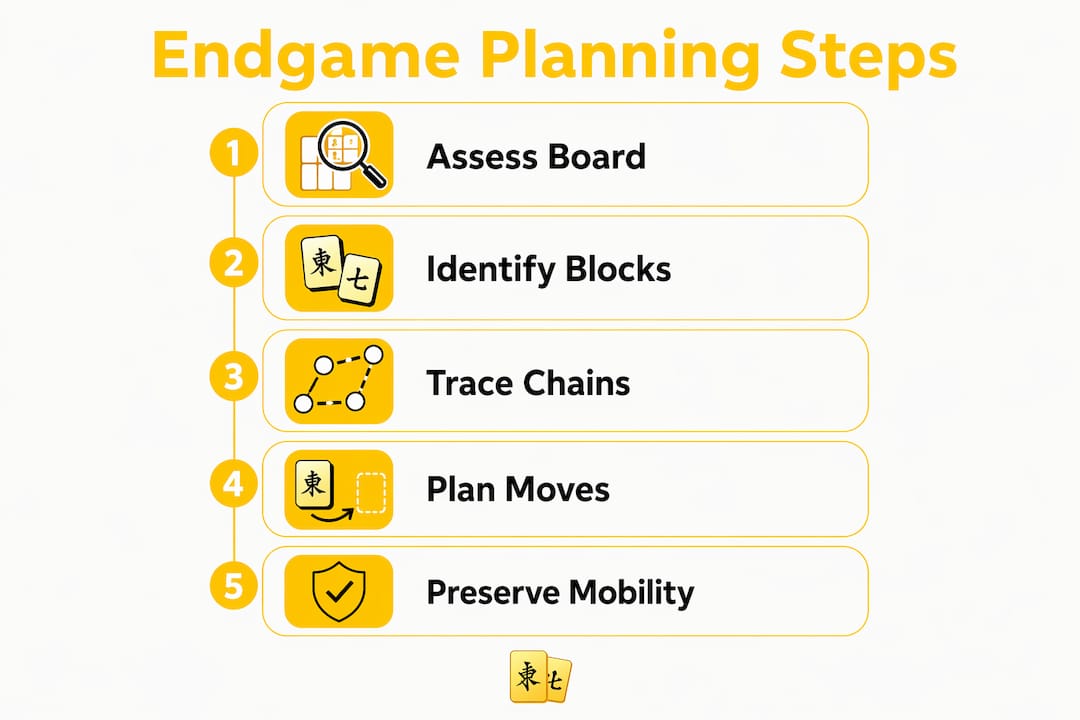
Pro Tip: When you spot a blocked layer, trace the full chain: what tile covers it, what covers that tile, and whether its match is accessible. If the chain is longer than three moves, free that stack before touching anything else.
Heuristics you can memorize for late-game decisions
Rules of thumb beat long calculations when the board is thin. These six heuristics cover the most common late-game decision points:
- Count mobility, not tiles. The number of legal matches remaining tells you more about board health than the raw tile count. Counting mobility is the better late-game metric.
- Preserve at least one pair. A kept pair acts as a safety buffer because both copies of that tile are off the table and cannot create a deadlock elsewhere.
- Prioritize freeing layered tiles. A move that opens two stacks is worth more than a quick flat match, even if the flat match looks tempting.
- Avoid isolating a single match. If removing a pair leaves its only accessible partner with no match, you have just created a future deadlock.
- Accept a longer route to protect mobility. When a short match sequence closes off a stack, the longer path that keeps options open is usually correct.
- Use exposed tiles as your safety evidence. Previously matched and visible tiles are the most reliable indicators of what is still available; concealed stacks carry the most uncertainty.
The deeper principle behind all of these: experienced players treat late-game moves as investments in future options, not just immediate matches. A move that opens two stacks is worth more than a single pair cleared if it preserves solvability.
Pro Tip: Pattern recognition speeds up these heuristics dramatically. After each game, replay the last 10 moves mentally and ask which choice reduced mobility. That single habit builds the pattern recognition that makes endgame decisions feel automatic.

Common late-game mistakes and how to fix them
Most unsolvable boards trace back to one of six errors. Each has a one-line correction.
- Panic-matching: Grabbing the first available pair without scanning alternatives. Fix: pause, count mobility, then match.
- Greedy clearing: Removing flat tiles quickly while ignoring buried stacks. Fix: free a layered tile before every flat match in the final 20 tiles.
- Breaking a useful pair: Matching a pair that was protecting a blocked layer. Fix: check whether the pair's removal exposes a new match or closes one.
- Ignoring orphan tiles: Leaving a tile whose match is buried until it is too late to reach it. Fix: identify orphan tiles at the start of the endgame and plan their liberation sequence first.
- Over-relying on random draws: Hoping the next available match will solve a mobility problem. Fix: disciplined checks before each move reduce the need for luck.
- Changing play cadence under pressure: Speeding up when the board looks bad. Fix: keep a steady tempo; rushing compounds errors.
"Players often discard a dangerous tile without scanning for safer alternatives. Disciplined checks reduce deadlocks." — Mahjong Playbook on panic-discard patterns
Panic-matching and greedy clearing are the two most destructive because they compound: one rushed match reduces mobility, which triggers another rushed match, and within three moves the board is unsolvable. Slow down precisely when the board feels urgent.
A step-by-step late-game sequence with decision rationale
Picture a board with 18 tiles remaining across three small stacks. Stack A has two tiles: a Bamboo 3 on top of a Bamboo 3 (a matched pair, both accessible). Stack B has three tiles: a Circle 7 on top, a Circle 7 beneath it, and a Wind tile at the base. Stack C has two exposed Circle 7s. One more Circle 7 sits flat on the table.
- Do not match Stack A immediately. The Bamboo 3 pair is safe and accessible anytime. Matching it now gives you nothing new.
- Assess Stack B. The top Circle 7 in Stack B is accessible. Its match is the flat Circle 7. Matching those two frees the second Circle 7 in Stack B, which can then match with one of Stack C's Circle 7s.
- Execute the Stack B sequence. Match the top Circle 7 from Stack B with the flat Circle 7. Now the buried Circle 7 in Stack B is exposed.
- Match the newly exposed Circle 7 with one from Stack C. This frees the Wind tile at Stack B's base and leaves one Circle 7 in Stack C.
- Now match the Bamboo 3 pair from Stack A. The Wind tile and the remaining Circle 7 are your final pair, assuming their matches are accessible.
The key decision was step 1: resisting the easy Stack A match to preserve the sequencing that freed Stack B. That is endgame planning in practice.
Pro Tip: Keep a neutral tempo through sequences like this. Rushing step 3 before confirming step 4 is available is how players strand the Wind tile with no accessible match.
Drills that build endgame planning skills
Repetition under realistic conditions is how late-game decisions become automatic. These four drills target the specific skills endgame planning requires.
- Last-10-tiles simulation. Play a full game, then replay only the final 10 moves from a saved position. Mahjong Academy's last-10-tiles strategy framework recommends reducing time-per-move to build automatic correct choices under pressure.
- Pair-preservation challenge. Set a rule: never match a pair unless you have confirmed the removal does not strand another tile. Track how many games you complete without a deadlock over 20 sessions.
- Mobility-count drill. Before every move in the final 20 tiles, count the number of legal matches available. Write it down. After the game, check whether mobility dropped sharply at any point and identify which move caused it.
- Forced-defense run. Play a game where you deliberately avoid the easiest match available and choose the move that frees the most buried tiles instead. This trains the habit of prioritizing layer clearance over quick clearing.
To measure improvement, track your deadlock rate across 20 games. A dropping deadlock count is the clearest signal that endgame decision-making is improving. Mahjong Online Club's free, no-registration platform makes it easy to run repeated sessions without friction, and the how-to-play guide walks through tile mechanics that underpin these drills.
- Track deadlock frequency per 20 games.
- Note which drill reduced deadlocks fastest for your play style.
- Increase drill difficulty by reducing time-per-move once success rates stabilize.
How solitaire endgame planning differs from multiplayer tactics
Solitaire and multiplayer Mahjong share a name and tiles, but their endgame priorities are almost opposite. Knowing the difference prevents you from importing the wrong mental model.
| Dimension | Solitaire endgame | Multiplayer endgame |
|---|---|---|
| Primary goal | Avoid deadlocks, preserve mobility | Avoid dealing into an opponent's winning hand |
| Key threat | Unsolvable board configuration | Opponent declaring win on your discard |
| Core tactic | Free layered tiles, protect pairs | Fold (betaori), discard genbutsu or suji-safe tiles |
| Success metric | Board cleared or mobility preserved | Points protected, no deal-in |
In Riichi Mahjong, folding (betaori) is recommended when you are two or more tiles from tenpai after an opponent declares riichi. The goal becomes avoiding a deal-in by discarding tiles confirmed safe by genbutsu (tiles already discarded by the opponent) or suji (tiles mathematically unlikely to complete a wait). None of that applies to solitaire, where there is no opponent hand to avoid.
Three quick reminders for solitaire players:
- Genbutsu and suji are multiplayer safety concepts. Solitaire has no deal-in risk.
- "Folding" in solitaire means preserving mobility, not abandoning your hand.
- Defensive play in solitaire is about board structure, not reading another player's discards.
Key Takeaways
Mahjong solitaire endgame planning works because it shifts your focus from quick matches to mobility preservation, deadlock avoidance, and deliberate layer clearance.
| Point | Details |
|---|---|
| Mobility over tile count | Count available legal matches, not remaining tiles, to gauge board health. |
| Preserve pairs deliberately | A kept pair removes two tiles from deadlock risk and protects board solvability. |
| Free layers before flat tiles | Buried tiles create unsolvable configurations; clear their path first. |
| Avoid panic-matching | Scan all available moves before committing; rushing compounds errors. |
| Mahjong Online Club drills | Free, no-registration practice sessions make last-10-tiles and mobility-count drills easy to repeat. |
Why calm repetition beats memorizing tricks
The conventional wisdom in Mahjong strategy circles is that endgame skill comes from knowing more rules. That framing is backwards. Endgame defense is practiced, not improvised: the players who navigate late-board positions well are not running longer calculations, they are pattern-matching faster because they have seen those configurations before.
This is exactly why the relaxation-focused approach at Mahjong Online Club is more effective than grinding competitive sessions. Low-pressure repetition builds the pattern library that makes endgame decisions feel calm and clear rather than urgent. The cognitive benefits, improved attention, working memory, and pattern recognition, accumulate through consistent short sessions, not through high-stakes pressure.
The platform's free, no-registration format removes every barrier between you and that repetition. No account setup, no ads interrupting your focus, no score pressure unless you want it. The blocked tile pattern guides on the site directly support the drill work described above.
Practice endgame planning on Mahjong Online Club today
Mahjong Online Club gives you a distraction-free solitaire environment where endgame drills are genuinely easy to run. No registration, no ads, no friction between you and the board. Load a game, run the last-10-tiles drill, close the tab, and come back tomorrow.
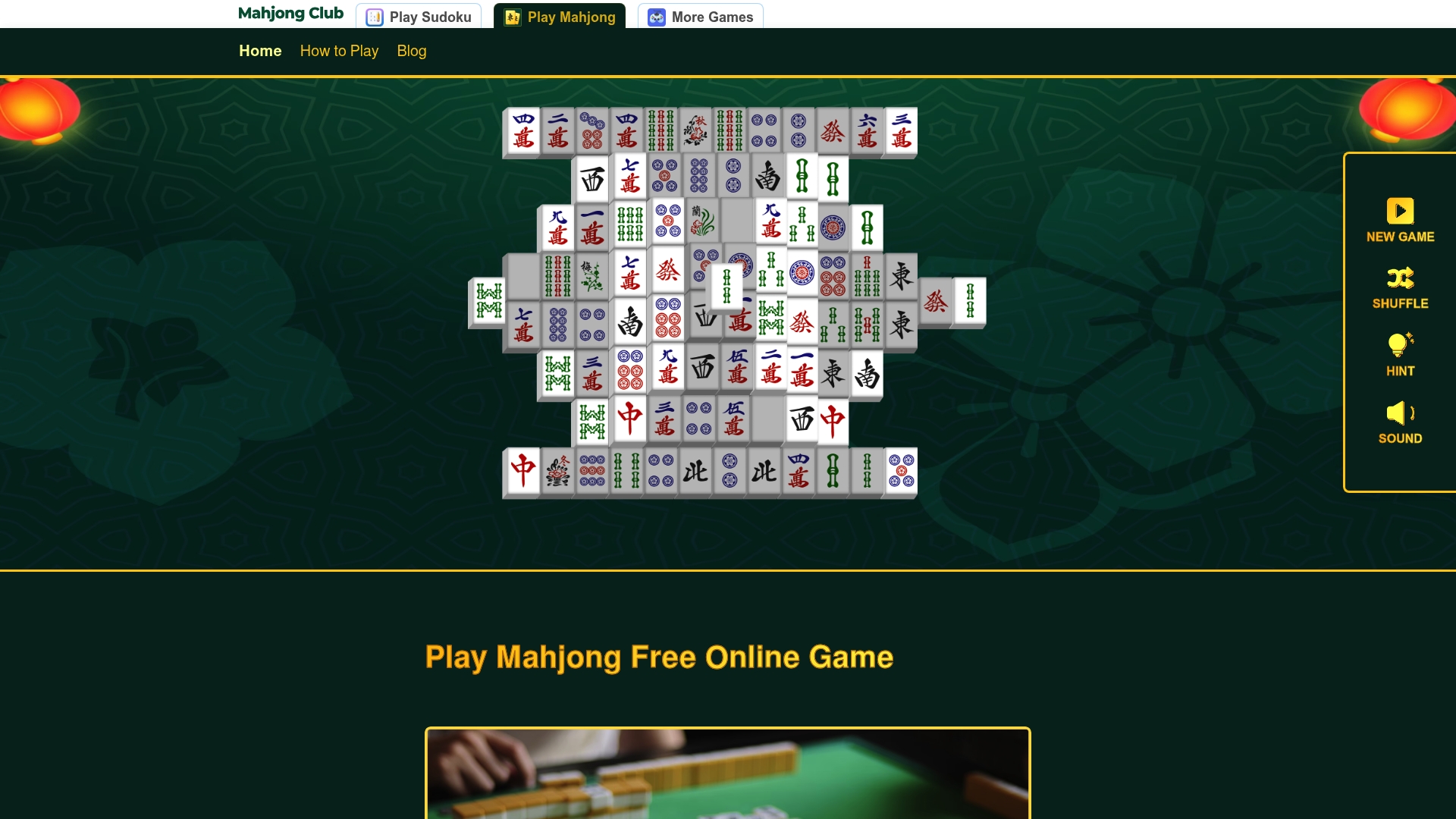
The platform's calm interface is built for the kind of focused, low-pressure repetition that actually builds endgame skill. Features that support your practice:
- Free play without registration — start a session in seconds.
- Guided strategy content — the how-to-play section covers tile mechanics and match sequencing.
- Calm, distraction-free UI — designed for relaxation and cognitive focus, not competitive pressure.
- Repeat sessions without penalty — replay the same layout to isolate and fix specific endgame errors.
Play your first endgame drill at Mahjong Online Club right now, no sign-up required.
Recommended
Similar Articles

Mahjong Bottleneck Tile Concept: Master Your Strategy
Discover what is mahjong bottleneck tile concept and master your strategy. Learn how to avoid critical tile shortages and improve your game.
Mahjong tile meanings: guide to suits, honors, flowers
Expert guide to Mahjong tile meanings with clear charts and examples. Understand suits, honors, and flowers across rulesets. Data-backed and practical.

Top 3 microsoftcasualgames.com Alternatives 2026
Explore 3 microsoftcasualgames.com alternatives to find enjoyable puzzle games. Discover your next favorite gaming platform today.