Mahjong Tile Symbols Guide for Beginners

Mahjong Tile Symbols Guide for Beginners
Mahjong tile symbols are defined by three distinct categories: suits, honors, and bonus tiles, each with unique visual patterns that determine how you build hands and score points. This mahjong tile symbols guide covers every category you need to recognize, from the circle-counting logic of Dot tiles to the often-misread White Dragon. Whether you are playing Chinese Mahjong, American Mahjong, or a variant governed by the National Mah Jongg League (NMJL), the same core symbol vocabulary applies. Recognizing these symbols quickly is not optional. It is the foundation of every strategic decision you make at the table.
1. What are the main suited tile symbols in mahjong?
The three primary suits in mahjong are Dots, Bamboo, and Characters. Each suit runs from 1 to 9, with four copies of each tile in a standard 144-tile set. That gives you 36 tiles per suit and 108 suited tiles total.
Dots are the most beginner-friendly suit. Each tile shows a pattern of circles you simply count. One circle means 1-Dot, nine circles means 9-Dot. No reading required.
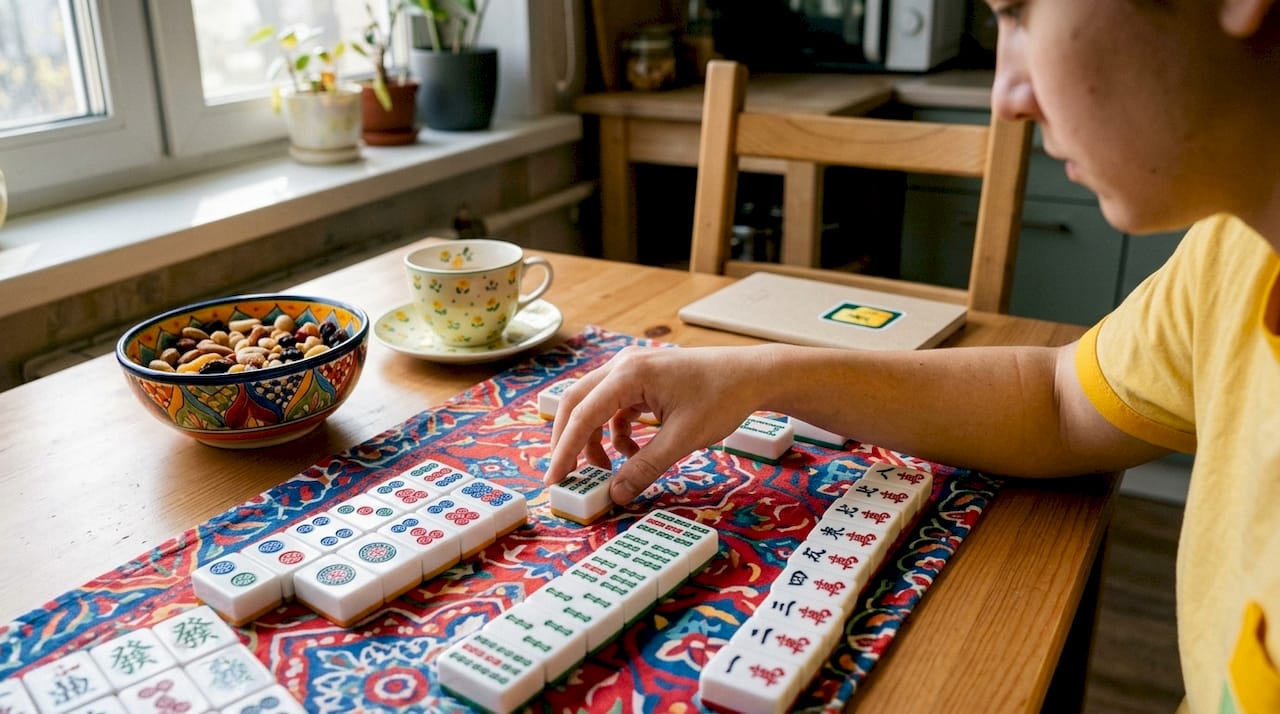
Bamboo tiles show vertical green stalks. Count the stalks to identify the number. The one exception is the 1-Bamboo tile, which depicts a bird instead of a single stalk. New players frequently mistake this bird image for a Flower tile. It is not. It belongs to the Bamboo suit and functions exactly like any other numbered tile.
Characters (also called Wan or Man tiles) show a Chinese character at the bottom and an Arabic numeral at the top. You do not need to read Chinese to use these tiles. Focus on the numeral. The character is decorative context, not a reading test.
- Dots: count the circles (1 through 9)
- Bamboo: count the stalks, remember the bird on 1-Bamboo
- Characters: read the Arabic numeral at the top
Pro Tip: Sort your hand by suit first, then by number. This habit cuts your tile-reading time in half during live play.
2. How do honor tile symbols differ from suits?
Honor tiles are the Winds and Dragons. They carry no numerical sequence, so they cannot form runs. Instead, they form sets of three or four identical tiles called pungs or kongs. Their value in scoring often exceeds that of suited tiles, especially when they match the round wind or your seat wind.
Wind tiles
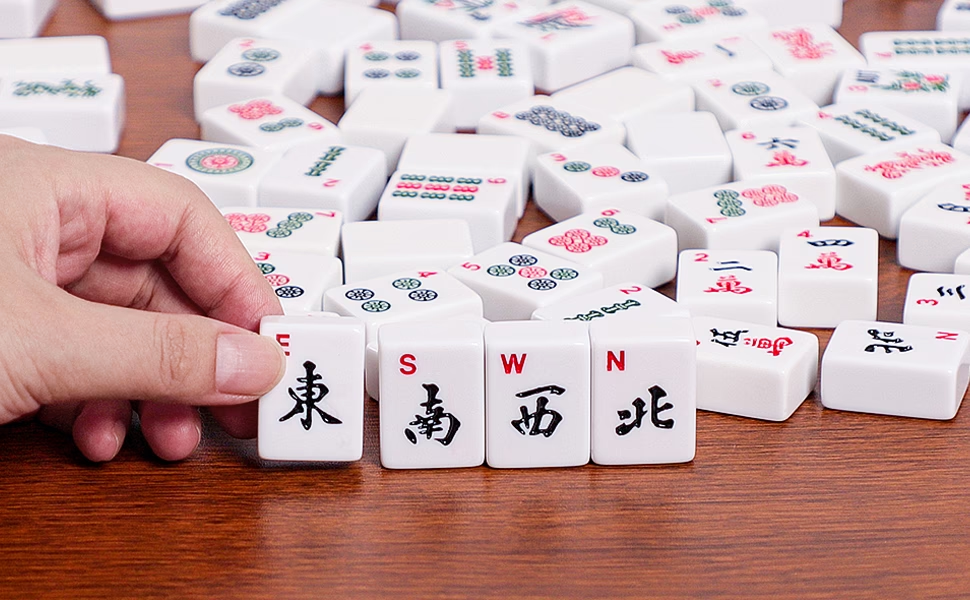
The four Wind tiles represent East, South, West, and North. Each displays a distinct Chinese character. A reliable mnemonic for beginners: the acronym NEWS (North, East, West, South) maps the four directions to a familiar word. Most physical tile sets also print a small English letter or abbreviation on the face, which makes identification faster.
Dragon tiles
The three Dragon tiles are Red, Green, and White. Each appears four times in a standard set. Red Dragon shows a bold red character meaning "center." Green Dragon shows a green character meaning "prosperity." White Dragon is the one that trips up beginners most often. It appears blank or with only a border frame. Do not treat it as a damaged tile or a blank placeholder. It is a fully playable Dragon tile with real scoring weight.
| Honor tile | Visual cue | Scoring role |
|---|---|---|
| East Wind | Chinese character for East | Scores double as round or seat wind |
| South Wind | Chinese character for South | Scores double as round or seat wind |
| West Wind | Chinese character for West | Scores double as round or seat wind |
| North Wind | Chinese character for North | Scores double as round or seat wind |
| Red Dragon | Bold red character | Always scores as an honor set |
| Green Dragon | Green character | Always scores as an honor set |
| White Dragon | Blank or framed tile | Always scores as an honor set |
Pro Tip: When you first open a new tile set, physically separate the White Dragon tiles and study them. Knowing what "blank" looks like in your specific set prevents costly misidentification mid-game.
3. What are bonus tile symbols like Flowers and Seasons?
Bonus tiles sit outside the three suits and the honor category. A standard set includes 4 Flower tiles and 4 Season tiles, each with distinct artistic imagery. Flowers typically show painted botanical designs. Seasons show imagery tied to spring, summer, fall, and winter.
The key rule: when you draw a bonus tile, you set it aside and draw a replacement tile from the wall. Bonus tiles do not count toward your hand structure. They score separately at the end of the round.
How bonus tiles score depends entirely on the variant you are playing. In Chinese Mahjong, each Flower or Season tile adds a fixed bonus to your final score. In American Mahjong, the handling of flowers and jokers follows different rules, and some hands require specific flower tiles to complete.
- Flower tiles: numbered 1 through 4, each with a unique floral image
- Season tiles: numbered 1 through 4, each representing a season
- Always draw a replacement tile after setting a bonus tile aside
- Check your variant's rulebook before assuming bonus tile scoring
The most common beginner mistake with bonus tiles is holding them in your hand as if they were playable suited tiles. Set them face-up in front of you immediately. That is the correct procedure in nearly every variant.
4. How does mahjong tile symbolism differ between Chinese and American sets?
The tile symbol vocabulary between Chinese and American mahjong is largely shared, but the tile counts and special tile rules diverge in ways that matter. Chinese Mahjong uses 144 tiles. American Mahjong sets often contain 152 tiles, adding 8 jokers to the mix.
Jokers are unique to American Mahjong. They display a joker or clown image and can substitute for any tile in a pung, kong, or quint. They have no equivalent in Chinese sets. If you learn tile symbols from a Chinese set and then sit down at an American Mahjong game, the jokers will appear unfamiliar and their role will be unclear without prior study.
American Mahjong also treats flower tiles as interchangeable. Any flower tile can stand in for any other flower tile in hands that call for them. Variant-specific rules affect symbol meanings and gameplay roles, which is why confirming your set type before you memorize tile functions is not a minor detail. It is a prerequisite.
| Feature | Chinese Mahjong | American Mahjong |
|---|---|---|
| Total tiles | 144 | 152 (with jokers) |
| Joker tiles | None | 8 jokers included |
| Flower tile rules | Fixed bonus scoring | Interchangeable in hands |
| Sequence formation | Allowed | Allowed |
| Governing body | Regional rule sets | National Mah Jongg League (NMJL) |
For a deeper comparison of how these sets differ in scoring and tile roles, the Chinese vs. American mahjong breakdown at Mahjong Online Club covers the full picture.
5. Quick recognition strategies for reading tiles under pressure
Fast tile reading is a skill, not a talent. It comes from drilling a small set of visual primitives until they are automatic. You do not need to read Chinese characters to play mahjong well. Pattern recognition is enough, and it is faster than language-based reading anyway.
Here is the recognition system that works for beginners:
- Dots: Count the circles. That is the entire skill. No character reading needed.
- Bamboo: Count the stalks. If you see a bird, it is 1-Bamboo. Treat it like any other Bamboo tile.
- Characters: Ignore the Chinese character. Read the Arabic numeral at the top of the tile.
- Winds: Look for the English abbreviation or use the NEWS mnemonic (North, East, West, South).
- Dragons: Red is red. Green is green. Blank or framed means White Dragon.
- Bonus tiles: Any tile with a flower or seasonal painting goes face-up in front of you immediately.
Verifying your tile inventory before your first game also prevents confusion. Different manufacturers include extra blank tiles or variant-specific tiles that can look ambiguous. Knowing exactly what is in your set removes guesswork during play.
"Tile efficiency starts with tile recognition. You cannot plan your hand if you are still decoding what you are holding."
Pro Tip: Sort your tiles by category first (suited, honor, bonus), then by suit and number. This two-step sort builds the habit of reading tiles by category before reading them by value, which is exactly how experienced players think.
For a full breakdown of how tile categories connect to hand strategy, the tile categories and strategy guide at Mahjong Online Club is worth bookmarking.
Key takeaways
Mahjong tile symbol mastery requires learning three distinct categories: suited tiles (Dots, Bamboo, Characters), honor tiles (Winds and Dragons), and bonus tiles (Flowers and Seasons), each with specific visual cues and gameplay roles.
| Point | Details |
|---|---|
| Three suited tile types | Dots, Bamboo, and Characters each use countable visual patterns, not Chinese literacy. |
| Honor tiles don't form sequences | Winds and Dragons build pungs or kongs only, and they carry strong scoring weight. |
| White Dragon is often blank | A blank or framed tile is a fully playable Dragon, not a damaged or missing tile. |
| American sets add jokers | American Mahjong includes 8 jokers in a 152-tile set, changing how bonus tiles work. |
| Confirm your set type first | Tile symbol meanings vary by variant, so identify your set before memorizing rules. |
Why tile symbol mastery matters more than most beginners expect
My honest take on learning mahjong tile symbols is this: most beginners underestimate how much their early confusion costs them. They spend the first several games decoding tiles instead of reading the table. Every second spent squinting at a Character tile is a second not spent tracking what your opponents are discarding.
The insight that changed how I teach beginners is that tile recognition is not about memorizing Chinese. It is about building a small set of visual reflexes. Count the dots. Spot the bird. Read the numeral. Recognize the blank. Once those four reflexes are automatic, your attention frees up for actual strategy: deciding which tiles to keep, which to discard, and what hand shape you are building toward.
The variant question matters more than most guides admit. A player who learns Chinese Mahjong tile symbols and then sits down at an NMJL game will be confused by jokers and interchangeable flowers. That confusion is not a failure of intelligence. It is a failure of preparation. Always confirm your variant before you drill your tile vocabulary.
The players I have seen improve fastest are the ones who treat tile recognition as a physical skill, not an academic one. They handle tiles. They sort them repeatedly. They quiz themselves. The mahjong tile meanings guide at Mahjong Online Club is a resource I recommend for exactly this kind of active, repeated review. Use it as a reference you return to, not a page you read once.
— Dmytro Romaniuk
Practice your tile knowledge with a free online game
Reading about tile symbols builds your foundation. Playing with them builds your speed.
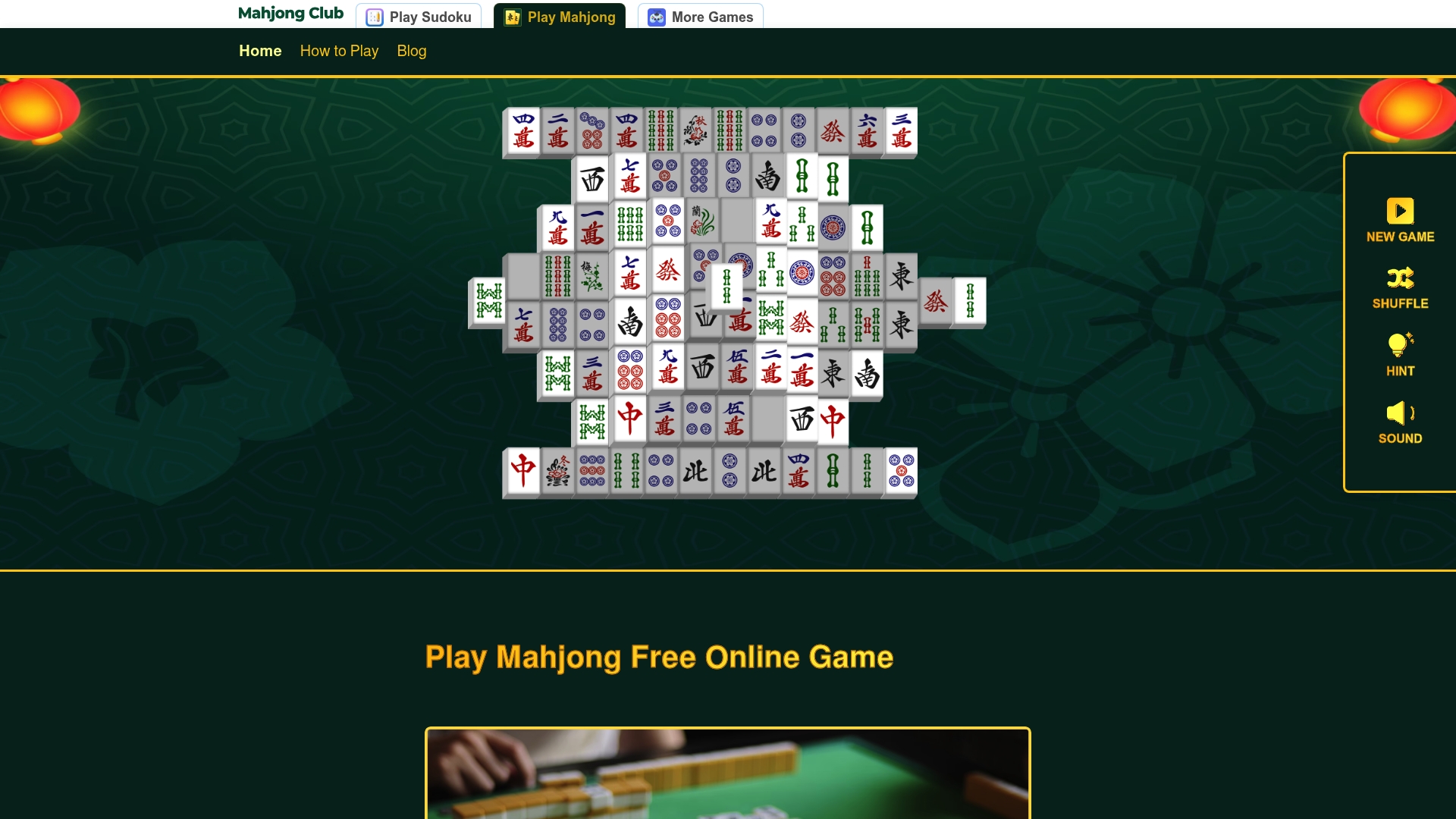
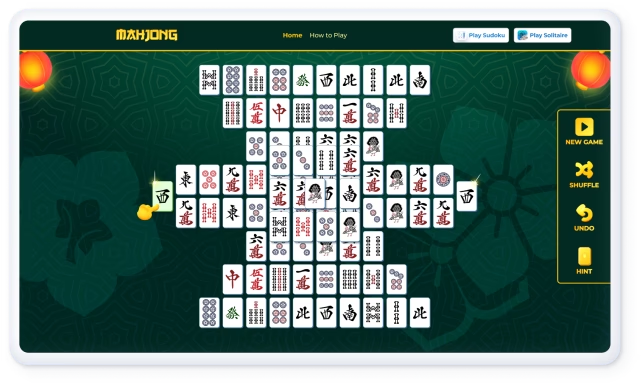
Mahjong Online Club offers a free, browser-based mahjong tile-matching game with no registration required. The interface is clean and distraction-free, which makes it a practical environment for applying what you have just learned about suits, honors, and bonus tiles. You can play mahjong free directly in your browser and start recognizing tile patterns under real game conditions. The platform also includes guides on how to play mahjong solitaire, covering tile rules and strategy in one place. Short sessions work well for drilling tile recognition without fatigue.
FAQ
What are the three main suits in mahjong?
The three main suits are Dots, Bamboo, and Characters, each numbered 1 through 9 with four copies of every tile in a standard set.
Why does the 1-Bamboo tile show a bird?
The 1-Bamboo tile traditionally depicts a bird perched on a bamboo stalk. It is part of the Bamboo suit and plays exactly like any other numbered Bamboo tile.
What does a blank tile mean in mahjong?
A blank or framed tile is the White Dragon, one of the three Dragon honor tiles. It is fully playable and scores the same as the Red and Green Dragons.
How many tiles are in an American Mahjong set?
American Mahjong sets typically contain 152 tiles, including 8 jokers not found in the standard 144-tile Chinese Mahjong set.
Do I need to read Chinese to play mahjong?
No. Tile recognition relies on visual patterns: counting circles on Dots, counting stalks on Bamboo, and reading Arabic numerals on Characters. Chinese literacy is not required.
Recommended
Similar Articles
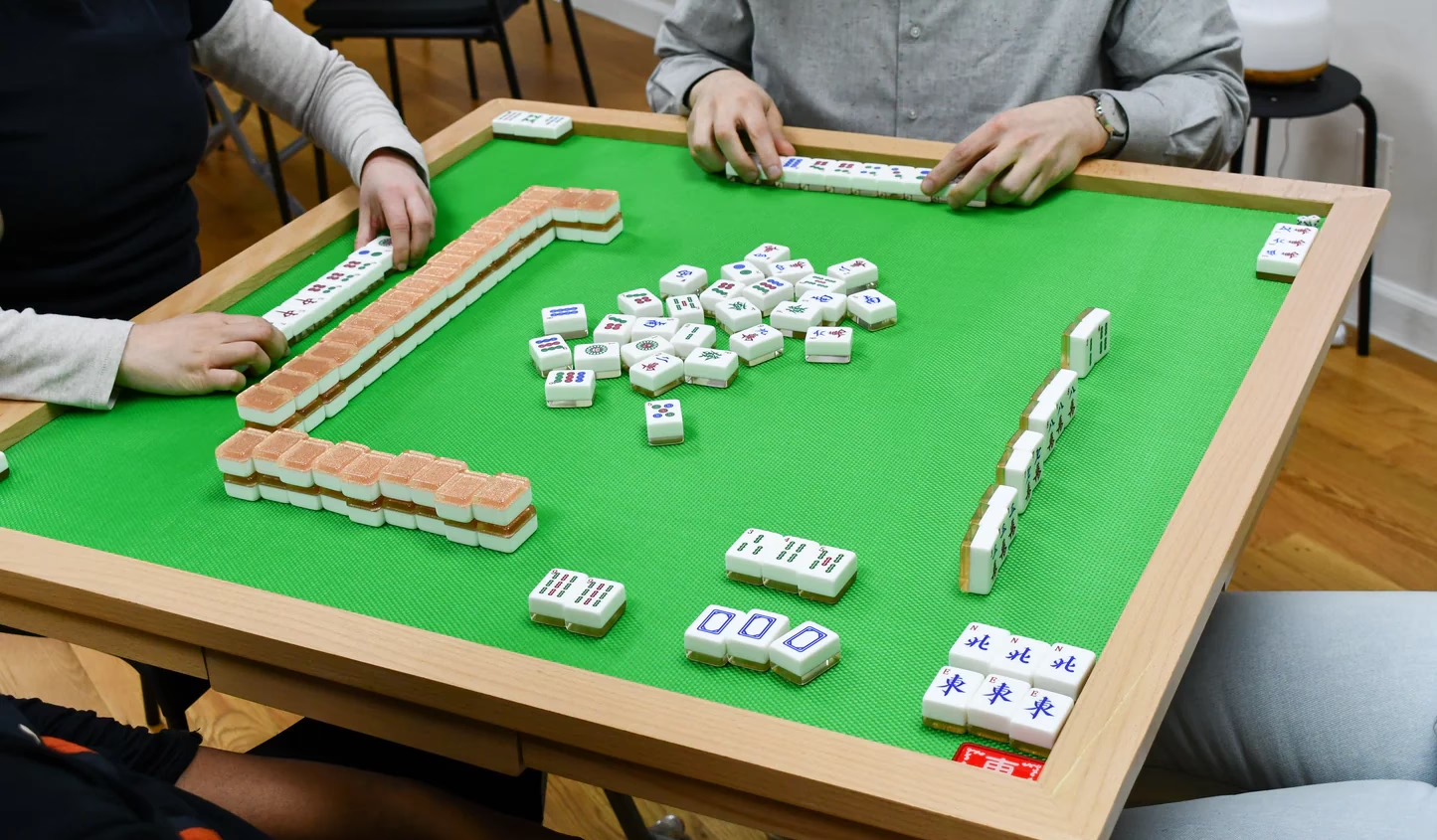
How to Set Up Mahjong: Dealer, Wall, and Tile Layout Guide
How to set up mahjong, step-by-step from a veteran teacher: expert wall, dealer, and tile layout guidance with data-backed tips for smooth play.
Best mahjong apps 2026: multiplayer, training, scoring
Best mahjong apps 2026: expert guide to multiplayer, training, and scoring tools. Data-backed picks and safety tips you can trust for every ruleset.

Tile Matching Games: 9 Proven Cognitive Benefits
Discover the benefits of tile matching games. Improve memory, enhance attention, and reduce stress through engaging puzzle play today!