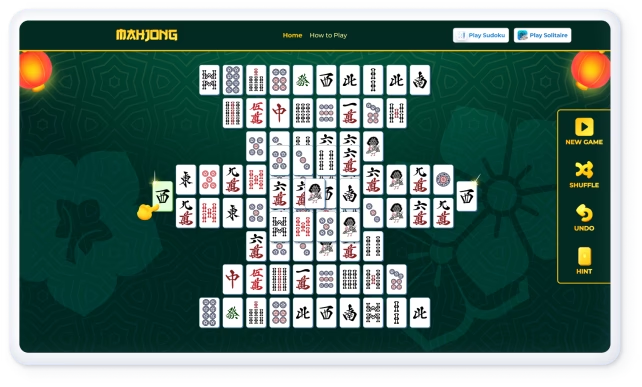
Mahjong Game Objectives Explained Simply for Beginners

Mahjong Game Objectives Explained Simply for Beginners
The core objective of Mahjong is to build a winning hand of 14 tiles structured as four sets and one pair. That single goal sits at the center of every variant you will encounter, from traditional Chinese Mahjong to American Mah Jongg. Understanding this structure before anything else gives you a foundation to build on. Mahjong Online Club treats this core principle as the starting point for every new player, and for good reason: once you know what a winning hand looks like, every rule and strategy clicks into place.
What are the basic building blocks of a Mahjong hand?
A legal Mahjong hand contains exactly 14 tiles, organized as four sets plus one pair. Each set is called a meld. The pair is two identical tiles. Together, they form the complete structure every player works toward.
There are three types of melds you need to know:
- Pung: Three identical tiles. Example: three 5-Bamboo tiles.
- Chow: Three consecutive tiles in the same suit. Example: 4, 5, and 6 of Characters.
- Kong: Four identical tiles. A kong counts as one meld but requires you to draw an extra tile to maintain hand size.
The pair sits outside the four melds. It is two matching tiles, and every winning hand needs exactly one. You cannot win with two pairs and three melds. The structure is fixed: four melds, one pair, 14 tiles total.
Beginners sometimes confuse a pung with a pair. A pung has three tiles; a pair has two. They serve different roles in the hand. Keeping that distinction clear from the start prevents a lot of confusion later.
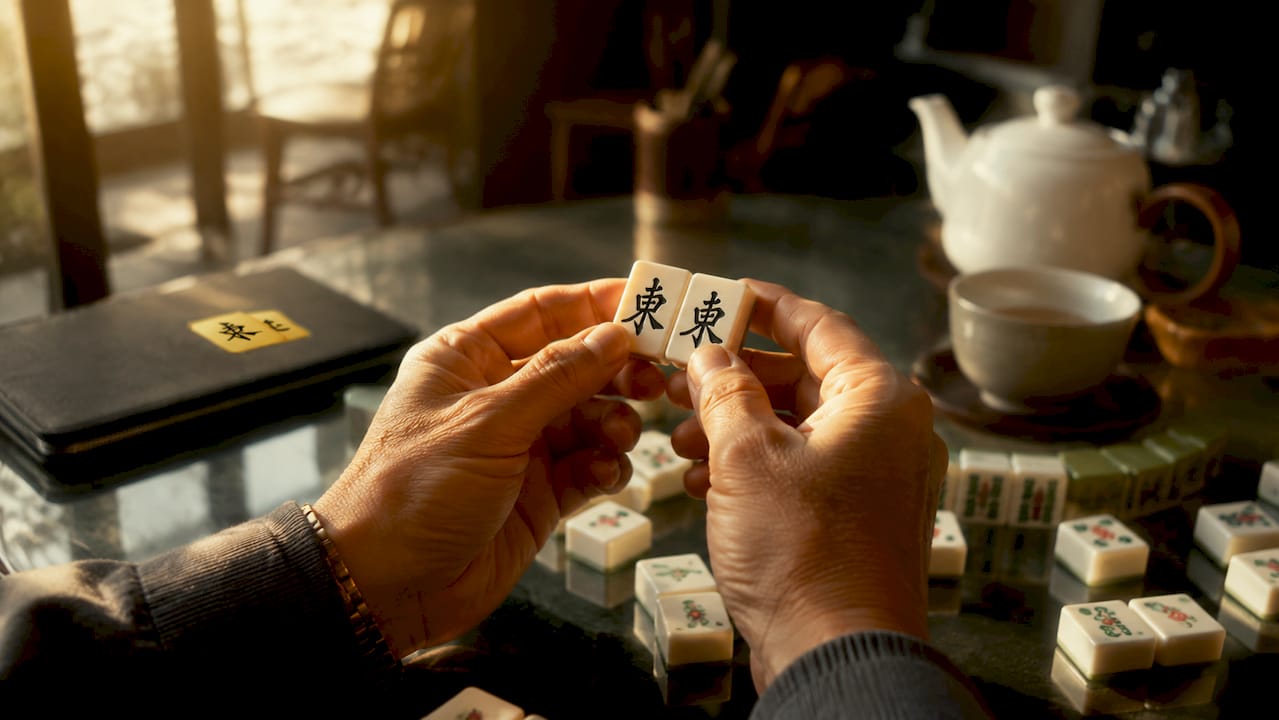
Pro Tip: Count your tiles before every discard. You should always hold 13 tiles before drawing and 14 tiles after drawing. If your count is off, stop and recount before you act.
How do regional variations change Mahjong objectives?
The core hand structure stays the same across variants, but the rules around what makes a hand valid shift significantly between Chinese and American Mahjong. Knowing these differences early saves you from learning the wrong rules for your game.
| Feature | Chinese Mahjong | American Mahjong |
|---|---|---|
| Hand structure | Four melds plus one pair | Must match a pattern on the NMJL card |
| Winning criteria | Legal structure plus minimum scoring threshold | Exact match to a listed pattern |
| Tile passing phase | None | Charleston (three rounds of passing) |
| Scoring system | Fan points based on hand value | Point values from 25 to 75 per NMJL card |
| Flexibility | High: many valid hand combinations | Low: only listed patterns are legal |
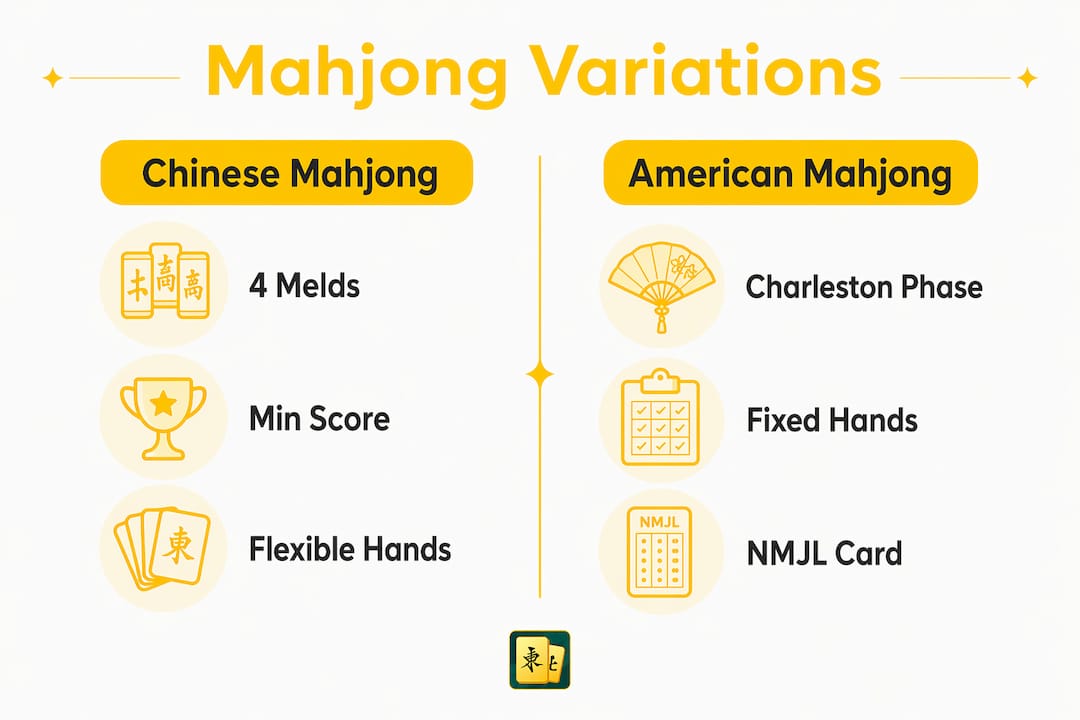
In Chinese Mahjong, you build any legal 14-tile hand that meets the minimum scoring threshold. The freedom is wide, but scoring requirements add a layer of discipline. In American Mahjong, the NMJL card defines every legal winning pattern, and patterns carry point values ranging from 25 to 75. The NMJL card itself costs $15 per year and updates annually.
American Mahjong also includes the Charleston, a tile-passing phase before play begins. Players pass tiles they do not want to neighbors, which shapes starting hands and adds a social, strategic layer not found in Chinese Mahjong. For a deeper look at how these two versions compare, the American vs. Chinese Mahjong guide on Mahjong Online Club breaks down the differences clearly.
Pro Tip: Start with Chinese Mahjong's core structure before tackling the NMJL card. Once four melds plus one pair feels natural, American Mahjong's specific patterns become much easier to read.
What role does scoring play in Mahjong winning hands?
Scoring is not just a way to keep score. In Chinese and Japanese Mahjong, a hand must meet a minimum value threshold to be declared a valid win. The most common threshold is 8 Fan, where Fan refers to scoring units assigned to specific hand features. A hand that looks structurally correct but scores below 8 Fan is invalid. You cannot claim the win.
This trips up beginners constantly. You might complete four melds and a pair, feel confident, and then discover your hand scores only 4 Fan. The win does not count. That is why understanding scoring runs parallel to understanding structure, not after it.
Common scoring pitfalls for beginners include:
- Declaring a win below the minimum Fan threshold. Always estimate your hand's Fan value before you claim the win.
- Ignoring bonus tiles. Flower and season tiles add Fan in many Chinese variants. Leaving them uncounted costs you points.
- Claiming a discard instead of self-drawing. In American Mahjong, self-pick wins from the wall double your score compared to claiming a discard. That difference shapes how aggressively you should chase tiles.
- Confusing hand value with hand legality. A hand can be structurally legal but still invalid if it misses the scoring floor.
American Mahjong handles scoring differently. The NMJL card assigns a fixed point value to each pattern. There is no minimum Fan threshold. If your tiles match a listed pattern, you win and collect the listed points. That simplicity makes American Mahjong more accessible for absolute beginners, even if the Charleston and pattern-matching add their own complexity.
Pro Tip: Focus on building a clean four-meld-plus-one-pair structure first. Once that feels automatic, layer in Fan counting. Trying to learn both at once slows progress significantly.
What are the most common mistakes in pursuing Mahjong objectives?
Most beginner errors come from hand management, not from misunderstanding the rules. The mechanics are straightforward. Executing them under pressure is where players slip.
- Holding too many tiles. New players often forget to discard after drawing. You must always return to 13 tiles after your discard phase. Holding more than 13 tiles before your draw is a rule violation and can void a win.
- Forgetting to discard after claiming. When you claim a discarded tile to complete a meld, you must immediately discard one tile from your hand. Skipping this discard is one of the most common beginner errors in Chinese Mahjong.
- Ignoring opponents' discards. Every tile an opponent throws away is information. Reading opponents' discards tells you which tiles are safe to throw and which tiles your opponents are likely chasing.
- Chasing a high-scoring hand too slowly. Speed and hand value are in constant tension. A fast, low-scoring win beats a slow, high-scoring hand that never completes. Beginners often hold tiles too long waiting for a perfect combination.
- Skipping table reading. Tracking discards is the most manageable strategic skill for new players. It requires no memorization of complex patterns, just consistent attention to what has already been played.
Defensive play is a skill that pays off immediately. When you notice an opponent discarding tiles from one suit, that suit is likely safe to throw. When discards suddenly stop, someone is close to winning. These signals are readable from your first game if you train yourself to watch.
Pro Tip: Count your tiles out loud before every discard until the habit is automatic. Tile efficiency starts with knowing exactly what you hold.
Key takeaways
The primary Mahjong objective is to complete a legal 14-tile hand of four melds and one pair, with scoring thresholds and regional rules determining whether that hand is a valid win.
| Point | Details |
|---|---|
| Core hand structure | Every winning hand requires four melds (pung, chow, or kong) plus one pair totaling 14 tiles. |
| Regional rule differences | Chinese Mahjong allows flexible hand building; American Mahjong requires matching a specific NMJL card pattern. |
| Scoring thresholds matter | In Chinese Mahjong, a structurally correct hand is invalid if it scores below the minimum Fan threshold. |
| Discard discipline | Always discard immediately after claiming a tile and maintain exactly 13 tiles before each draw. |
| Table reading wins games | Tracking opponents' discards is the fastest way for beginners to play safer and plan better hands. |
Why I think beginners overcomplicate Mahjong from the start
Most new players I talk to make the same mistake: they try to learn scoring, regional rules, and strategy all at once. That approach stalls progress fast. Mahjong has a clean, learnable core. Four melds, one pair, 14 tiles. That is the whole objective. Everything else, Fan thresholds, the Charleston, self-pick multipliers, builds on top of that foundation.
My honest advice is to play your first dozen games focused entirely on completing the structure. Do not worry about whether your hand scores 8 Fan. Do not stress about the NMJL card. Just practice assembling four melds and a pair before the wall runs out. That repetition builds the pattern recognition that makes every advanced concept easier to absorb later.
The part that surprises most beginners is how much satisfaction comes from the process itself, not just from winning. Reading the table, spotting a safe discard, watching your hand take shape tile by tile. That strategic depth is what keeps players coming back. Winning is the goal, but the thinking in between is the game. Give yourself permission to learn it gradually, and you will find the objectives stop feeling like rules and start feeling like tools.
— Dmytro Romaniuk
Ready to put these objectives into practice?
Reading about Mahjong objectives is a solid start. Playing them out in real time is where the learning accelerates. Mahjong Online Club lets you play Mahjong free online directly in your browser, with no registration required and no ads interrupting your focus.
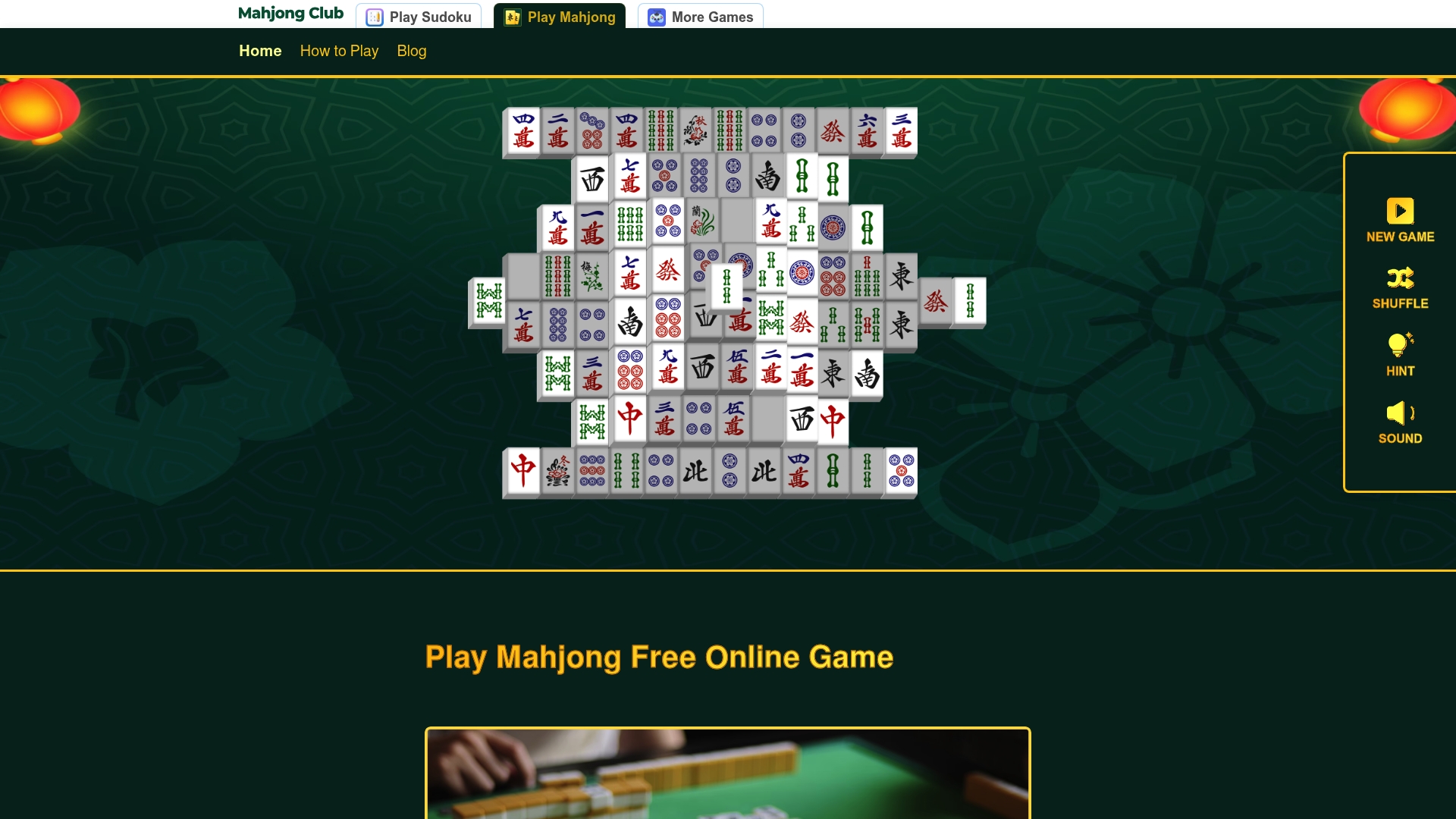
The platform is built for exactly this stage of learning: a calm, distraction-free environment where you can practice tile matching, test your hand-building instincts, and build the pattern recognition that makes Mahjong click. If you want step-by-step guidance alongside your play sessions, the how to play guide on Mahjong Online Club walks you through rules, tiles, and strategy at your own pace. Start a game, apply what you learned here, and watch the objectives become second nature.
FAQ
What is the main objective of Mahjong?
The main objective is to complete a legal hand of 14 tiles made up of four melds and one pair. The first player to build this structure and meet any required scoring threshold wins the round.
What is a meld in Mahjong?
A meld is a set of tiles that forms part of a winning hand. The three types are a pung (three identical tiles), a chow (three consecutive tiles in one suit), and a kong (four identical tiles).
How does scoring affect whether you win in Mahjong?
In Chinese and Japanese Mahjong, a hand must reach a minimum value, often 8 Fan, to count as a valid win. A structurally correct hand that scores below this threshold cannot be declared a winning hand.
What is the Charleston in American Mahjong?
The Charleston is a tile-passing phase at the start of American Mahjong where players pass unwanted tiles to neighbors across three rounds. It shapes starting hands and is unique to the American variant.
How do I avoid the most common beginner mistakes?
Count your tiles before every discard to stay at 13, discard immediately after claiming a tile, and watch what your opponents throw away to identify safe plays and spot who is close to winning.
Recommended
Similar Articles
Best mahjong apps 2026: multiplayer, training, scoring
Best mahjong apps 2026: expert guide to multiplayer, training, and scoring tools. Data-backed picks and safety tips you can trust for every ruleset.
American Mahjong vs Chinese Mahjong: Rules, Scoring & Sets
American Mahjong vs Chinese Mahjong: Expert guide to rules, scoring, and set differences. Data-backed insights and practical tips to choose your style.

What Is Mahjong Explained: Rules, Tiles & Variants
Discover what is Mahjong explained: learn the rules, tile types, and variants of this strategic game that rivals chess in complexity.