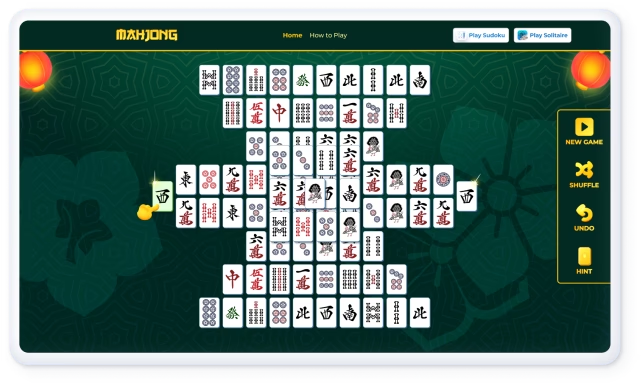
How Free Games Fit Corporate Environments in 2026

How Free Games Fit Corporate Environments in 2026
Short, free browser games belong in corporate environments, and the evidence is clear enough to act on. Single-player Mahjong Solitaire, played in 1–5 minute desk breaks, can restore attention, reduce stress, and sharpen pattern recognition without disrupting workflow or creating IT headaches. The recommended starting point is Mahjong Online Club: free, ad-free, browser-based, and no signup required, which means zero procurement friction and minimal privacy risk.
Research published on ScienceDirect confirms that browser-based games can support problem-solving and creative thinking by providing a brief mental reset that interrupts stress and fatigue. A Kansas State study reported in BBC Worklife found that 1–2 minute game microbreaks correlated with higher reported happiness compared to peers who skipped them. That is a low-cost intervention most HR teams can pilot in a week.
Table of Contents
- How do free games fit corporate environments, and why does it matter?
- What are the best formats for Mahjong Solitaire sessions at work?
- What should IT and managers check before allowing browser games?
- How do you measure impact and build manager buy-in?
- How do you choose a workplace-safe game?
- What policy language and rollout steps do you need?
- Key Takeaways
- Why the "games at work" conversation is finally worth having
- Mahjong Online Club fits the workplace criteria you just read about
- Useful sources and further reading
How do free games fit corporate environments, and why does it matter?
The case for short browser games at work rests on three converging lines of evidence: cognitive science, workplace wellbeing research, and a practical shift in managerial attitudes.

Harvard Business Review reports that managers increasingly regard structured game breaks as a valid form of cognitive recovery, comparable in effect to mindfulness. That framing matters because it moves gaming from a taboo into a recognized wellness tool, one HR can defend with research rather than apologize for.
The cognitive mechanisms are specific. A short Mahjong Solitaire session engages pattern recognition and working memory at low intensity, which resets directed attention without adding cognitive load. The science behind Mahjong's calming effect points to the same attention-restoration principle: mild, absorbing tasks allow the prefrontal cortex to recover from sustained focus. Creative incubation follows the same logic: stepping away from a problem briefly often surfaces solutions that grinding through it does not.
Four practical benefits employees and managers can expect:
- Relaxation and stress reduction: short sessions lower cortisol-linked tension without requiring a full break room or wellness program.
- Cognitive reset: attention and working memory recover faster after a low-demand game than after passive scrolling.
- Social glue: solo games like daily puzzles generate watercooler conversations that improve organizational culture, even when play is individual.
- Accessible, low-cost intervention: no budget, no installation, no specialist training required.
Forbes notes that office games are reappearing as stress-management tools, with rising interest across industries. The shift is cultural as much as scientific.
What are the best formats for Mahjong Solitaire sessions at work?
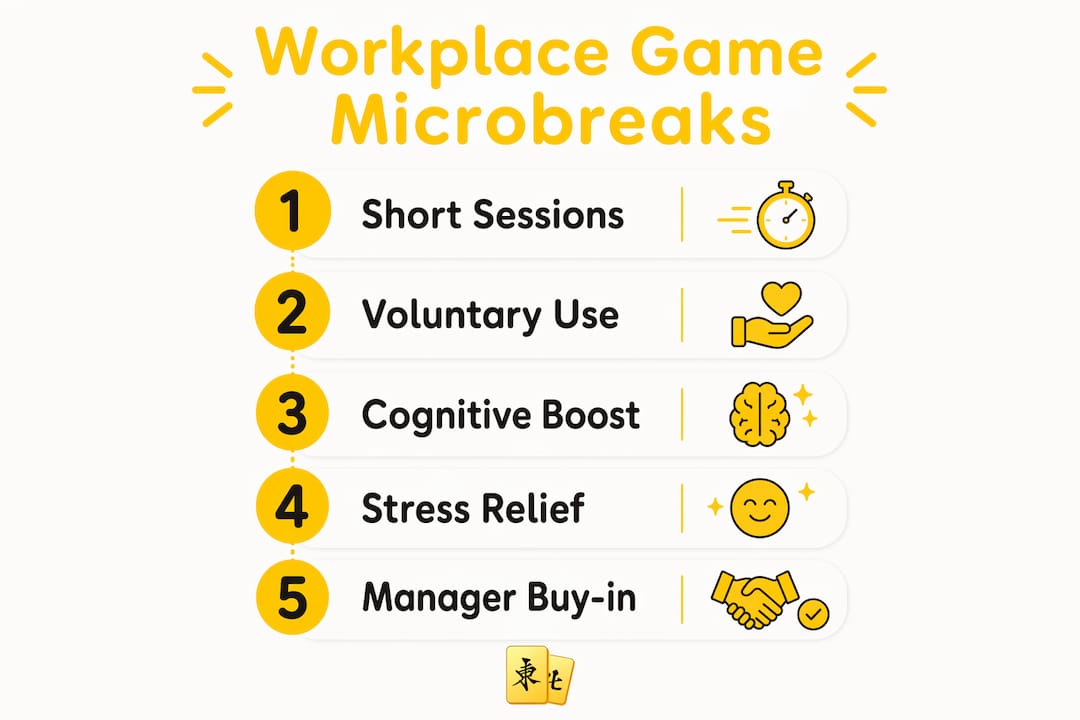
The highest-yield format is the desk microbreak: 1–2 minutes, voluntary, and timed to a natural pause between tasks. Practitioner guidance from BBC Worklife confirms that truly micro breaks work best; longer sessions can feel draining if the game is cognitively demanding, which is why a familiar, low-intensity tile-matching game outperforms a puzzle with escalating difficulty.
Three formats map well to different workday rhythms:
Desk microbreak (1–2 minutes): Best after completing a focused task or before switching contexts. Open the browser, play one short round, close it. The stress-free Mahjong session approach applies here: no pressure to finish, no score anxiety.
Lunch reset (5–10 minutes): A slightly longer session during the lunch hour works well for employees doing routine or repetitive morning work. Mahjong for lunch breaks is a natural fit because the session length matches a coffee break and requires no setup.
Voluntary wellness period: Some teams designate a 10-minute optional digital downtime slot once or twice a week. Participation stays voluntary; the goal is normalizing recovery, not mandating it.
A sample schedule for a knowledge worker: 10:00 AM, 1–2 minute desk microbreak after the morning deep-work block; 12:30 PM, 5-minute lunch reset; 3:30 PM, optional 2-minute break before the afternoon meeting run. Total: under 10 minutes of game time, spread across natural transition points.
One important caveat from The Conversation's research: when employees are overstretched, even light games can feel like one more demand. Match the format to the workload. On high-pressure days, skip the microbreak or shorten it to 60 seconds.
What should IT and managers check before allowing browser games?
Browser-based, no-download games carry lower IT risk than installed software, but they still warrant a quick review. The core concern is not the game itself but what travels with it: ad networks, third-party trackers, and external scripts that load alongside the game content.
A practical IT checklist:
- Content filtering: confirm the game URL passes your existing web filter categories (entertainment/games is typically low-risk).
- Script and tracker review: use a tool like uBlock Origin or browser developer tools to check which third-party domains load. Ad-free games with minimal telemetry pass this check quickly.
- Network bandwidth: single-player browser games consume negligible bandwidth; a one-time check during a pilot confirms this.
- Acceptable use policy alignment: verify the game falls within existing break-time personal use allowances.
- Data collection audit: confirm the game requires no account creation and collects no personally identifiable information.
Privacy is the stickier issue. Ad-supported games often load cross-site cookies and fingerprinting scripts that conflict with corporate data policies. The cleanest solution is to whitelist only ad-free, no-account options. Ad-free games eliminate the tracker problem at the source.
Browser-based games are preferred in corporate environments precisely because they bypass heavy IT procurement; PWA and web technologies enable cross-OS support with minimal friction. That advantage disappears if the game loads a dozen ad-network scripts, so the ad-free criterion is not optional.
Pro Tip: Whitelist the game's root domain rather than a specific URL path. This covers any future page changes without requiring a new IT ticket, and it takes about two minutes to configure in most enterprise web filters.
How do you measure impact and build manager buy-in?
Run a small, time-limited pilot before asking for broad organizational support. A 2–4 week window with 15–30 volunteers gives you enough signal without overcommitting resources.
Pilot design: recruit volunteers from one or two teams, keep participation optional, and ask a control group (same teams, non-participants) to complete the same brief weekly check-in. Track four lightweight metrics:
- Participation rate: what percentage of invited employees played at least once per week?
- Self-reported energy: a 1–5 scale question at end of day, Tuesday and Thursday.
- Focused session count: ask participants to log how many uninterrupted 25-minute work blocks they completed (a simple tally, not software monitoring).
- Qualitative feedback: three open questions at week four: What did you notice? Would you continue? Any concerns?
A mini case example HR can adapt: a 20-person customer service team runs a four-week voluntary microbreak pilot using a browser Mahjong game during afternoon breaks. At week four, 14 of 20 participants report feeling less fatigued by 3:00 PM, and the team's self-reported focus scores rise modestly. That data, presented in a one-page summary, gives a manager a defensible reason to expand the pilot.
Integrated browser games can also facilitate cross-department interactions and informal leadership emergence without significant resource investment, provided the policy is transparent and the design is accessible.
How do you choose a workplace-safe game?
Prefer single-player, short-session, ad-free browser games that require no download and no registration. Those four criteria eliminate most IT and privacy concerns before the first check-in.
| Primary benefit | Typical session | IT/security risk | Accessibility | Cognitive/older-adult fit |
|---|---|---|---|---|
| Relaxation, pattern recognition | 2–5 min | Low (ad-free, no login) | Browser, no signup, mobile | High |
| Word puzzle, vocabulary | 3–5 min | Low to medium (some ads) | Browser, optional account | Medium |
| Casual arcade reflex | 1–3 min | Medium (ad networks common) | Browser or app | Low to medium |
| Strategy/resource management | 10–30 min | Medium to high (accounts, IAP) | App or download | Low for short breaks |
Mahjong Solitaire sits in the first row. Its tile-matching structure is familiar, low-pressure, and well-suited to older adults and cognitive benefit, which matters for age-diverse workplaces.
Four selection criteria to apply immediately:
- No executable download required.
- No account creation or email address.
- Ad-free or verifiably low-ad with no cross-site trackers.
- Sessions completable in under 5 minutes without penalty for stopping early.
Mahjong Online Club meets all four. Its ad-free, no-signup design is the reason it appears as the recommended option throughout this article, not brand preference.
What policy language and rollout steps do you need?
Keep policy short, permissive, and focused on time-bounded, voluntary use during designated breaks. Employees respond better to trust-based language than to surveillance-adjacent restrictions.
Sample policy snippet (HR can adapt): "Employees may use approved browser-based games during scheduled breaks and lunch periods for personal relaxation. Sessions should be limited to break time and should not interfere with work responsibilities. Approved games are listed on the intranet; all approved options are browser-based, require no download, and collect no personal data. Use is voluntary. Please confirm that any game you use is licensed for personal, non-commercial use."
That last sentence covers the licensing checkpoint: most free browser games permit personal use but not commercial redistribution. A quick review of the game's terms of service takes five minutes and protects the organization.
6-step rollout checklist:
- IT reviews and whitelists the approved game domain.
- HR drafts a one-paragraph policy and posts it to the intranet.
- Managers receive a two-sentence briefing: what the pilot is, why it is voluntary, and how long it runs.
- Employees receive a short email with the approved URL, the session-length guidance, and the feedback form link.
- HR runs the 2–4 week pilot with lightweight metrics (see the measurement section above).
- Review date is set at week four; decision to expand, adjust, or close is made from pilot data.
Diversity and inclusion note: game selection should account for the full range of employees. Single-player, culturally neutral tile games tend to be more universally accessible than games with competitive leaderboards or culturally specific references.
Key Takeaways
Short, ad-free browser games can fit corporate environments as structured microbreaks that restore attention, reduce stress, and require minimal IT overhead.
| Point | Details |
|---|---|
| Microbreaks work best at 1–2 minutes | Match session length to workload; skip or shorten on high-pressure days. |
| Ad-free, no-signup games reduce IT risk | Eliminate cross-site trackers and data collection concerns before the first IT check. |
| Run a 2–4 week pilot first | Use four lightweight metrics: participation, self-reported energy, focus count, and qualitative feedback. |
| Policy should be short and trust-based | One paragraph, voluntary use, approved URL list, and a licensing check covers most organizations. |
| Mahjong Online Club is the recommended pick | Free, ad-free, browser-based, no signup, and designed for short restorative sessions. |
Why the "games at work" conversation is finally worth having
The conventional wisdom has been that games at work signal wasted time. That framing was always too simple, and the research has caught up. The more useful question is not whether employees should play but which games, for how long, and under what conditions.
Single-player tile games like Mahjong Solitaire occupy a specific and underappreciated niche: they are absorbing enough to interrupt rumination but not so demanding that they add cognitive load. That combination is rare. Most "wellness" interventions require either significant time (meditation apps, guided breathing) or social coordination (team activities). A two-minute browser game requires neither.
What I find most compelling about the microbreak research is the workload caveat. The benefit is real, but it is conditional. Employees who are genuinely overstretched do not recover from a game break; they resent it. That means the rollout conversation is not just about IT whitelisting. It is about workload management. If your team is consistently too busy to take a two-minute break, the game is not the problem to solve.
Mahjong Online Club's ad-free, no-signup design removes the usual objections before they arise. The pilot approach described here gives HR the evidence to make the case internally. Start small, measure simply, and let the data do the persuading.
Mahjong Online Club fits the workplace criteria you just read about
The four criteria from the choosing-game section above: no download, no account, ad-free, and sessions under five minutes. Mahjong Online Club meets all of them by design.
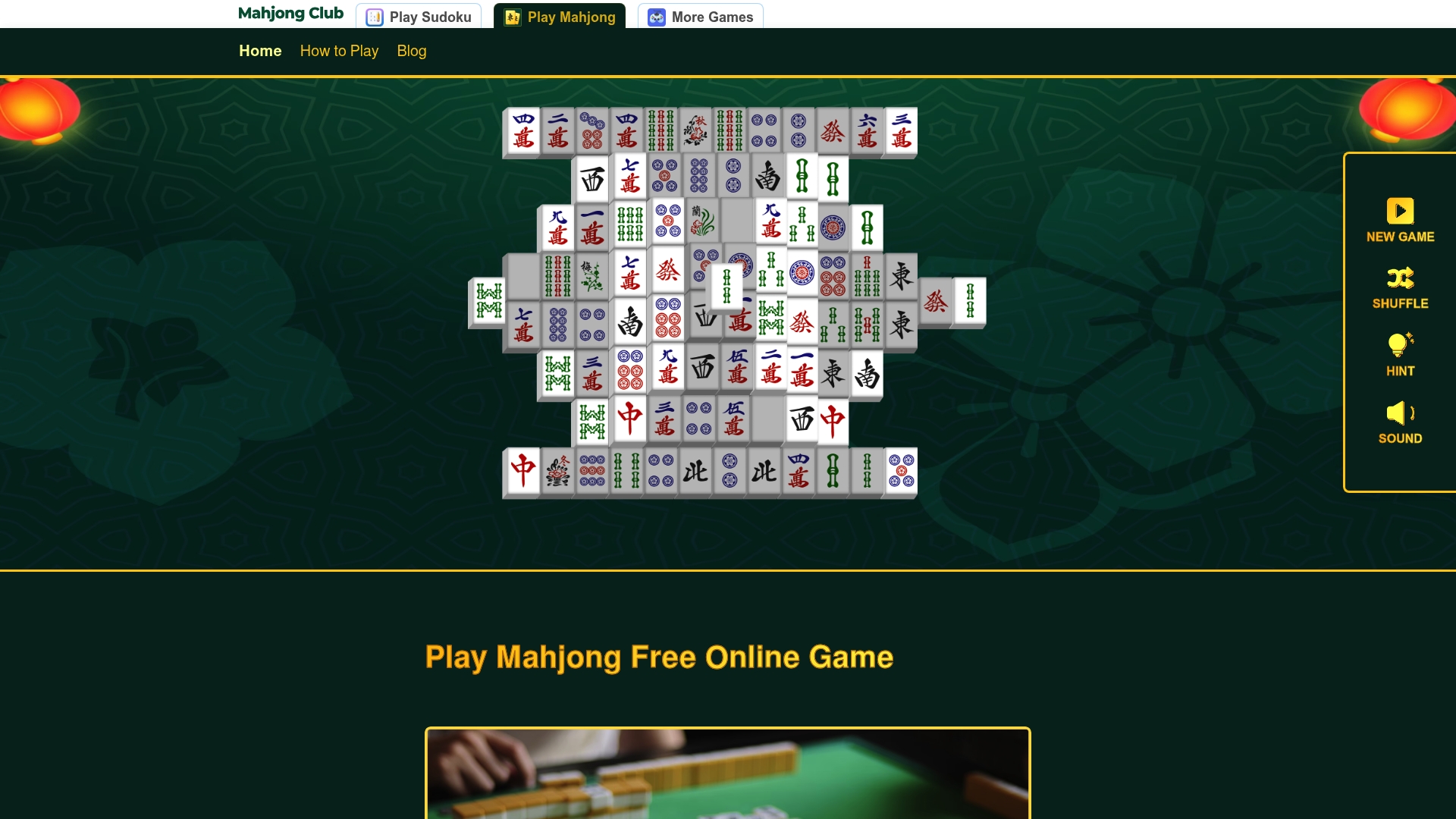
The platform is free, runs entirely in your browser, and requires no registration. Its interface is built for short, restorative sessions, with a clean layout that loads quickly on any device, including older hardware common in mixed-age workforces. The cognitive benefits of Mahjong are built into the tile-matching structure itself: pattern recognition, working memory, and sustained attention, all at low intensity.
For HR and IT: whitelist the domain, share the URL in your pilot email, and run the four-week check-in. For players: start a free game now and see whether a two-minute session at your next natural break point changes how the rest of your afternoon feels.
Useful sources and further reading
- Why Gaming Is Good for the Workplace — Harvard Business Review: The clearest managerial-level argument for structured game breaks as cognitive recovery; cite this in internal memos.
- Browser-based games and problem-solving — ScienceDirect: Peer-reviewed support for creative and cognitive benefits; useful for HR evidence packs.
- Can playing games like Wordle help improve work? — The Conversation: Covers both the social benefits and the workload caveat; balanced and readable.
- Can gaming at work make you more productive? — BBC Worklife: Reports the Kansas State microbreak study; good for illustrating the happiness-correlation finding.
- Games Making a Comeback — Forbes: Cultural and stress-management framing; useful for change-management conversations.
- Browser games and IT friction — Accel / Artisan: Explains the PWA/cross-OS advantage and the policy transparency requirement.
- Mahjong Online Club — ad-free, no-signup browser Mahjong: The recommended platform for workplace pilots; ad-free design addresses the main IT privacy concern directly.
Recommended
Similar Articles
Mahjong Flowers: Rules, Scoring, Timing, and Strategy
Expert guide to mahjong flowers: rules, scoring, and smart timing across Hong Kong, American, and Riichi styles. Data-backed, clear, and practical.
How to Clean Mahjong Tiles: Step-by-Step Care Guide
Expert guide on how to clean mahjong tiles by material—Bakelite, bone/bamboo, and plastic—with safe steps, pro tips, and data-backed care advice.

What Does Free Tile Mean in Mahjong Solitaire?
Learn what does free tile mean in Mahjong Solitaire. Discover how understanding this concept can improve your game strategy and enhance your play.