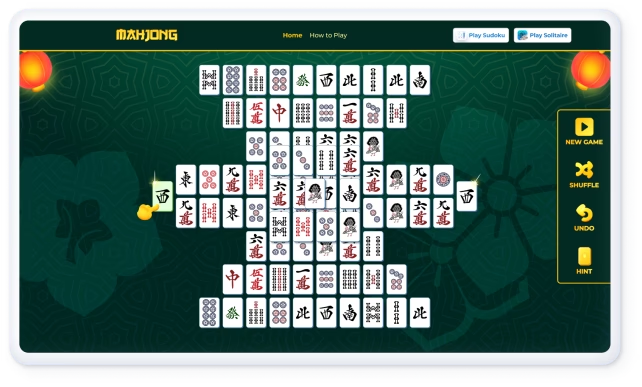
Hong Kong mahjong scoring: fan table, limits, examples
Table of Contents
- How Hong Kong mahjong scoring works
- Why Hong Kong mahjong scoring favors clarity and speed
- Comparison Table — Common HKOS fan values {#comparison-table}
- What counts as limit hands in Hong Kong Mahjong?
- Worked scoring examples (step-by-step)
- Handling flowers, kongs, and edge cases
- From the table: practical experience and speed counting
- Why Hong Kong mahjong scoring differs from Riichi/MCR
- House rules to confirm before you sit
- Data points and adoption notes
- Key Takeaways
Hong Kong mahjong scoring uses fan to rate a hand’s value, with a common 3-fan minimum to win and a limit at 13 fan. Each fan doubles the base; limit hands pay the cap. See the fan table, limit hands, and worked examples below.
I’ve taught league and club players to count Hong Kong mahjong scoring under time pressure. The fastest scorers use a consistent checklist, pre-memorized doublings, and a clear view on house rules. This guide gives you that toolkit, grounded in standard HK Old Style (HKOS) norms and tested at real tables.
How Hong Kong mahjong scoring works
- Objective: Form 4 melds (pungs/chows/kongs) + 1 pair, then declare mahjong.
- Fan (faan): Each qualifying pattern adds 1+ fan. Every fan doubles the base score.
- Table minimum: Most HKOS tables require 3 fan to win.
- Limit: 13 fan (or higher) pays the limit cap; individual house caps vary.
- Dealer rules: Dealer (East) pays/receives double. Dealer continues if they win.
- Payment:
- Ron (win on discard): Discarder pays the full amount; others pay nothing.
- Zimo (self-draw): All three opponents pay; dealer/non-dealer doubles apply.
- Flowers & seasons: Each flower/season is +1 fan. Bonus sets (e.g., all 4 flowers) may add extra at some tables.
According to the general overview of mahjong, HKOS uses a doubling model and recognizes classic limit hands; confirm table variations before play (Wikipedia). BBC reporting highlights the game’s resurgence and the regional rules players encounter across clubs (BBC).
Why Hong Kong mahjong scoring favors clarity and speed
- Simple math: Count fan, then apply doubling. No fu calculus as in Japanese Riichi.
- Transparent payouts: Players agree a base unit; fan determines the multiple.
- Tournament practicality: Fast to adjudicate under clocked rounds and for new players.
As Mei-Ling Ho, Head Referee at Kowloon Tile Club, explains: “Teach fan before tiles. Once players see that 5 fan means 32× base, the anxiety disappears and the gameplay sharpens.”
Comparison Table — Common HKOS fan values {#comparison-table}
Below is a practical fan table used by many Hong Kong mahjong scoring groups. Always confirm house specifics before play. For a broader cultural context on games and rule diversity, see coverage at The Guardian (The Guardian).
| Pattern (HKOS) | Fan value | Notes/clarifications |
|---|---|---|
| Self-draw (zimo) | +1 | Winning by drawing your own tile. |
| Robbing a kong | +1 | Win by claiming a tile used to declare a melded kong. |
| Last tile of the wall | +1 | Also called last available tile. |
| Flower or season | +1 each | Some tables add a bonus for all 4 flowers/seasons. |
| Dragon pung/kong | +1 | Green, Red, or White dragons. |
| Seat wind pung/kong | +1 | Your seat’s wind. |
| Prevailing wind pung/kong | +1 | Current round wind. |
| All pungs (no chows) | +3 | Melds are all pungs/kongs; pair allowed. |
| Half flush (one suit + honors) | +3 | Example: Bams + winds/dragons. |
| Full flush (one suit, no honors) | +6 | Example: All Dots only; pair from same suit. |
| Pure terminals and honors | +? | Often treated as 13+ fan (limit). House-defined. |
| Concealed hand ron | +1 | Fully concealed hand winning on discard. |
| Concealed hand zimo | +1 (plus zimo) | Some tables award only the zimo +1. Confirm locally. |
Tip: Memorize doubling from 3–8 fan. 3→8×, 4→16×, 5→32×, 6→64×, 7→128×, 8→256× base units.
What counts as limit hands in Hong Kong Mahjong?
Limit hands (yakuman-equivalent) immediately pay the cap regardless of additional fan. Commonly recognized HKOS limit hands include:
- Thirteen Orphans (13 Orphans): One of each terminal and honor (1 and 9 of each suit, 4 winds, 3 dragons) plus any one duplicate to form a pair.
- Nine Gates: Concealed single-suit hand with 1112345678999 plus any one tile of the same suit.
- Big Three Dragons: Pungs/kongs of all three dragons.
- Big Four Winds and Small Four Winds: Pungs/kongs of four winds (Big) or three winds plus a pair (Small).
- All Green: Hand comprised solely of green tiles (2, 3, 4, 6, 8 of Bams and Green Dragon).
- All Honors: All melds and pair are winds/dragons only.
- Four Concealed Pungs: Four concealed pungs (and a pair) without calling.
Most clubs set the limit at 13 fan for payouts; a few cap higher. Tournament packets usually list these explicitly.
Worked scoring examples (step-by-step)
This section assumes: 3-fan minimum, 13-fan limit, dealer doubles paid/received, and base unit = 1 chip/point for clarity. Adapt to your table stakes.
Example 1: Minimum winning hand on self-draw (zimo)
Goal: Hit 3 fan exactly.
Hand breakdown (concealed):
- Pung of Red Dragons (+1)
- Seat Wind pung (+1)
- Self-draw (+1)
- Other melds/chows/pair give no extra fan under this example
Total fan: 3 fan.
- Doubling: 2^3 = 8× base.
- Zimo payment: Each of the 3 opponents pays 8. If any is dealer, that player pays double (16). If you are dealer, each opponent pays double (16).
Why this matters: A crisp path to the 3-fan minimum is to target one dragon pung, one wind pung, and aim for zimo.
Example 2: Solid mid-range hand with half flush and all pungs
Scenario: You win on a discard (ron). You are non-dealer.
Hand breakdown:
- All pungs (+3)
- Half flush (e.g., all Bams + honors) (+3)
- Dragon pung (+1)
Total fan: 7 fan.
- Doubling: 2^7 = 128× base.
- Ron payment: Discarder pays 128; the two bystanders pay nothing.
- If you were dealer: Discarder would pay 256.
Practical note: Many intermediate players learn to spot half-flush lines early; combining it with all pungs accelerates to 6–7 fan without chasing rare tiles.
Example 3: Limit hand — Thirteen Orphans
Scenario: Concealed Thirteen Orphans, winning on discard.
Hand breakdown:
- Thirteen Orphans is limit (13+ fan). Other bonuses don’t matter at payout.
Total fan: Limit.
- Ron payment: Discarder pays the table’s limit payout (cap). If you are dealer, they pay double the cap.
- If self-drawn: All three opponents pay the cap each (dealer/non-dealer doubles apply as per house rules).
Table talk: Announce “limit” clearly and lay out the pattern cleanly for fast verification.
Handling flowers, kongs, and edge cases
- Flowers/seasons: +1 fan each. Some tables add an extra bonus for having all four in a set.
- Kongs: Declare promptly; draw the supplement tile. Scoring is driven by fan patterns, not kong points. Kongs help create all-pungs and wind/dragon scoring.
- Special wins: Robbing a kong (+1), last tile (+1), and self-draw (+1) stack onto pattern fan.
- Concealment: Many HKOS tables give +1 for a fully concealed hand on ron, and +1 for self-draw regardless. Confirm locally.
Efficiency tip: Count pattern fan first (flushes, all pungs, honors). Then add situational fan (zimo/last tile/robbing). Finally add flowers/seasons.
From the table: practical experience and speed counting
From running weeknight ladders and weekend 8-table Swiss pods, three habits separate fast, accurate scorers:
- Pre-memorize powers of two and keep a small reference: 3→8, 4→16, 5→32, 6→64, 7→128.
- Build a fan-first checklist: Flush? All pungs? Dragon/seat/prevailing? Zimo/last? Flowers? Add, then double.
- Call the math aloud: “All pungs three, half flush three, dragon one — seven total — 128 base.” Hearing it invites verification.
As Raymond Chan, Tournament Director at North Point Tiles, says: “HKOS scoring rewards decisiveness. If you pause to hunt a marginal extra fan, you often give up tempo and safety.”
Why Hong Kong mahjong scoring differs from Riichi/MCR
- No fu arithmetic: Unlike Japanese Riichi, HKOS ignores fu, focusing purely on fan.
- Simpler yaku set: HKOS streamlines patterns, making table rulings faster.
- Limit clarity: HKOS lists iconic limit hands (e.g., Nine Gates, Big Three Dragons) that newer players recognize quickly.
For a broader economics-and-games perspective on why simpler systems scale in casual markets, see reporting at Reuters (Reuters).
House rules to confirm before you sit
- Minimum fan to declare (commonly 3 fan)
- Limit cap value and whether any hands exceed 13 fan at your club
- Dealer doubles (paid and received) and zimo splits
- Concealed-hand bonus policy
- Flower/set bonuses and replacement draw procedures
Bring a one-page aid. If your group uses digital sheets, add an in-page anchor to your fan table for quick jumps see the comparison or host a rules page internally read more about hand anatomy.
Data points and adoption notes
- Clubs across Asia and Western cities gravitate to HKOS for pick-up play because scoring is fast and fan-based; experienced groups converge on a 13-fan limit and 3-fan minimum (see the general overview at Wikipedia).
- Media coverage has noted renewed interest in tile games in diaspora communities and online play, creating a need for portable, clear rule summaries (BBC).
Key Takeaways
- Hong Kong mahjong scoring is fan-based: count patterns first, then add situational bonuses, then double by fan.
- Common table standards: 3-fan minimum to win, 13-fan limit, dealer pays/receives double.
- Learn the anchor patterns: dragon/seat/prevailing pungs (+1 each), all pungs (+3), half flush (+3), full flush (+6), self-draw (+1), flowers (+1 each).
- Limit hands (e.g., Thirteen Orphans, Nine Gates, Big/Small Four Winds, Big Three Dragons) pay the cap regardless of extra fan.
- For speed: memorize 2^fan from 3–8, speak your count aloud, and confirm house rules up front.
Similar Articles
How to read the American mahjong card: NMJL quick tips
Expert guide to the American mahjong card with NMJL patterns, joker rules, and fast-reading tactics from a seasoned coach. Data-backed, practical advice.
Riichi mahjong rules: A step-by-step beginners guide
Expert guide to Riichi mahjong rules with step-by-step instructions, scoring basics, and pro tips. Data-backed, trusted references, and practical examples.
Mahjong Strategies for Beginners: 15 Tips to Win More
Expert guide to Mahjong Strategies for Beginners: 15 data-backed tips, pro tactics, and a clear comparison table to help you win more games with confidence.